
Traffic Management Signs: A Complete Work Zone Reference
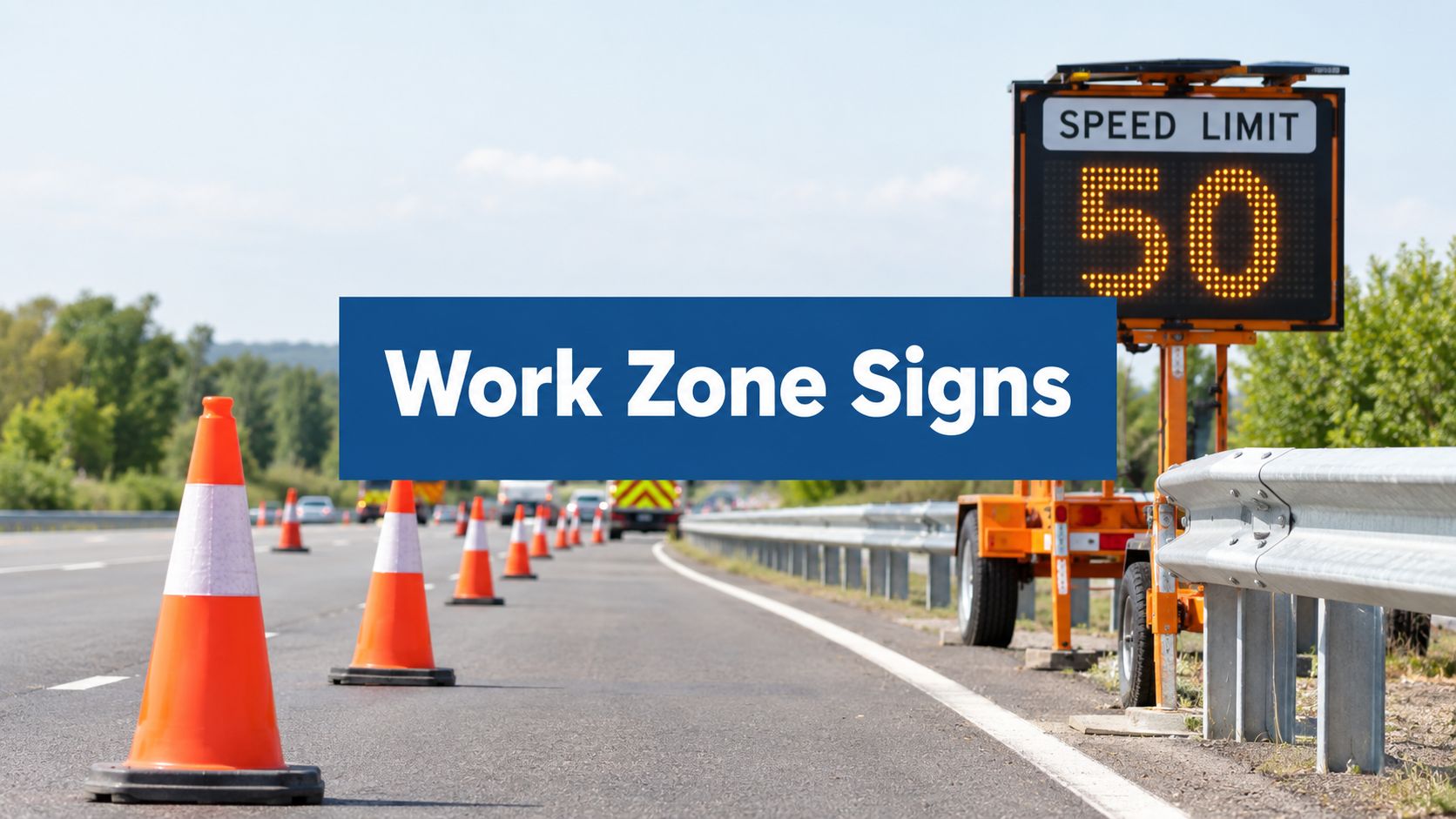
You're standing beside a Sydney roadwork site when a driver approaches the temporary speed limit, brakes late and passes the controller's position with little room to spare. The sign is not decoration. It tells the driver that the operating environment has changed, supports the controller's direction, and forms part of the approved arrangement that keeps traffic and workers separated.
That distinction matters. Traffic management signs are controlled safety devices, not a collection of portable warnings that can be shifted until they “look right”. On a live site, the sign's category, colour, size, position, visibility and relationship with other devices all affect whether the traffic guidance arrangement works. A controller who understands that system can identify a poor setup before a driver does.
Table of Contents
- Why Traffic Management Signs Are Safety-Critical Infrastructure
- The Four Functional Categories of Traffic Management Signs
- Regulatory, Warning, Guidance, and Condition Sign Groups
- Temporary Signs and Traffic Guidance Scheme Signage
- Australian Standards, Austroads, and State Sign Systems
- How Traffic Guidance Schemes Sequence Signs on Site
- Static Signs Compared with Variable Message Signs
- Mobile Worksites, Convoys, and Changing Sign Contexts
- Compliance Checklist for Traffic Controllers and Managers
- Quick Reference for Common Work Zone Signs
- Bringing It Together and Where to Go Next
Why Traffic Management Signs Are Safety-Critical Infrastructure
A speed limit sign beside roadworks has a practical job and a legal context. It communicates a changed requirement to approaching drivers, gives the traffic controller a consistent instruction to reinforce, and helps establish the operating conditions around the work area. In New South Wales, prescribed traffic control devices are legally controlled. The Road Transport (Safety and Traffic Management) Act 1999 makes it an offence to install, display, interfere with, alter or remove one without authority, with a maximum penalty of 20 penalty units. The same framework also prohibits nearby signs, markings, structures or devices that could reasonably be mistaken for an official traffic control device, as outlined by Transport for NSW's traffic engineering and sign guidance.
That is why a controller shouldn't treat a misplaced sign as a minor housekeeping issue. If a sign is turned away from approaching traffic, hidden by a parked vehicle, moved closer to a hazard without approval or replaced with a non-standard face, the whole arrangement may stop communicating consistently. Responsibility can extend across the people who designed, approved, installed and managed the work zone.
Read the plan before touching the sign
The Traffic Guidance Scheme, or TGS, is the operational plan that shows how signs, cones, barriers, tapers and traffic control points work together. It isn't enough to recognise a speed disc or a roadwork symbol in isolation. The controller must check whether that device belongs at that location, whether the approach sight distance matches the drawing and whether the worksite has changed since the scheme was prepared.
A Sydney site can change quickly. A stockpile may extend into the shoulder, a bus may stop in front of an advance sign, or a lane may narrow after excavation. Each change can alter what the driver sees. The correct response is to follow the site's authority and escalation process, not to improvise a new sign sequence.
Practical rule: If the sign doesn't match the approved arrangement, stop and escalate the discrepancy before treating it as a simple placement adjustment.
Controllers also need to manage fatigue, because sign checks and traffic decisions become less reliable when attention drops. Training such as the Basic Fatigue Management Course can support broader fatigue controls, but it doesn't replace the TGS, the applicable road authority requirements or the controller's responsibility to remain alert.
The Four Functional Categories of Traffic Management Signs
A work zone sign should answer one of four questions. What must the driver do? What hazard is ahead? Which route should the driver follow? What temporary condition exists? Those questions correspond to regulatory, warning, guidance and condition functions.
The exact catalogue and application depend on the relevant Australian Standard and state road authority system. Transport for NSW maintains a register that identifies standard signs by classification, numbering, shape and colour, covering signs that regulate, warn, inform and guide road users. Use that register and the approved TGS rather than relying on a memory of a sign seen at another site.
| Category | Shape and colour | Legal status | Example |
|---|---|---|---|
| Regulatory | Commonly circular, with a strong regulatory colour treatment | Communicates a road rule or required movement | Speed limit disc |
| Warning | Commonly diamond-shaped, with a high-visibility warning treatment | Alerts drivers to a hazard or changed road environment | ROADWORK AHEAD |
| Guidance | Directional layout using arrows, panels or route information | Directs traffic through the approved path | Directional arrow |
| Condition | Shape and colour depend on the temporary condition being communicated | Identifies a restriction, closure or special operating state | ROAD CLOSED |
Regulatory signs
A regulatory sign tells a driver what is required or prohibited. A temporary speed limit disc is the obvious worksite example, but lane-use restrictions and keep-left or keep-right instructions can also control movement. Its force comes from the applicable road rules and authorisation, not from the fact alone that it is mounted on a portable stand.
Warning signs
A warning sign gives drivers time to recognise a hazard and adjust their speed or attention. ROADWORK AHEAD, workers symbols, plant operating symbols and uneven-surface warnings are useful only when drivers can see them early enough to respond. A warning face placed immediately beside the hazard may be technically recognisable but operationally weak.
Guidance signs
Guidance signs help a driver follow the route selected by the TGS. Arrows, detour information and route continuation signs prevent a driver from entering the work area or making a late decision. They work best when the route is continuous and each sign confirms the previous instruction.
Condition signs
Condition signs describe the state the driver is about to encounter, such as a road closure, lane closure or altered traffic arrangement. The controller must make sure the physical layout agrees with the message. A ROAD CLOSED sign beside an open path creates confusion and may encourage drivers to ignore later instructions.
People preparing for field duties can compare the practical scope of a Traffic Controller Course Blue Card with the authorisations and training required for their role. The sign category still has to be checked against the site plan.
Regulatory, Warning, Guidance, and Condition Sign Groups
Use the four groups as a field lookup, but don't mistake a catalogue for a placement decision. The TGS determines which signs are needed, where they appear and how they operate with devices around them. AS 1742 and the relevant state manuals provide the system behind that decision.
| Sign group | Common sign | Shape and colour cue | Governing standard |
|---|---|---|---|
| Regulatory | Speed limit, keep left, keep right | Circular regulatory face or directional regulatory treatment | Relevant AS 1742 requirements and state implementation |
| Warning | ROADWORK AHEAD, workers, plant operating, uneven surface | Diamond warning face with a high-visibility warning treatment | Relevant AS 1742 warning provisions and state manual |
| Guidance | Detour arrow, END ROADWORK, stockpile marker | Directional panel, arrow or information treatment | Relevant AS 1742 guidance provisions and approved TGS |
| Condition | ROAD CLOSED, LANE CLOSED, contraflow indicator | Temporary condition face selected for the arrangement | Relevant AS 1742 provisions and state road authority requirements |
Regulatory group
Speed limits control the operating environment around the work. Keep-left and keep-right signs direct vehicles around an obstruction or through a selected side of the carriageway. They're mandatory where the authorised arrangement requires them, and a controller shouldn't substitute a general warning sign for a regulatory instruction.
Warning group
ROADWORK AHEAD introduces the work area. Workers, plant operating and uneven surface symbols describe different risks, so they shouldn't be treated as interchangeable. A worker symbol may be appropriate where people are exposed to traffic, while a plant warning communicates a different interaction between moving equipment and road users.
Guidance group
Detour arrows and directional panels keep a driver on the intended path. An END ROADWORK sign can signal the end of a temporary condition where the approved sequence calls for it. Stockpile markers identify a roadside obstruction or stored material, but they don't make an unsafe stockpile acceptable.
Condition group
ROAD CLOSED, LANE CLOSED and contraflow indicators describe the arrangement the driver will meet. They're conditional on the TGS and the actual worksite. A lane-closed sign without a corresponding closure, taper or approved diversion creates an instruction that the road layout cannot support.
Sign size and placement must follow the applicable speed environment and offset requirements. The Victorian technical paper that cites AS 1742 describes a distinction between size A and size B temporary signs, including the use of size B at higher speeds or where the sign sits closer to the travel path. Don't apply a generic “large enough” judgement. Confirm the approved size from the current scheme and authority guidance.
Temporary Signs and Traffic Guidance Scheme Signage
Temporary signs are the working layer of a roadwork arrangement. They may introduce the hazard, establish a changed speed environment, identify a lane closure or direct traffic around the work. Their value comes from sequence and context, not from the number of signs placed at the roadside.
A TGS might show advance warning signs, position signs and condition signs in a defined order. A first warning face gives the driver notice, a later sign explains the approaching restriction, and the taper or barrier arrangement makes the instruction visible in the road geometry. If the controller moves one sign without checking the rest of the sequence, the driver may receive the wrong message at the wrong point.
Speed, distance and sign size
Advance distance must be selected from the applicable standard and state guidance. It changes with operating speed, road alignment, visibility, traffic volume and the nature of the hazard. A sign on a straight, open approach may be visible from much farther away than the same sign near a crest, bend, intersection or parked vehicle.
The sign's size also depends on the speed environment and its offset from the traffic path. The Victorian guidance describes size A for temporary signs up to 90 km/h when the required offset is achieved, with size B applying at higher speeds or lower offsets. That example demonstrates the principle, but it doesn't authorise a controller to transfer Victorian settings directly to a NSW worksite.
The right question isn't “How many signs do we have?” It's “Can the approaching driver read, understand and act on the sequence before reaching the conflict point?”
Don't improvise the T-series
T-series references appear in many temporary traffic management drawings, but the code, meaning and placement must be read from the current approved plan. A T1-1 or T1-18 shown on a particular scheme is not a universal instruction to place those signs at every roadwork site. Longer tapers, restricted sight distance and changing approaches may require repeaters or an amended arrangement, subject to the relevant authority process.
Temporary signs also need to be distinguishable from permanent infrastructure and kept clear of competing information. Queensland describes a Traffic Guidance Scheme as an arrangement of temporary signs and devices used to warn traffic and guide it through or past a work area or temporary hazard. That definition captures the important point: the scheme controls how the devices work together.
| Sign code | Meaning | Typical placement | Repeater required? |
|---|---|---|---|
| T1 series | Advance warning selected by the scheme | Before the work area at the approved sight-distance point | Only where the approved arrangement or conditions require it |
| T2 series | Position or approach information | At the approach location shown on the TGS | Confirm from the drawing and field visibility |
| T3 series | Temporary condition or worksite information | At the point or transition identified by the scheme | Depends on length, visibility and authority requirements |
| Temporary speed sign | Changed operating requirement | Before the changed environment and at locations shown on the scheme | Follow the approved sequence and applicable sign-spacing rules |
Australian Standards, Austroads, and State Sign Systems
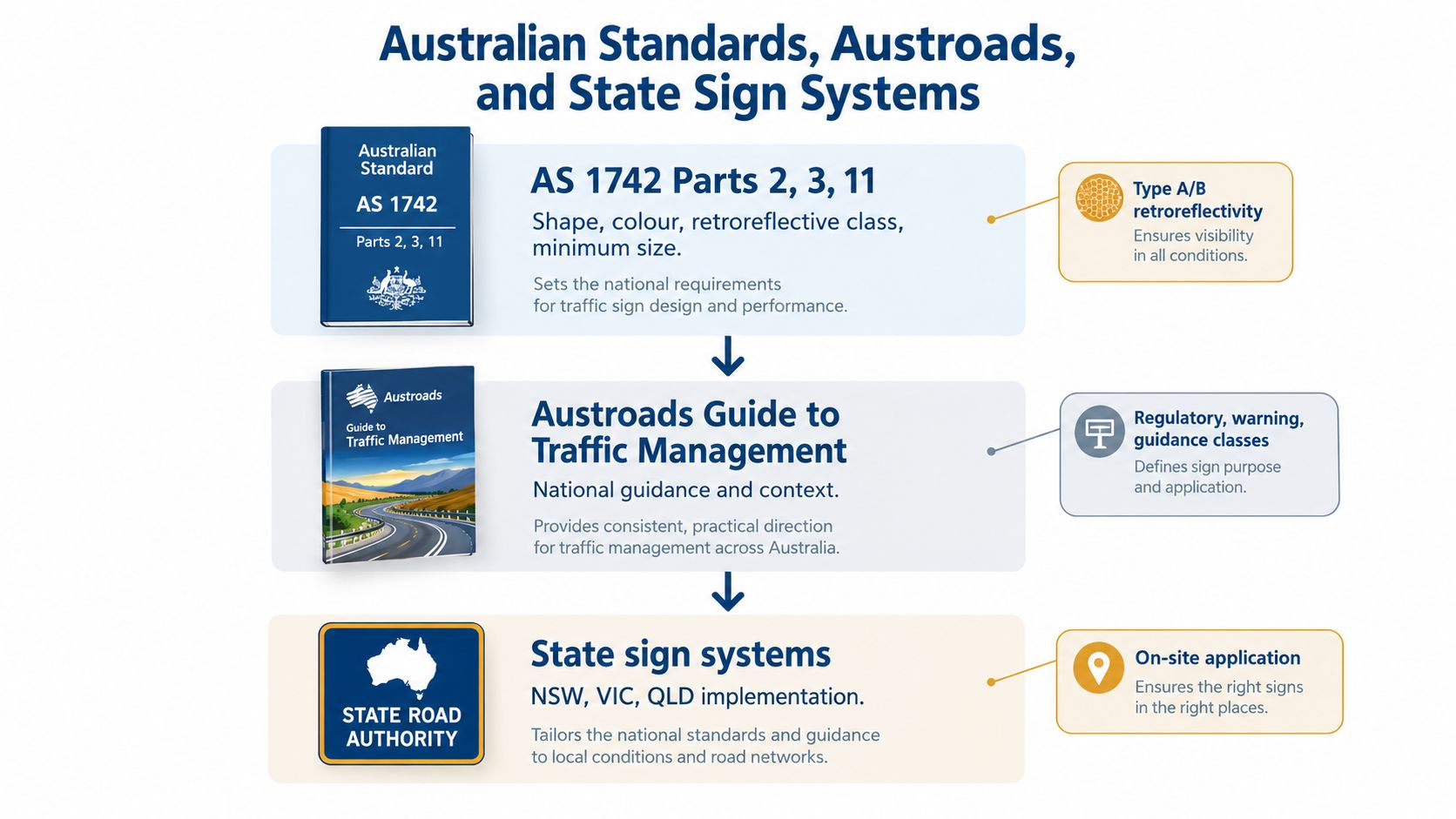
Australian traffic management signs sit within a layered system. AS 1742 provides the national sign language and design foundation. Austroads guidance explains how traffic control devices operate in road and worksite contexts. State and territory road authorities then apply those principles through local manuals, approval processes, device registers and TGS requirements.
The hierarchy matters when a controller faces a conflict between a familiar sign and the approved site arrangement. A sign may have the correct general symbol but the wrong size, colour treatment, mounting arrangement or location for the road environment. The current state authority document and approval condition determine how the national framework is applied at that site.
How the layers influence a field decision
Austroads says signs should be legible, appropriately positioned longitudinally and laterally, consistent with the road environment and concise. It also says new signs should be designed and tested to the relevant Australian Standards, including AS 1742 Parts 1 and 2, AS 1743, AS 1744 and AS 2342, as set out in the Austroads Guide to Traffic Management Part 10.
In practice, the choice flows downward:
- National design: The standard establishes the recognised sign form, classification and design characteristics.
- Operational guidance: Austroads connects that sign with sight distance, road context, traffic movement and worksite control.
- Local application: The road authority confirms the approved device, TGS layout, consent pathway and any jurisdiction-specific condition.
A contractor researching broader industrial signage Australia options still needs to separate general workplace signage from approved road traffic control devices. A product can be durable and highly visible while remaining unsuitable for a public-road TGS.
How Traffic Guidance Schemes Sequence Signs on Site
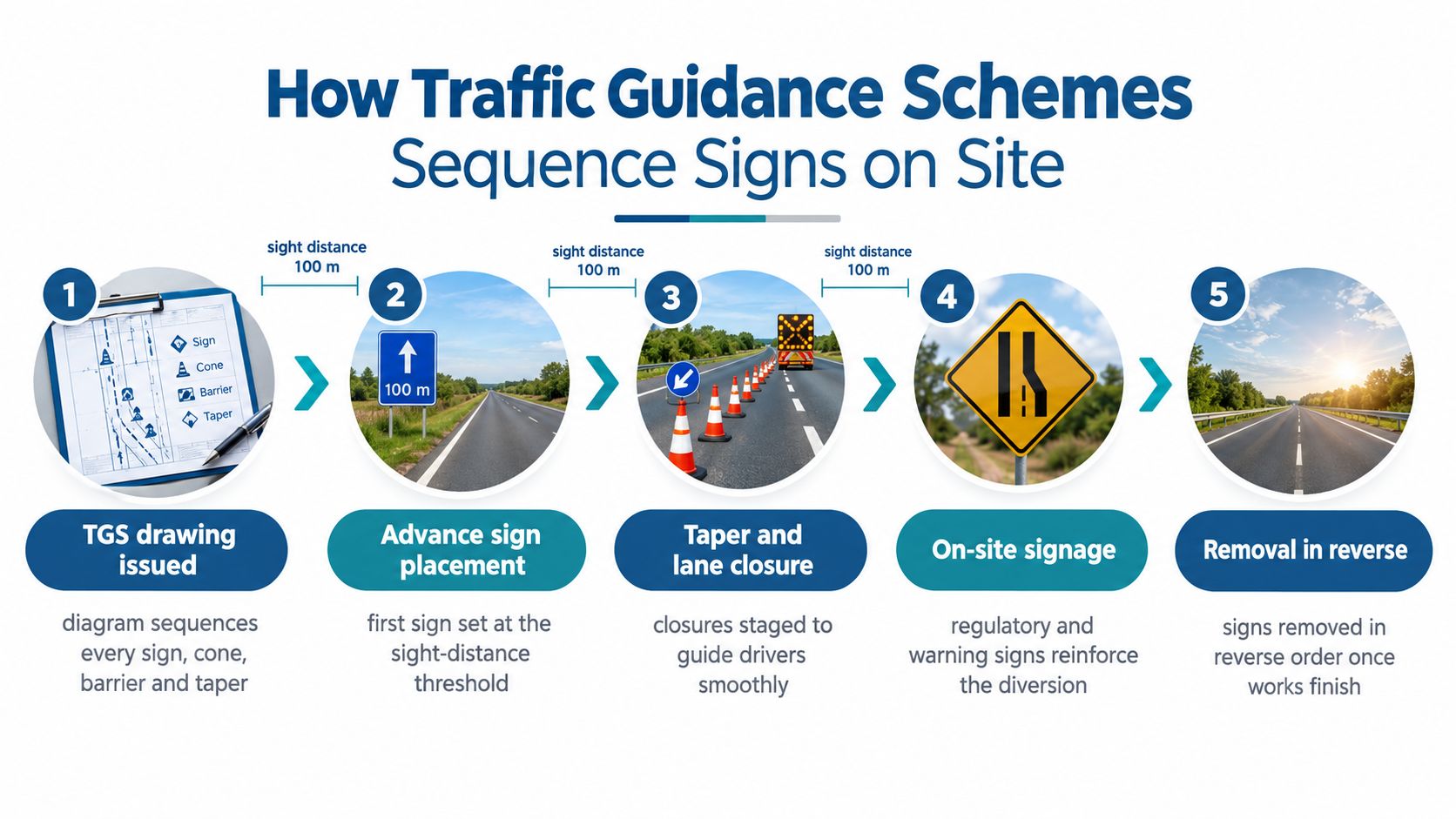
A Traffic Guidance Scheme is a diagram of movement, not a flat sign list. It sequences advance warnings, speed controls, tapers, cones, barriers, traffic controllers and termination signs so a driver receives each instruction before the next decision point.
On a two-lane, two-way closure, the driver may first encounter advance warning, then a change to the operating speed, then a lane or side-of-road instruction, followed by the taper and the work area. After passing the activity, termination information confirms when the temporary arrangement ends. The exact sequence depends on the approved plan, road geometry and authority requirements.
Sight distance controls the sequence
Every sign should be visible from the preceding sign, and the driver should have enough time to interpret the message before reaching it. If a bend, crest, vegetation, heavy vehicle or construction plant blocks that relationship, the controller must escalate the issue. The answer may involve moving the sign, changing the approved arrangement or reducing the operating speed zone, but it shouldn't be an unauthorised roadside adjustment.
A traffic controller belongs inside this sequence. Hand signals and a stop-slow bat can reinforce the arrangement at a control point, but they don't replace advance warning signs or the physical separation shown on the TGS. A pilot vehicle can support traffic movement through a constrained section, yet the convoy still needs the approved warning and protection devices.
Read the scheme before opening the worksite, then read it again before moving the first sign. The Prepare Work Zone Traffic Management Plan Course is relevant to people who need to understand how planning decisions become a field arrangement, but every project still relies on its current approved documents.
Static Signs Compared with Variable Message Signs
A static sign gives a fixed message through a retroreflective face. A variable message sign, or VMS, can display changing information, while a variable speed limit sign or arrow board can support a more dynamic traffic arrangement. These devices solve different problems and shouldn't be treated as interchangeable.
A static ROADWORK AHEAD or speed limit sign is predictable and recognisable. It remains available when power, communications or programming access fails. A VMS can provide a timely message about a lane closure or changing traffic condition, but it introduces approval, programming, display and maintenance requirements.
| Attribute | Static signs | Variable message signs |
|---|---|---|
| Message | Fixed and selected in advance | Changeable within the approved system |
| Power | No electronic power required | Requires a functioning power source and display system |
| Best use | Standard warnings, regulations and guidance | Changing conditions that need an approved dynamic message |
| Approval | Must match the authorised sign and TGS | Message, device and deployment may require additional authority approval |
| Limit | Cannot respond to a new condition without replacement or adjustment | Doesn't automatically replace a regulatory or warning sign |
| Field check | Face, orientation, size, visibility and condition | Display legibility, message authorisation, power, positioning and operation |
Queensland's roadworks guidance says temporary variable speed limit signs may be used on motorways and high-speed roads with speed limits of 80 km/h and above, subject to approval by the relevant regulatory authority. The same guidance states that lane closures shouldn't begin until the variable speed limit has been reduced, and that the first lane control device must show a continuously flashing red cross. That is a tightly controlled sequence, not a general invitation to deploy an electronic board.
The Northern Territory and Western Australia also apply jurisdiction-specific conditions to variable or mobile message devices. Approval pathways, permitted messages and operator requirements must be confirmed with the relevant authority. A VMS can supplement a TGS, but it doesn't make an unauthorised lane closure compliant.
Mobile Worksites, Convoys, and Changing Sign Contexts
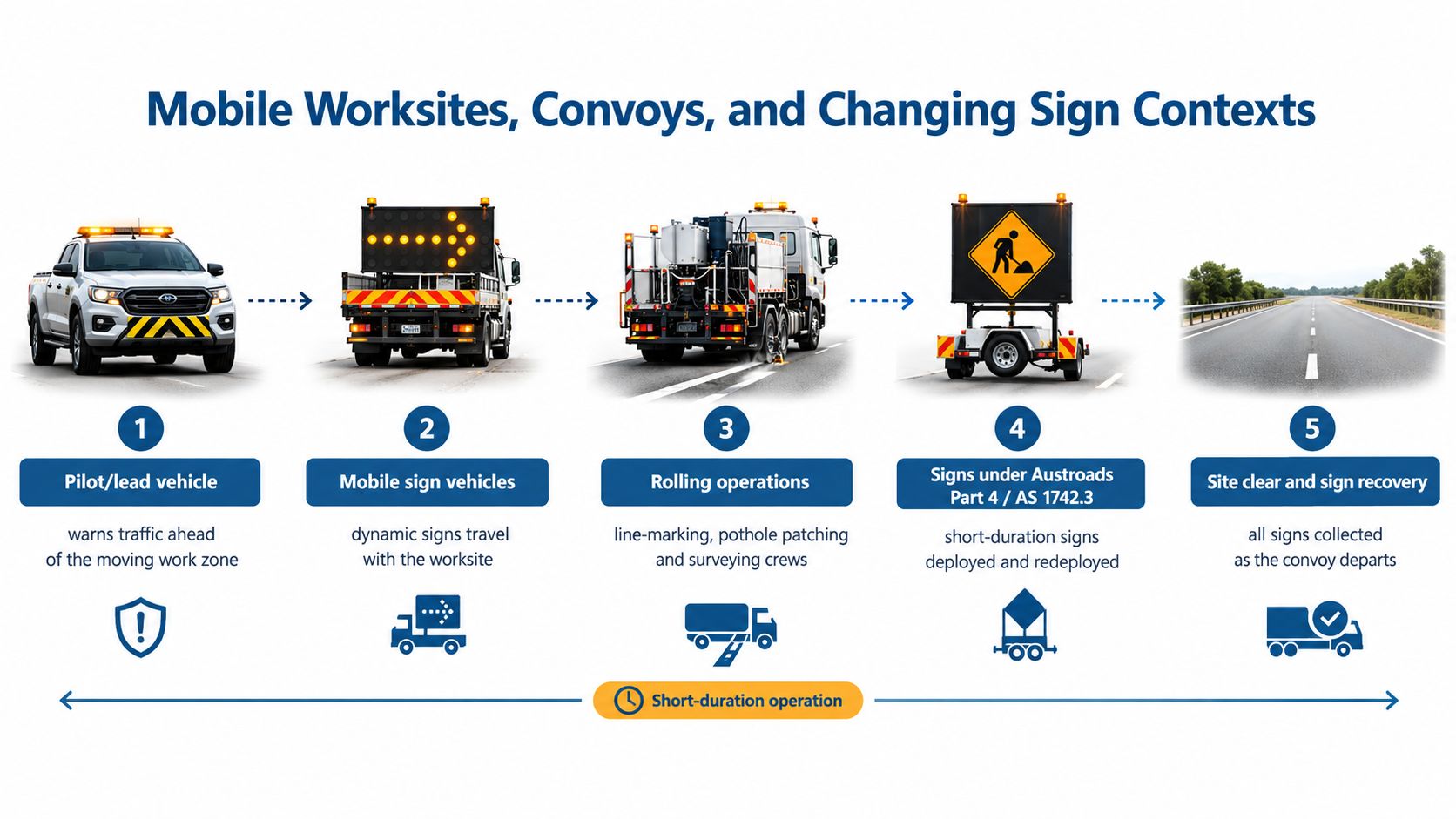
A mobile worksite changes the sign problem. A rolling line-marking convoy, pothole repair crew or surveying team doesn't leave the same hazard in one place for the whole shift. The signs and protection devices must travel with the operation, remain visible to approaching traffic and be redeployed as the work front moves.
Austroads Part 4 specifically addresses mobile worksites and includes guidance on recommended sight distances for static signs used with mobile convoys, side streets, signalised intersections and freeway ramps. That focus is useful because a generic roadwork sign list won't tell a controller how the sign sequence should change when the hazard is moving.
Keep the warning with the moving hazard
A lead vehicle can warn approaching traffic before the convoy, while a shadow or trail vehicle can provide protection behind the work area. Arrow boards, beacons and vehicle-mounted signs may supplement the arrangement, but they don't remove the need to follow the approved mobile-work guidance. A contractor carrying a warning sign without the required protection vehicle, attenuator or sight-distance arrangement has a compliance gap, not a complete system.
For a 60 km/h moving worksite on a two-lane road, start with the approved mobile-work TGS and identify the sight-distance threshold before deployment. Position the advance warning vehicle or sign where approaching drivers can see and understand it before reaching the convoy, keep the lead and work vehicles separated according to the scheme, and maintain a protected trail vehicle where the approved arrangement requires one. Recheck the spacing after every change in road alignment or traffic condition.
The Operate Truck or Trailer Mounted Attenuators TMA resource is relevant to workers responsible for those protective vehicles. The sign face alone doesn't protect a moving crew. The convoy arrangement, vehicle protection and traffic space must operate together.
Compliance Checklist for Traffic Controllers and Managers
A field check should be quick enough to perform before opening the worksite and whenever conditions change. Group the check under placement, visibility, approval and removal.
Placement
- Match the TGS: Confirm every sign belongs to the current approved drawing.
- Check the approach: Verify the sign sits at the required distance for the site's operating speed and road geometry.
- Face traffic: Set the sign squarely toward approaching drivers, not toward the work crew or shoulder.
- Protect the route: Make sure the sign doesn't intrude into the travel path or create a new hazard.
Visibility
- Clear the face: Remove mud, dust, tape, stickers and other material that reduces recognition.
- Check the night view: Confirm retroreflective material can be seen under approaching headlights.
- Remove obstructions: Look for vegetation, parked vehicles, plant, stockpiles and temporary fencing.
- Check sign-to-sign visibility: Make sure the driver can see the next instruction before reaching the current sign.
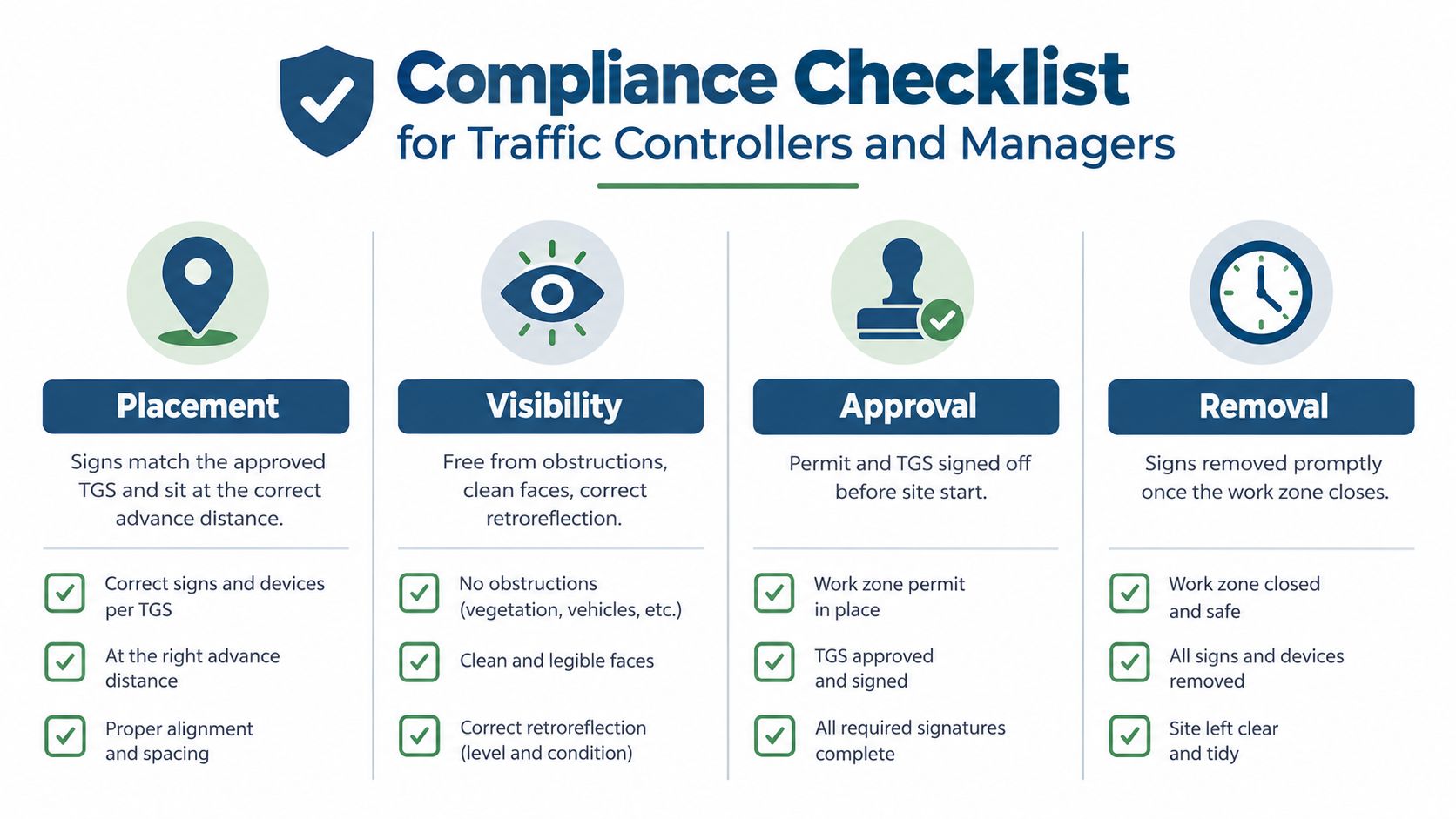
Approval
- Confirm the designer's sign-off: Check that the TGS has been approved through the required process.
- Verify special devices: Confirm authority endorsement for non-standard signs, VMS messages and temporary speed arrangements.
- Check current documents: Don't rely on a superseded drawing or an old site copy.
- Record changes: Escalate and document changes instead of moving devices without notice.
Removal
- Close the arrangement properly: Cover or collect signs when the approved temporary condition is inactive.
- Protect live traffic: Don't leave a sign facing traffic overnight if the message no longer applies.
- Store faces carefully: Prevent scratching, bending and contamination of retroreflective surfaces.
- Audit the last sign: Removal is incomplete if a driver can still see an obsolete instruction.
The two items most often missed are sign-to-sign visibility and prompt removal when the worksite closes. Both problems can persist after the crew has packed up, when drivers have no worker present to explain the contradiction. The Blue Card Traffic Control Course can be considered alongside the site's documented competency and supervision arrangements.
Quick Reference for Common Work Zone Signs
This table is a field reminder, not a substitute for the approved TGS, a state-specific approval or the site risk assessment. Confirm the sign face, code, size and placement against the current road authority documents before installation.
| Sign name | Shape | Colour | Meaning |
|---|---|---|---|
| ROAD WORK AHEAD | Diamond | High-visibility warning treatment | Roadwork or a temporary work area is ahead |
| PREPARE TO STOP | Diamond | High-visibility warning treatment | Drivers may need to stop at the upcoming control point |
| LANE CLOSED | Temporary panel or approved condition format | High-visibility temporary treatment | A lane is unavailable ahead |
| END WORKSITE | Approved information or termination format | State-approved treatment | The temporary worksite condition ends |
| REDUCE SPEED | Regulatory or approved temporary format | Regulatory treatment | Drivers must comply with the changed speed requirement |
| Workers symbol | Diamond | High-visibility warning treatment | Workers may be operating near the traffic path |
| FLAGMAN symbol | Diamond | High-visibility warning treatment | Traffic control personnel may be ahead |
| Detour arrow | Directional panel | High-visibility guidance treatment | Follow the indicated alternate route |
| Pedestrian guidance sign | Approved guidance format | State-approved treatment | Directs pedestrians through the temporary arrangement |
Shape and colour are recognition tools, but the message only works when the sign is authorised, legible and consistent with the physical route. If the field arrangement differs from the table, the TGS takes priority over memory.
Bringing It Together and Where to Go Next
Traffic management signs work as one layer of a wider compliance system. The current TGS, AS 1742, Austroads guidance, the relevant state road authority manual and accredited controller training must agree before the work begins. NSW teams should check Transport for NSW, while other jurisdictions should consult the Department of Transport and Main Roads in Queensland, VicRoads, Main Roads WA or the Department for Infrastructure and Transport in South Australia for current approvals and templates.
Managers and controllers who need planning knowledge can review the RIIRIS402E and RIICWD503E Traffic Management Plan Course and keep monitoring authority updates as manuals change.
TP Training offers practical, nationally recognised training for traffic control, work zone planning and related workplace skills across NSW. Visit TP Training to review the course pathway that matches your role and build safer, more confident site practice.

You may also like
Responsibilities of Employers: A Complete NSW Safety Guide

First Aid Training Cost: A Complete Guide for Sydney Workers