EWP Licence Requirements Your Complete Guide for NSW
Getting an EWP licence in NSW requires you to meet age and identity criteria, complete nationally recognised training with a Registered Training Organisation, pass a formal assessment, and then apply to SafeWork NSW. For a boom-type EWP with a boom length of 11 metres or more, the relevant high-risk work licence is the WP class.
You might be looking at a construction, civil works, warehouse, maintenance, or facilities role where an Elevating Work Platform is part of the job. The machine may already be waiting on site, your employer may have asked whether you hold a “yellow card” or a WP licence, and the terminology can make a straightforward career step feel more complicated than it needs to be.
The key is to identify the machine correctly before booking training. This guide breaks the EWP licence requirements into a practical NSW pathway, from choosing the right qualification and preparing your documents to completing assessment and lodging your licence application.
Table of Contents
- Your Path to Operating an EWP Safely in NSW
- Understanding EWP Licences Under vs Over 11 Metres
- Checking Your Eligibility for an EWP Licence
- Completing Your Nationally Recognised Training and Assessment
- How to Apply for and Renew Your EWP Licence
- Start Your EWP Training with TP Training in Sydney
Your Path to Operating an EWP Safely in NSW
Your goal isn't just to collect a card. You need training that matches the machine you'll operate, the worksite hazards you'll face, and the legal licensing category that applies to the equipment. A careful start prevents the common mistake of completing training for an under-11-metre machine when your intended role involves a boom-type EWP at or above the licensing threshold.
The pathway at a glance
The complete process follows a logical sequence:
- Identify the EWP: Confirm whether it's a boom-type machine and check its original boom length.
- Choose the qualification: Under-11-metre equipment generally follows a competency-based training pathway, while a boom-type EWP at or above the threshold requires the WP high-risk work licensing pathway.
- Check eligibility: Make sure you meet the age requirement, can provide acceptable identity evidence, and are ready for the language, literacy, and numeracy demands of the course.
- Complete training and assessment: Enrol with an RTO, learn the theory, practise on suitable equipment, and complete the formal assessment.
- Apply to SafeWork NSW: Use the required documentation and lodge your application after receiving the relevant training outcome.
- Maintain currency: Keep your licence details and renewal obligations organised so you can continue working lawfully.
Safe Work Australia explains that high-risk work licensing is a mandatory precondition for certain work, rather than an optional extra added by an employer. You'll also need to follow site procedures, equipment familiarisation requirements, risk controls, and PPE rules. For broader workplace planning, TP Training's guidance on EWP risk assessment can help you understand how the machine fits into a documented safe system of work.
Your clothing matters too. Hi-vis expectations vary between workplaces and tasks, so this practical guide to UK hi-vis requirements explained offers useful background on visibility garments, even though NSW sites will ultimately follow their own site rules and Australian safety requirements.
Practical rule: Never rely on the machine's nickname, the platform's appearance, or the height you'll use on the day. Confirm the machine type and original boom specification before enrolling.
Understanding EWP Licences Under vs Over 11 Metres
The most important distinction is between under-11-metre EWP training and the WP high-risk work licence. In Australia, a high-risk work licence is mandatory for a boom-type elevating work platform when the boom length is 11 metres or more. Safe Work Australia defines boom length as the greater of the vertical distance from the supporting surface to the platform floor at maximum height, or the horizontal distance from the boom rotation point to the platform's outer edge at maximum reach, based on the machine's original design. See the Safe Work Australia EWP overview for the regulator's explanation.
That definition creates an important practical distinction. The measurement isn't limited to the platform floor height, and it isn't recalculated merely because the machine is being used at a lower height. Safe Work Australia also states that post-manufacture alterations that reduce the boom length don't remove the licensing requirement when the original design met the threshold.
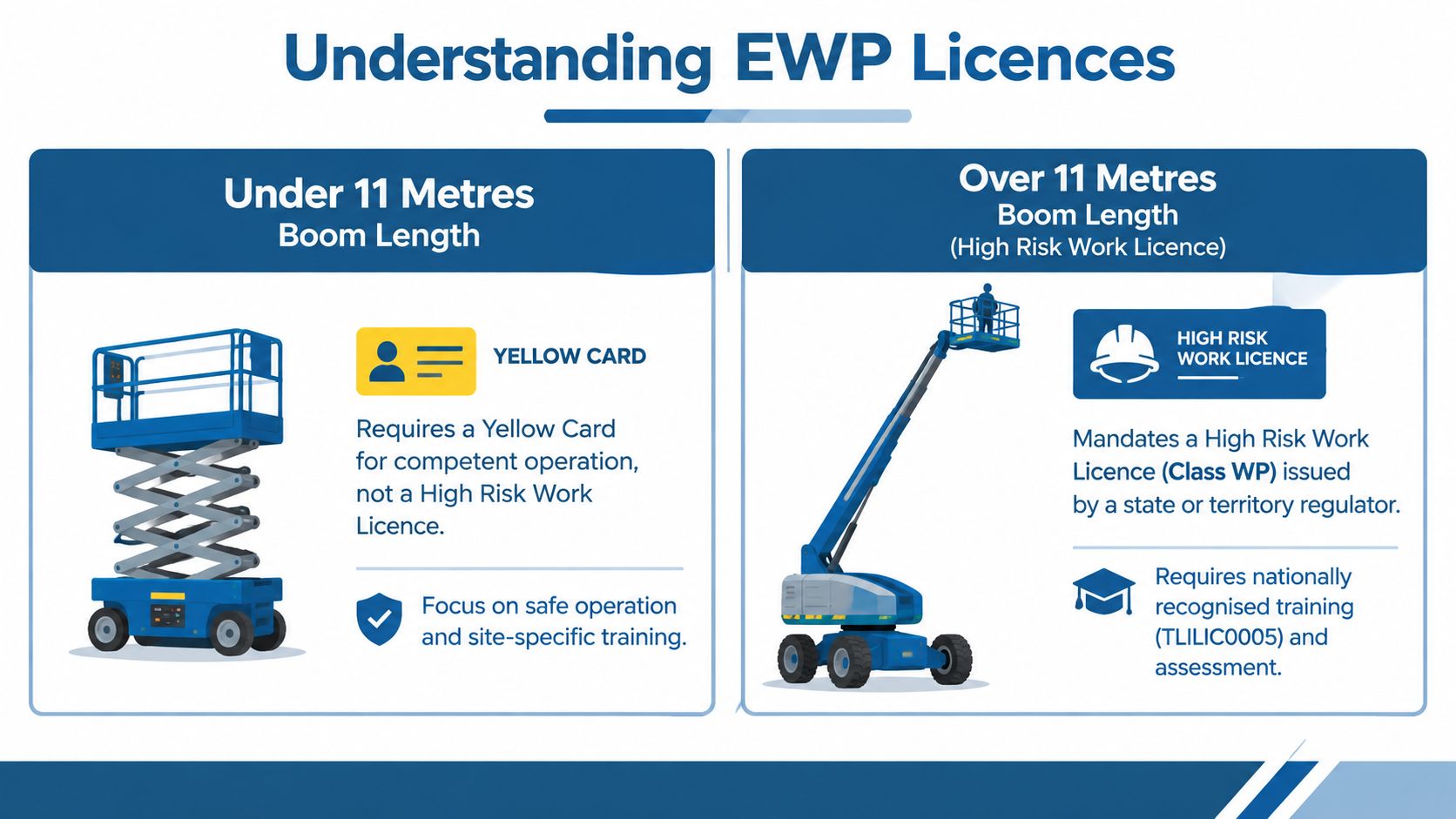
A scissor lift isn't automatically treated the same way as a boom-type EWP for this licensing trigger. The WP requirement is tied to boom-type equipment and the relevant boom measurement, not every machine that raises a platform. Under-11-metre equipment still needs appropriate operator training, workplace instruction, and site verification, even where the high-risk work licence trigger doesn't apply.
EWP qualification comparison under 11m vs over 11m
| Feature | EWP Under 11m, Yellow Card | EWP Over 11m, High Risk Work Licence, WP Class |
|---|---|---|
| Legal status | Training evidence for competent operation, not the national WP high-risk work licence | High-risk work licence required for a boom-type EWP at or above the threshold |
| Equipment focus | Suitable under-11-metre EWP and relevant machine type | Boom-type EWP covered by the WP licensing category |
| Training pathway | Practical operator training and site-specific familiarisation | Nationally recognised training and formal assessment for TLILIC0005 |
| Application | Follow the employer or site process for training verification | Apply to the relevant state or territory regulator after assessment |
| Worksite use | Subject to site requirements, supervision, and equipment familiarisation | Licence must be held before performing the regulated high-risk work |
| Common mistake | Assuming the card replaces a WP licence for larger boom equipment | Assuming WP automatically replaces machine-specific familiarisation |
If your role involves smaller access equipment, Riihan301E Elevate Work Platform Course Operate Boom Under 11M Yellow Card Ewp is one example of practical, nationally recognised training with experienced trainers and hands-on learning across NSW. If you're comparing the categories in more detail, TP Training also provides an explanation of elevated work platform training.
A simple decision test
Ask your employer or hiring contact three questions:
- Is the machine boom-type, or is it a scissor lift?
- What is the machine's original boom length?
- Does the site require additional evidence, such as familiarisation or a verification process?
If the answers point to a boom-type machine at or above the threshold, plan for the WP pathway. If the equipment is under the threshold, confirm the site's accepted training evidence before booking.
Checking Your Eligibility for an EWP Licence
Before you pay for training, check whether you can complete the enrolment and licensing process. Eligibility isn't only about operating skill. SafeWork NSW needs to identify you properly, and the training environment requires you to understand instructions, safety information, and assessment questions.

Your pre-enrolment checklist
Age: You must be at least 18 years old to be issued a High Risk Work Licence, including the WP-class licence for operating a boom-type EWP at or above the threshold. Safe Work Australia sets out this age requirement in its guidance on high-risk work licences.
Identity: Prepare the identity documents requested by SafeWork NSW. The application process uses an Evidence of Identity check, commonly described as a 100-point check, where accepted documents are allocated different values. Your training provider can tell you what to bring to enrolment, but the regulator's requirements should control your final preparation.
Language, literacy, and numeracy: You need enough English and practical literacy to understand safety instructions, interpret workplace information, complete written questions, and communicate with the trainer or assessor. You may also need to read equipment information, identify hazards, and record checks accurately.
Physical and practical readiness: Training involves classroom participation and hands-on equipment operation. Tell the RTO before training if you need reasonable support, have difficulty reading course materials, or require clarification about the practical environment.
Why identity preparation matters
A mismatch between your enrolment documents and your licence application can delay the process. Bring original or accepted documents in the format requested, use the same personal details throughout your paperwork, and ask the RTO what evidence it needs before the course begins.
You don't need to memorise technical language before enrolling. You do need to be willing to ask questions, follow instructions precisely, and demonstrate safe decisions rather than rushing through the equipment tasks.
Completing Your Nationally Recognised Training and Assessment
For the WP pathway, the nationally recognised unit is TLILIC0005, Licence to operate a boom-type elevating work platform, boom length 11 metres or more. Training.gov.au records the unit as current since its release on 13 September 2018. You can verify the unit details through training.gov.au's TLILIC0005 listing.
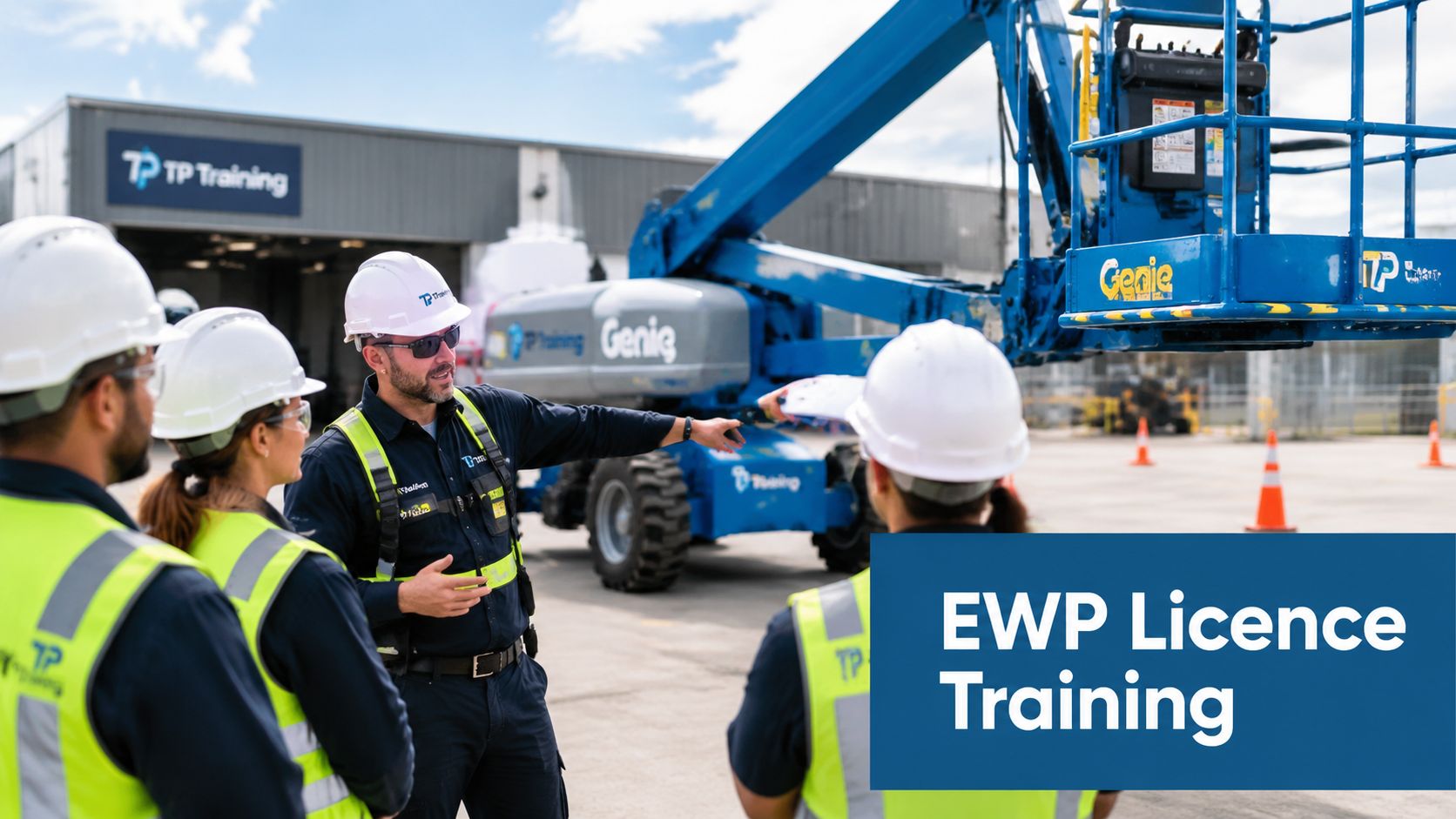
The course combines knowledge with practical performance. You aren't being assessed only on whether you can move the platform. You need to show that you can prepare the job, recognise hazards, use controls, operate the equipment correctly, and finish the task safely.
What training usually develops
The theory component gives you the reasoning behind safe operation. It may address:
- Work planning: Read the task, identify the work area, and consider access, ground conditions, overhead hazards, and nearby people.
- Risk control: Select controls that reduce the chance of contact, crushing, falls, instability, or unintended movement.
- Equipment knowledge: Understand the machine's controls, safety features, operating limitations, and emergency procedures.
- Pre-start checks: Inspect the equipment before operation and identify defects that must be reported.
- Communication: Coordinate with workers, spotters, supervisors, and other site users.
- Shutdown: Park, lower, isolate, and secure the EWP according to the required procedure.
Practical sessions let you repeat these actions under supervision. A good trainer will correct unsafe habits early, explain why a control matters, and give you opportunities to build confidence without treating speed as the main measure of competence.
Assessment insight: Skills-based assessments reward consistent, observable decisions. If you want broader context on how employers evaluate demonstrated capability, read this resource on understanding skills-based hiring assessments.
Preparing for the formal assessment
Expect both knowledge-based questions and a practical skills demonstration. The assessor needs evidence that you understand the requirements and can perform the relevant tasks safely, not merely that you have attended the course.
Before training, organise your Unique Student Identifier details and review TP Training's advice on creating and managing your USI. During the course, listen for the reasons behind each step, practise deliberately, and ask the assessor to clarify any instruction you don't understand.
If you successfully complete the required assessment, the training provider issues the relevant training outcome, including a Statement of Attainment for the unit. That document supports the next administrative stage, but it isn't the same thing as the regulator-issued high-risk work licence.
How to Apply for and Renew Your EWP Licence
Passing TLILIC0005 doesn't complete the NSW process by itself. You must take your training result and supporting documents to the state regulator through the required application pathway.
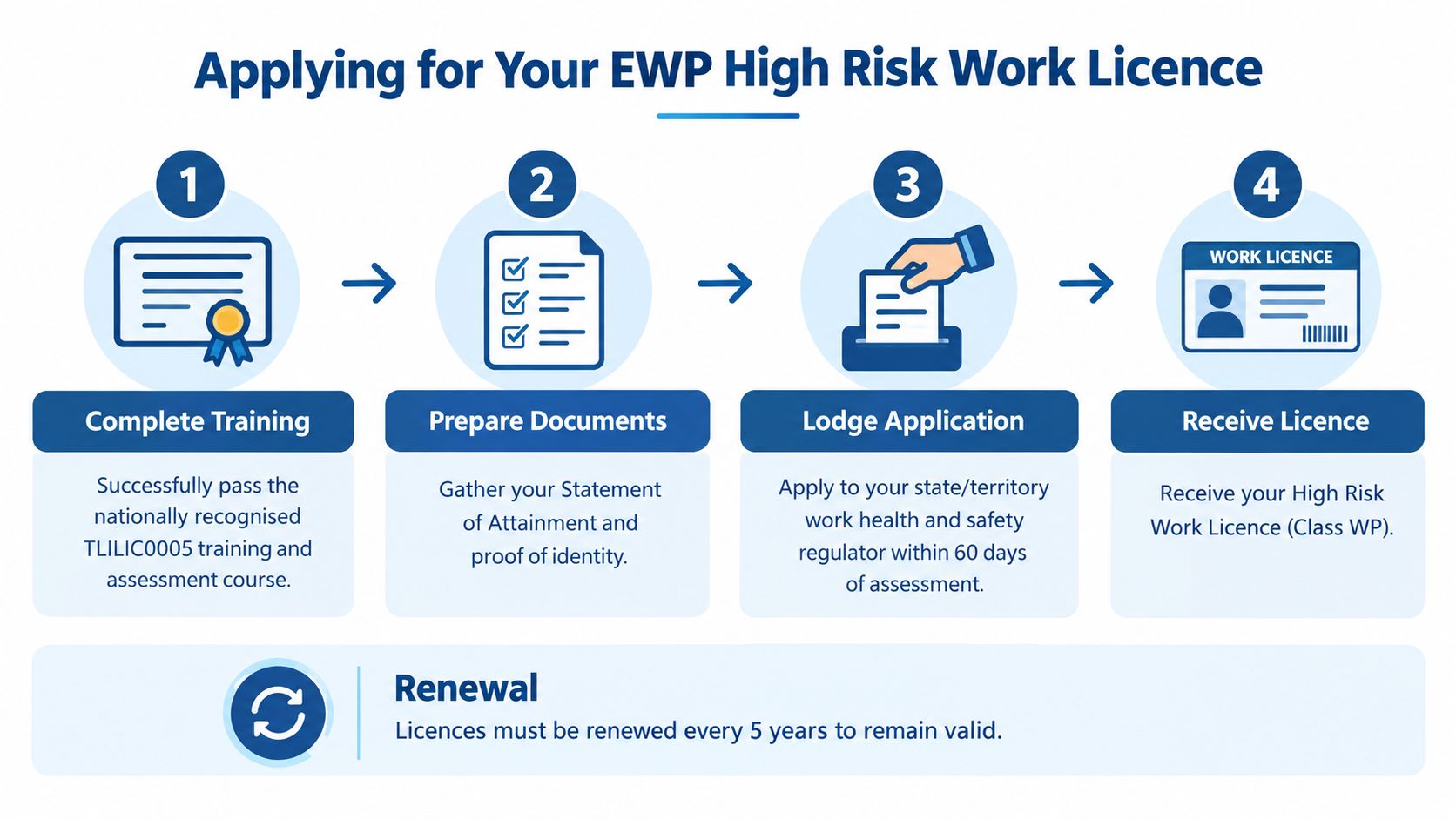
Assemble the application
Use the current SafeWork NSW instructions and prepare the documents requested for your application. The usual checklist described for this pathway includes:
- Application form: Complete the relevant high-risk work licence application accurately.
- Statement of Attainment: Provide the document issued by your RTO after successful assessment. The course information supplied for this pathway states that it is valid for 60 days, so don't leave the application until the deadline is close.
- Proof of identity: Use the accepted Evidence of Identity documents and ensure your details match your training records.
- Photograph: Prepare the required passport-sized photograph in the format requested.
- Application fee: Check the current fee directly with SafeWork NSW before lodging, as fees can change.
The regulator's process may direct you to an online service or an Australia Post outlet, depending on the application instructions in force. Follow the current NSW process rather than relying on an old form, advice from a colleague, or a social media checklist.
For a plain-language comparison with other operator licensing processes, how to get an operator licence offers general administrative context, but NSW applicants should still use SafeWork NSW's own requirements for this licence.
Keep the renewal date visible
A High Risk Work Licence is valid for 5 years, and renewal is required to keep it current. The SafeWork NSW high-risk work licence guidance can help you understand the NSW pathway, but check the regulator's current renewal instructions before acting.
Put the expiry date in your calendar, keep your contact details current, and start checking the renewal process before the licence lapses. If you change employers, retain copies of your licence and training records so you can respond quickly when a site asks for evidence.
Start Your EWP Training with TP Training in Sydney
Once you've identified the equipment, the next decision is choosing training that matches your work plans. A smaller EWP role may call for under-11-metre operator training, while a boom-type EWP at or above the threshold requires the TLILIC0005 WP licensing pathway. If your work may involve both categories, ask an RTO whether a combined option suits the machines and sites you expect to use.
TP Training lists several relevant pathways for workers in NSW:
- TLILIC0005 Licence to Operate a Boom-Type Elevating Work Platform, Over 11m: This is the nationally recognised pathway associated with the WP high-risk work licence.
- RIIHAN301E Operate Elevating Work Platform, Yellow Card: This supports training for relevant under-11-metre EWP operation.
- EWP Over and Under 11m Combined Course: This may suit a learner who needs training across both equipment categories, subject to the provider's course requirements and the machines used in training.
Choose a course that fits the job
Ask the RTO about the equipment available, assessment requirements, identity documents, USI arrangements, and the application steps after successful completion. Experienced trainers and hands-on practice matter because safe EWP operation depends on decisions made before the platform moves, not just familiarity with the joystick.
TP Training delivers practical safety and vocational training through NSW locations including Penrith, Burwood, Auburn, Parramatta, and Sydney CBD. Its EWP training in Sydney information provides a starting point for comparing the available pathways and planning your next step.
Don't book based on the phrase “EWP licence” alone. Send the RTO the machine type and original boom details, explain the role you're applying for, and confirm whether the employer needs the WP licence, under-11-metre training, or both. That short conversation can prevent the wrong enrolment and give you a clearer route into construction, civil works, maintenance, warehousing, or industrial work.
TP Training offers TLILIC0005 WP licensing training, RIIHAN301E Yellow Card training, and an EWP Over and Under 11m Combined Course at convenient Sydney locations. Review the options, confirm the qualification that matches your equipment, and visit TP Training to take the next step towards working safely and confidently with EWPs.

You may also like
Construction Induction Training in NSW Explained
CPR Training Face Shields: A Practical Australian Guide