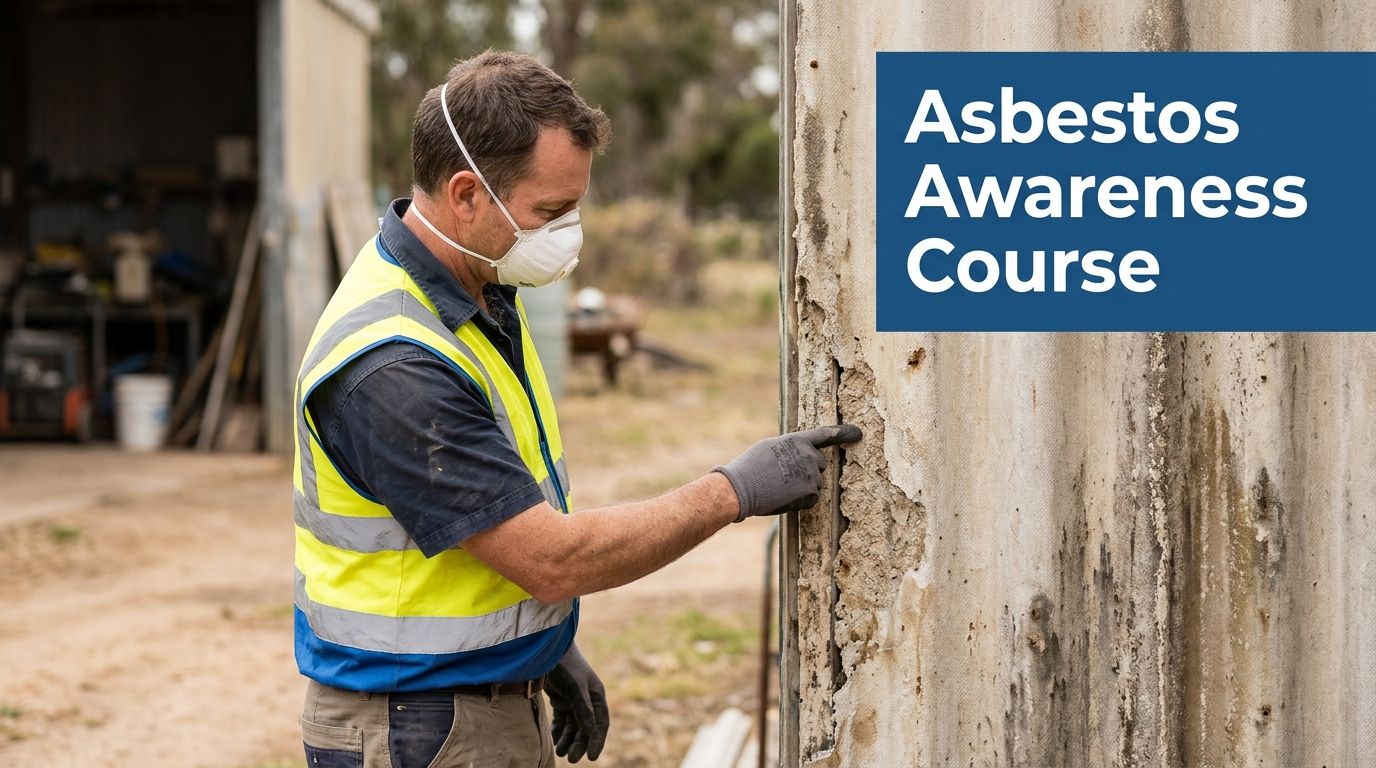
Online Asbestos Awareness Course Course
A tradie steps into a 1970s fibro bathroom renovation and sees a fibrous sheet behind the wall. Does he reach for the grinder, or reach for the phone? That decision exposes the gap most course pages ignore. An Online Asbestos Awareness Course can give you a certificate quickly, but the certificate alone won't tell you whether the material is asbestos, whether your state accepts the training, or what you must do before work stops.
For Australian workers, the right question isn't just whether the course is convenient. It's whether the training is legally relevant to your job and strong enough to change your next decision on site. This guide gives you the straight answer, including the difference between awareness and licensed removal, the ACT compliance trap, and the checks to make before you book.
Table of Contents
- Why an Online Asbestos Awareness Course Matters in 2026
- What Asbestos Still Means for Australian Workers
- State by State Rules for an Online Asbestos Awareness Course
- What a Good Online Asbestos Awareness Course Course Actually Covers
- Does a Short Online Course Change Real On-Site Decisions
- Where Awareness Training Ends and Licensed Removal Begins
- Choosing and Booking the Right Online Asbestos Awareness Course Course
Why an Online Asbestos Awareness Course Matters in 2026
Could a short online course change what a worker does after spotting suspect material, or just produce another certificate? That is the question employers and workers should ask before booking. Convenience matters for mobile crews and small contractors, but the certificate must also count for the work and state requirements that apply.
A bathroom strip-out can become dangerous before anyone sees dust. Old wall sheeting, vinyl flooring, textured ceilings, pipe lagging and cement products may look ordinary in older Australian buildings. Without practical awareness training, a worker may cut around a suspect sheet instead of treating it as a reason to stop.
Australia's asbestos legacy remains widespread. Government guidance says asbestos is found in 1 in 3 Australian homes, and around 13 million tonnes of asbestos-containing materials were consumed in the built environment, as set out in Australia's asbestos facts and figures guidance. The same guidance estimates 6.2 million tonnes of legacy asbestos remained in the built environment in 2021. Builders, electricians, plumbers, demolition crews, maintenance workers and renovators all need to recognise the risk. Awareness training is not limited to licensed removalists.
The first step is recognising the trigger
Online delivery works for workers moving between sites, contractors who cannot spare a full day and employers onboarding people across locations. It only earns its place if the course teaches a response workers can apply immediately:
- Stop the task. Do not drill, grind, sand, cut or break suspect material.
- Keep people away. Prevent workers and others from entering the immediate area.
- Notify the right person. Tell the supervisor, PCBU or site manager what you found.
- Get competent advice. Identification, testing, removal and disposal must meet relevant requirements.
A practical construction risk management guide reinforces the broader control principle. Workers must recognise the hazard before the site's control process can work.
Practical rule: A completion certificate should support a stop-work decision, not encourage a worker to push ahead.
In 2026, treat online awareness training as the first control, not the entire asbestos management system. Before enrolling, check whether the course supports recognition, reporting and safe decisions, and whether its certificate is accepted for the intended work in your state.
What Asbestos Still Means for Australian Workers
Australia banned asbestos use nationally in 2003, but the ban didn't remove materials already installed in homes, commercial premises and infrastructure. Safe Work Australia recorded 176 Australians compensated for asbestos disorders during the 2010–11 to 2014–15 period, including mesothelioma, asbestosis and exposure without apparent injury. Construction was the largest affected industry at 24%, while labourers represented 26% of occupations most at risk and technicians and trades workers represented 44%. These figures appear in Safe Work Australia's asbestos infographic.
The danger is practical, not historical. A plumber opening a wall, a sparky drilling through a panel, a demolition worker removing a bathroom or a maintenance worker disturbing old insulation can encounter material that was installed legally before the ban. Workers don't need to be asbestos removalists to need awareness. They need to know when an ordinary task has become an asbestos risk.
Australian Asbestos Burden at a Glance
| Metric | Figure | Source |
|---|---|---|
| Australian homes containing asbestos | 1 in 3 | National asbestos facts and figures guidance |
| Asbestos-containing materials consumed in the built environment | Approximately 13 million tonnes | National asbestos facts and figures guidance |
| Legacy asbestos remaining in the built environment in 2021 | Estimated 6.2 million tonnes | National asbestos facts and figures guidance |
| Australians who die each year from asbestos-related diseases | Around 4,000 | National asbestos facts and figures guidance |
The national guidance also estimates that around 99% of mesothelioma deaths and 30% of lung cancer deaths are attributable to past asbestos exposure. The long delay between exposure and disease makes casual attitudes especially dangerous. Feeling fine after a renovation task tells you nothing about whether the work was safe.
A generic induction can explain that asbestos is harmful. It may still leave a worker unsure about identification, risk assessment, exclusion zones, communication and disposal. That gap is why asbestos-specific learning matters. For workers also exposed to respirable crystalline silica, TP Training provides practical, nationally recognised 10830Nat Silica Awareness Training with experienced trainers and hands-on learning across NSW. The hazards differ, but the work habit is the same, recognise the risk before disturbing the material.
State by State Rules for an Online Asbestos Awareness Course
Does an online asbestos certificate count wherever your workers are sent? Do not assume it does. Every regulator imposes the same core duty: train workers before they risk exposure. What differs is the paperwork each one accepts. A certificate that looks acceptable in NSW may not answer an ACT requirement.
SafeWork NSW says its online Asbestos Awareness and Safety Course helps employers meet the legal duty to train workers likely to encounter asbestos. Its campaign page reports over 20,000 enrolments and a 4.3/5 feedback rating. That makes NSW a useful example of an online awareness pathway, not a blanket approval for every course in every state. Review the SafeWork NSW asbestos guidance and match the training evidence to the worker's tasks.
State-by-State Rules for Online Asbestos Awareness Training
| State/Territory | Regulator | Key Requirement | Caveat |
|---|---|---|---|
| NSW | SafeWork NSW | Train workers likely to encounter asbestos and retain evidence of completion. | Check that the course content suits the worker's tasks and NSW requirements. |
| VIC | WorkSafe Victoria | Provide suitable asbestos information, instruction and training before relevant work. | A general certificate doesn't replace task-specific controls or removal licensing. |
| QLD | Workplace Health and Safety Queensland | Ensure workers receive appropriate information, instruction and training where asbestos may be encountered. | Confirm the course is accepted for the role and work activity. |
| WA | WorkSafe WA | Train workers who may be exposed to asbestos risks. | Employer duties and removal requirements still apply beyond awareness training. |
| TAS | WorkSafe Tasmania | Provide asbestos information and training relevant to the workplace. | Don't treat online completion as authorisation to disturb material. |
| NT | NT WorkSafe | Train workers who could encounter asbestos during their work. | Verify local expectations before interstate or specialist work. |
| ACT | WorkSafe ACT | Workers covered by the declaration must complete nationally accredited 11084NAT Course in Asbestos Awareness training. | Generic online awareness certificates may not be accepted. |
The ACT is the major trap. WorkSafe ACT says training completed before 1 January 2008 is not accepted for asbestos awareness purposes. Affected workers must retrain through an RTO accredited to deliver 11084NAT Course in Asbestos Awareness. The requirement applies regardless of seniority, qualifications, licensing status or apprenticeship status. Read the WorkSafe ACT asbestos awareness training requirements before sending workers to ACT projects.
A NSW or Queensland worker travelling to Canberra should not rely on a generic certificate without checking acceptance. For workers needing both subjects, TP Training provides practical, nationally recognised 10830Nat 11084Nat Crystalline Silica Exposure Prevention Asbestos Awareness Combo Courses. Employers can also use white card course information to distinguish general construction induction from asbestos-specific training.
For every jurisdiction, the PCBU should record who was trained, the course completed, the completion date and the additional site controls that apply. A certificate proves completion. It does not authorise anyone to disturb suspect material or replace the controls required for the job.
What a Good Online Asbestos Awareness Course Course Actually Covers
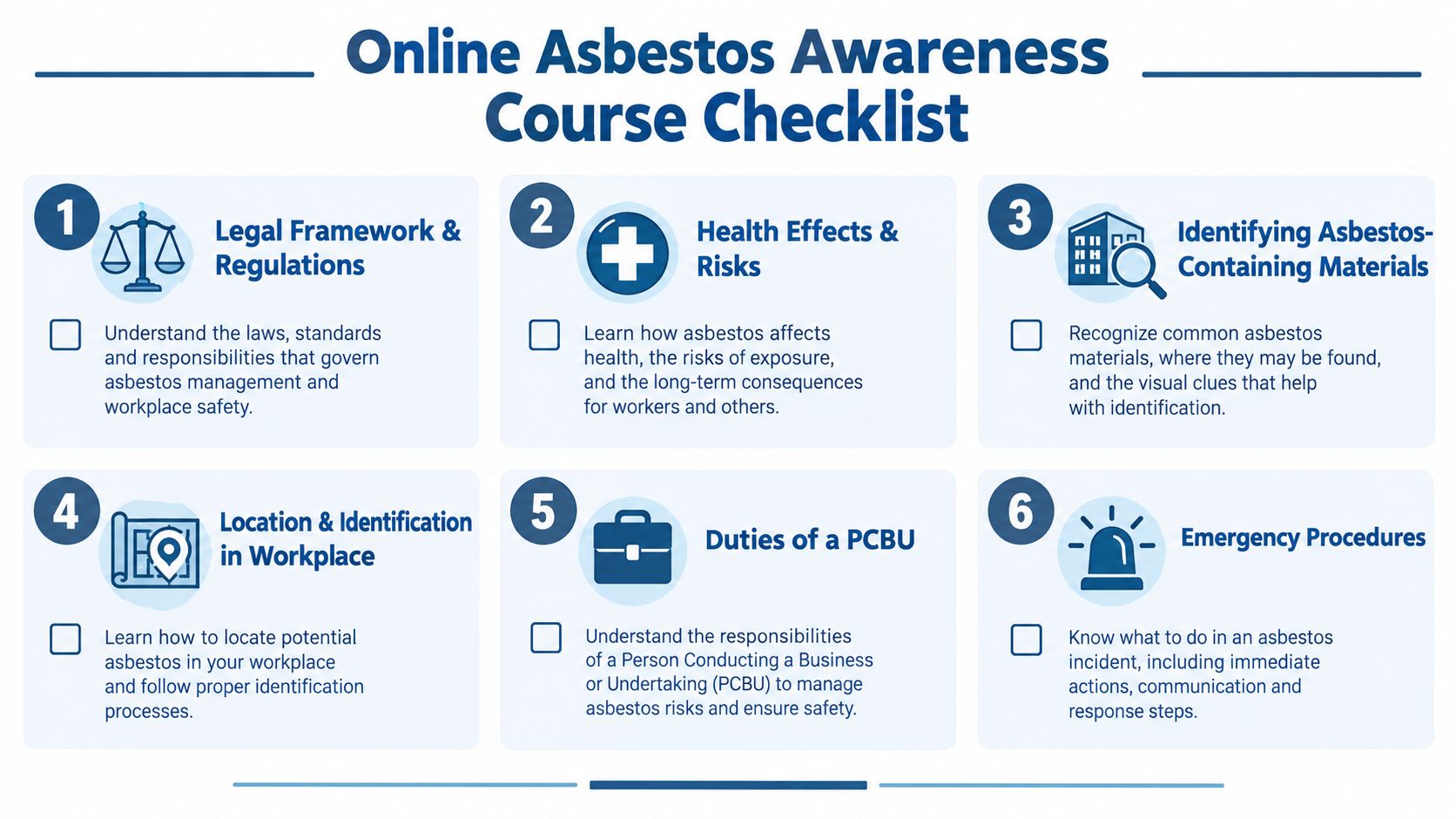
A credible course should teach workers what to do before they disturb a suspect material. SafeWork NSW identifies core topics including asbestos identification, activities that create exposure, long-term health impacts, safe handling, risk communication and control measures. If a course spends most of its time on a generic welcome screen and finishes with automatic attendance evidence, it's not doing the job.
The content workers must remember
Start with the material itself. The course should explain asbestos, the three main commercial types, chrysotile, amosite and crocidolite, and the kinds of products found in older Australian buildings. It should cover likely locations such as fibro sheeting, flooring products, textured finishes, roofing materials, electrical boards and insulation. Visual recognition is a warning signal, not proof. A worker shouldn't identify asbestos by appearance alone and then continue work.
The health section needs to connect inhaled fibres with long-term disease. Workers should understand the risks associated with asbestosis, mesothelioma and lung cancer, without being given the false impression that a mask makes uncontrolled disturbance acceptable.
A strong module then moves from knowledge to decisions:
- Recognise: Treat suspect material as potentially hazardous until properly assessed.
- Avoid disturbance: No grinding, sanding, cutting, drilling, dry sweeping or improvised cleanup.
- Communicate: Tell the supervisor and explain the concern clearly to other workers.
- Control access: Keep people away while the site determines the next step.
- Follow the plan: Use the asbestos register, site controls and competent professionals where required.
- Respond to an incident: Know who to notify and how to prevent further exposure.
How to judge the online format
Look for knowledge checks that use realistic renovation and maintenance scenarios, downloadable reference material and a final assessment that tests decisions rather than rewarding automatic completion. The course should also explain the National Asbestos Register and show how awareness training fits into the employer's broader asbestos management process.
Weak signals include completion in under 30 minutes, no assessment, no state mapping and no explanation of what a certificate does or doesn't authorise. For a wider view of how structured workplace checks can be organised, how OperatorCompliance structures inspections offers useful context. A safety inspection and an awareness course aren't the same tool, but both should turn vague concern into documented action. You can also compare the role of online learning with working at heights training online, where course completion still needs to connect with site-specific controls and supervision.
Does a Short Online Course Change Real On-Site Decisions
A Sydney demolition labourer finds a fibrous sheet behind a bathroom wall. He suspects asbestos, puts on a disposable mask and reaches for a grinder. He may know asbestos is dangerous, yet still miss the decision that matters most: stop work, isolate the area and escalate the concern.
The 2022 National Asbestos Awareness Survey report found that around 82% of surveyed tradespeople had completed at least some work-related training, while only 23% reported taking a dedicated asbestos course. Online learning itself is not the failure. The failure is assuming general safety participation proves asbestos-specific competence. The National Asbestos Awareness Survey report makes that gap clear.
Where workers fail after short online asbestos courses
| Decision Point | Common Failure | Why Short Training Misses It |
|---|---|---|
| Recognising ACM | Treating old sheeting, flooring or textured finishes as ordinary building waste | A quick module may list products without testing recognition in a realistic scenario |
| Choosing PPE | Assuming a mask makes grinding or cutting acceptable | PPE can distract from the primary control, preventing disturbance |
| Setting an exclusion zone | Letting other workers continue nearby | Workers need practice applying controls, not just definitions |
| Escalating to a supervisor | Continuing because the job is urgent | A certificate doesn't create confidence to stop production and report the hazard |
SafeWork NSW survey findings reinforce the problem. 56% of surveyed residents had not looked for information or asked someone about asbestos in the previous 12 months, and 34% incorrectly believed any qualified tradesperson could remove asbestos from a workplace. The same guidance reports that 38% selected inappropriate disposal methods, while 17% remained unsure or incorrectly believed some risky construction items did not contain asbestos.
The true test comes after completion. Can the worker recognise uncertainty, prevent disturbance, keep others clear and contact the right person? If not, the employer needs stronger supervision, site briefings, registers and task controls.
A certificate proves training occurred. It does not prove the worker can safely remove asbestos. The course earns its place when it changes the next site decision, especially under time pressure.
Where Awareness Training Ends and Licensed Removal Begins
Can an awareness certificate authorise asbestos removal? No. It teaches a worker to recognise suspect material, avoid disturbing it and report it. It does not permit drilling, cutting, breaking, removing or disposing of asbestos-containing material.
Under Safe Work Australia's model code, a person without a Class A or Class B asbestos removal licence may remove 10 m² or less of non-friable asbestos, described as approximately the size of a small bathroom. A Class B licence is required for removal of more than 10 m² of non-friable asbestos. Read the model code for safely removing asbestos, then check the rules applying in your jurisdiction before work begins.
Know which side of the line you're on
Non-friable asbestos is bonded into a material, yet cutting, sanding, breaking or poor handling can release fibres. Friable asbestos crumbles more easily or can be reduced to powder, so its removal requires the higher level of control associated with Class A licensed removal. A White Card and an awareness certificate do not qualify a worker for either removal class.
The square-metre threshold does not remove the need for planning. A small bathroom may contain several materials, adhesives, backing products and residues. The complete scope can therefore require licensed removal, notifications, controls and clearance arrangements.
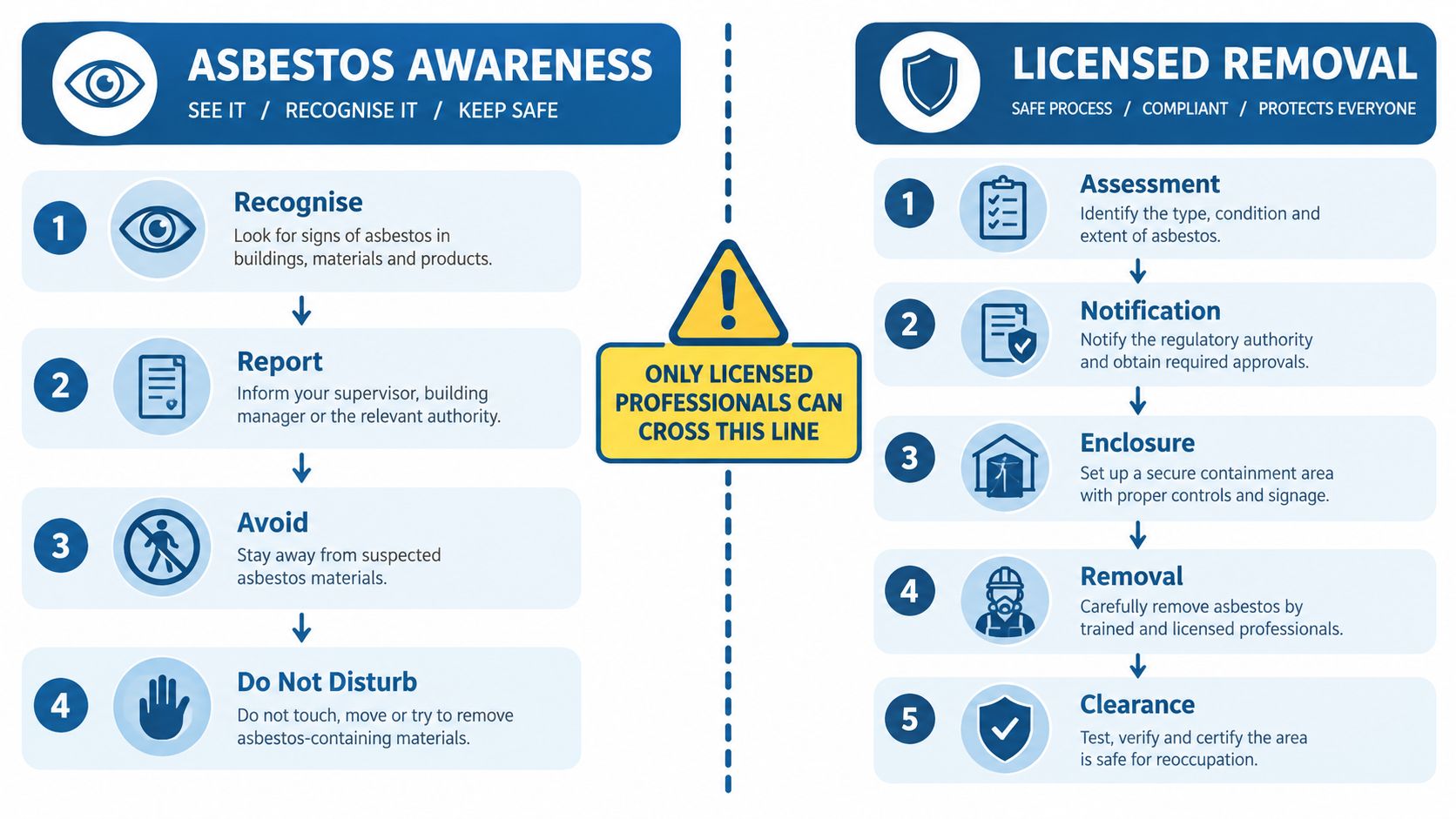
Use the response steps covered earlier, then keep the site closed until the PCBU or supervisor has arranged the right professional. Before starting, a licensed removalist may need the asbestos register, site plans, material identification or testing records, the proposed work scope, notifications and the required control and clearance arrangements. If those documents are missing, the job is not ready.
TP Training provides a White Card Training Course with experienced trainers and hands-on learning across NSW. That construction induction training sits alongside asbestos awareness. Neither replaces a removal licence.
Choosing and Booking the Right Online Asbestos Awareness Course Course
Before paying for an online module, ask questions that marketing pages often avoid. The course should identify the exact training product, explain where the certificate is accepted and state clearly whether it provides general awareness only or satisfies a particular jurisdictional requirement.
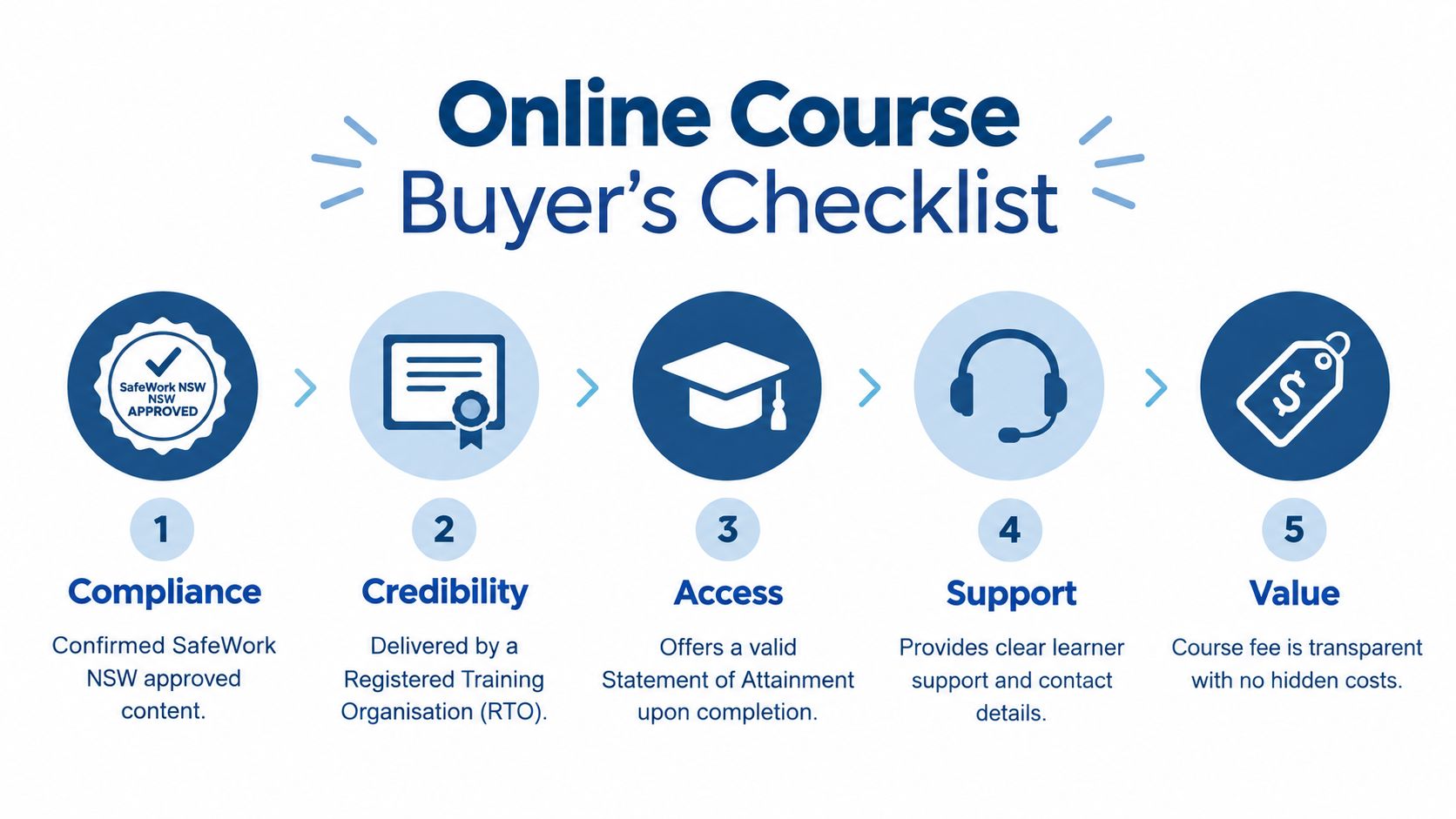
Use this buyer's checklist
- Confirm the course identity: Check whether it is the nationally accredited 11084NAT Course in Asbestos Awareness, rather than a generic WHS induction.
- Check jurisdictional acceptance: Ask specifically about NSW, Victoria, Queensland, Western Australia, Tasmania, the Northern Territory and the ACT.
- Verify the provider: Confirm that an RTO delivers the training and that successful learners receive a valid, downloadable or verifiable Statement of Attainment where applicable.
- Inspect the assessment: Look for scenario-based questions about suspect materials, stop-work decisions, communication and controls.
- Ask about records: Employers need evidence of who completed training and when. Find out how learner records and replacement documents are handled.
- Check support: A real contact channel matters when a worker or supervisor is unsure about course content.
- Reject weak signals: Completion in under 30 minutes, no assessment, no state mapping and a PDF attendance slip should make you walk away.
Don't confuse a White Card, a generic induction or a short awareness presentation with authorisation to remove asbestos. Also don't assume that every nationally described course automatically meets the ACT pathway. WorkSafe ACT's requirements make the 11084NAT question especially important for workers who may carry out asbestos-related work there.
Before booking, organise your Unique Student Identifier requirements using this guide to creating and managing a USI. Then review the course details, assessment process, RTO information and jurisdictional statements rather than buying on completion speed alone.
For workers looking for a specific enrolment pathway, enrol in TP Training's 11084Nat Asbestos Awareness Training Course and check the current course information before committing. The right choice is the one that gives you recognised training, clear jurisdictional relevance and practical guidance for stopping work when suspect asbestos appears.
TP Training provides practical, nationally recognised 11084Nat asbestos awareness training with experienced trainers and hands-on learning across NSW. Visit TP Training to review the course pathway and book training that helps you recognise, report and avoid asbestos risks before they become a site incident.

You may also like
CPR Training Face Shields: A Practical Australian Guide
Civil Construction Plant Operations Courses Explained