
RSA and RCG Sydney CBD: Your Complete Training Guide
You've got the job offer, the roster is waiting, and the manager wants you on shift in the Sydney CBD as soon as possible. The catch is usually not the classroom part, it's the paperwork chain after training. If you don't handle the RSA and RCG Sydney CBD compliance steps in the right order, a finished course can still leave you stuck before your first shift.
For hospitality workers in the city, the pressure point is simple: get certified, get the interim paperwork right, and clear the NSW admin process fast enough to work. That means knowing which role needs RSA, which role needs RCG, and what happens after the trainer hands over the statement of attainment. The venues move quickly in late-night Sydney, but the compliance path doesn't forgive guesswork.
Table of Contents
- Why Sydney CBD Hospitality Workers Need Both RSA and RCG
- Eligibility Requirements and Document Preparation
- Booking Your Course and What to Expect on Training Day
- The Post-Training Compliance Workflow Most Guides Miss
- Which Roles Require RSA, RCG, or Both Credentials
- Renewal Obligations and Long-Term Compliance Planning
Why Sydney CBD Hospitality Workers Need Both RSA and RCG
A venue can roster you on for bar service, gaming, or both, and each duty carries its own compliance path. In New South Wales, RSA training is required for anyone who sells, serves, or supplies alcohol to the public, and it must be completed through a Liquor & Gaming NSW Approved Training Provider (NSW Government RSA training guidance). A gaming role brings a separate requirement, so one certificate does not automatically cover every shift in a CBD venue.

The alcohol side and the gaming side are separate
The mistake I see most often is staff assuming a bar certificate also covers the gaming room. NSW treats liquor and gaming as separate compliance obligations, even though both sit under Liquor & Gaming NSW oversight. A bartender may only need RSA, a gaming attendant may only need RCG, and a worker who shifts between both needs both credentials.
Practical rule: If your roster can move you from the bar to the gaming area, sort out both credentials before you accept the shift pattern.
Late-night venues add another layer. In the Sydney CBD Entertainment area, at least one RSA marshal must be engaged during the supervised trading period, which runs from midnight until 3.30am or until trading ceases if earlier (NSW Government RSA training guidance). Managers build rosters around that requirement, so a missing credential can block a shift even when the job offer is already in place.
The post-training admin matters just as much as the classroom. After the course, workers still need to complete the Liquor & Gaming NSW online assessment and then apply for the Service NSW competency card, which means the documents you bring and the details you enter need to line up cleanly. A missing photo ID, a mismatch in personal details, or unreadable paperwork can hold up the application and delay your first shift.
A clear responsible service of alcohol refresher also helps workers understand what RSA covers and what it does not. For venues that expect staff to move across different service points, a consistent drinks training approach supports the same standard across the roster, which is what CBD operators want when they are trying to fill shifts fast and stay compliant.
Eligibility Requirements and Document Preparation
The fastest way to stall a Sydney CBD start date is to book before checking the paperwork. NSW compliance is not just about attending the course, it depends on matching your identity documents, choosing the right credential for the role, and having enough English to finish the assessment without avoidable errors. For workers trying to move from offer to first shift quickly, that admin can decide whether you start next week or sit out another roster cycle.
Check your eligibility before you pay
Start with identity. The Service NSW competency-card process requires verification, and training providers also need valid photo ID at enrolment or assessment time (Service NSW RSA and RCG competency card application). In busy CBD venues, delays usually begin because hiring moves faster than document checks.
Bring the documents you will need later, not only the ones that get you into class.
A sensible pre-booking check should cover the following:
- Age and role fit: Confirm you are eligible for the credential tied to the work you will do.
- Photo identification: Make sure your ID is current and matches your application details.
- English readiness: You need enough language comprehension to complete the training and assessment without stumbling on instructions.
- Payment and enrolment details: Keep the receipt or booking confirmation accessible in case the provider asks for it.
Interstate workers often get caught here. NSW does not recognise interstate RCG training as a substitute for NSW-accredited training, so Sydney employers cannot accept an out-of-state card and move on. That makes role mapping worth checking before you book, especially if you are aiming for a venue that mixes bar service and gaming duties.
USI problems create another avoidable delay. If your Unique Student Identifier is not in order, use TP Training's guide to creating and managing your USI before course day rather than during enrolment.
For workers comparing RSA options, a NSW-facing RSA course is one example of practical, nationally recognised training with experienced trainers and hands-on learning across NSW. The test is whether the course lines up with the NSW compliance pathway and the job you want.
Booking Your Course and What to Expect on Training Day
A Sydney CBD shift can start fast. If your booking is wrong, your ID details do not match, or your paperwork is incomplete, the day turns into a delay before you even reach the floor. The training itself is usually the easy part. The risk is turning up ready to learn but not ready for the admin trail that follows.
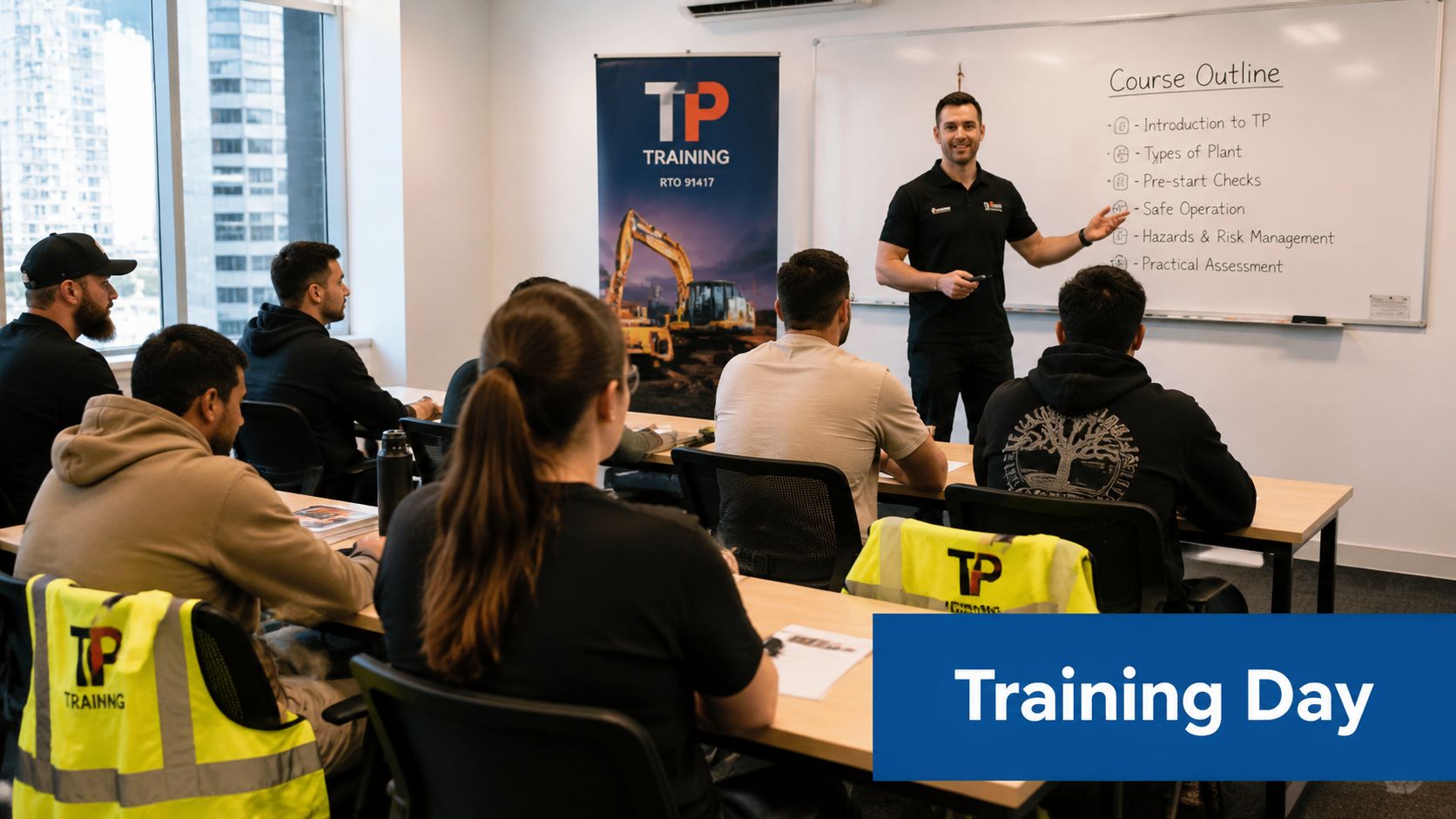
What the day usually looks like
Bookings are usually made online or by phone, and the practical goal is simple, pick a session that fits the roster you want to start on. In the CBD, that means leaving enough room after training for the next compliance steps, not just squeezing in a class before an induction or trial shift. A decent coordinator will tell you exactly what to bring, usually ID, booking confirmation, and any provider-specific documents, so you do not lose time at check-in.
The classroom should feel work-focused. Good trainers use real venue situations, service calls, and compliance choices that mirror Sydney CBD conditions, especially where alcohol service and gaming duties overlap. That helps workers avoid the common problem of knowing the rule but freezing when a manager asks them to step behind the bar or onto the gaming floor.
For people who are bundling hospitality tickets, TP Training's overview of affordable RSA, RCG, food safety supervisor and barista training shows how learners often line up multiple certificates around the same work goal instead of treating each course as a separate project.
How to arrive ready
- Bring your ID and booking details: Do not rely on a photo of the wrong document in your phone gallery.
- Check the venue location early: Sydney CBD transport is easy to misjudge when you are carrying paperwork and watching the clock.
- Ask about support before the class starts: If you need language support or help with the assessment format, raise it early.
- Keep RSA and RCG separate in your head: They are related, but they do different jobs.
Good providers also explain what happens after training, because the classroom is only one part of the process. For many workers, the next delay comes after class, especially when they are trying to line up the affordable RSA, RCG, food safety supervisor and barista training they need with a start date that is already close.
The Post-Training Compliance Workflow Most Guides Miss
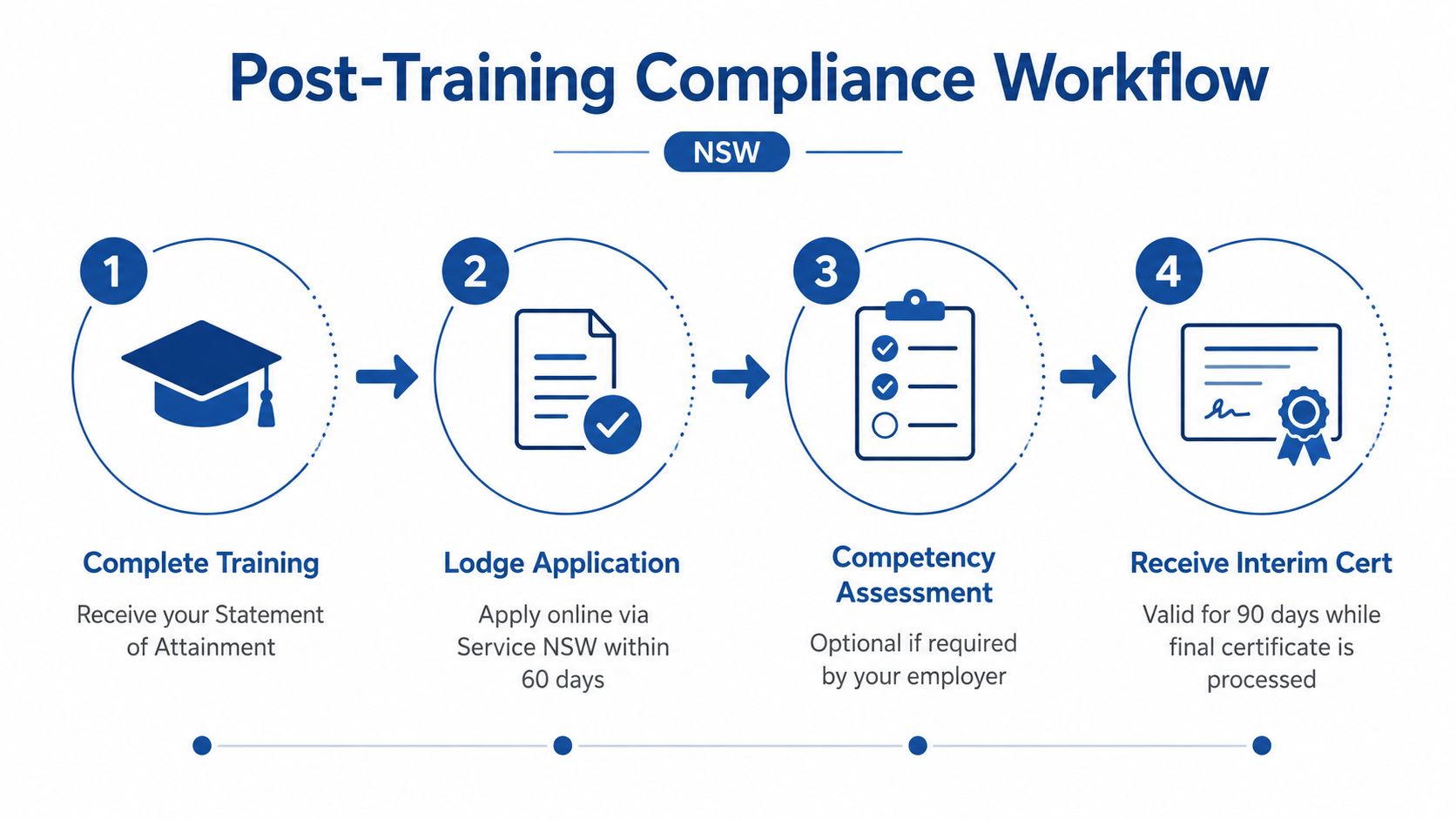
A lot of workers leave class thinking the hard part is done. In Sydney CBD hospitality, that is where the admin starts. The training certificate matters, but NSW still expects the remaining steps before you are fully roster-ready.
RCG has an extra NSW assessment step
For RCG, NSW requires an additional Liquor & Gaming NSW online assessment after class and before the competency card application is finalised (CBD College overview of RSA and RCG workflow). The assessment is a 25-question test, it requires a 100% pass mark, and it allows unlimited attempts. It is usually completed in one sitting within about 20 to 45 minutes.
That extra step catches people out because they assume the course finish means they are ready to start. It does not. If the assessment is left until later, the card process stalls, and the start date with the venue can slip.
Interim certificates are what get you moving
The interim certificate is the document that lets you work while the card application is being finalised through Service NSW (Service NSW competency card application). That matters in the CBD, where shifts are often arranged quickly and managers want proof that the paperwork is in order, not just proof that you attended training.
A clean sequence helps avoid delays:
- Complete training. Finish the approved RSA or RCG course.
- Finish the NSW assessment if RCG applies. Leave no gap between class and test.
- Use the interim certificate correctly. Keep it ready for roster checks.
- Lodge the card application with Service NSW. Match your ID details exactly.
If your ID, assessment result, or application details do not line up, the process can stop even after the course is done. That is the part many new starters miss, and it is why document readiness matters as much as the training itself.
If you are also sorting other compliance documents, check the rules around how long a first aid certificate lasts before you rely on an out-of-date card for work.
Which Roles Require RSA, RCG, or Both Credentials
The quickest way to avoid paying for the wrong course is to match the credential to the duties, not the venue name. A hotel bar, a club gaming room, and a mixed entertainment venue can all sit in the CBD, but the compliance need comes from what you do on shift.
Role mapping for Sydney CBD venues
| Job Role | RSA Required | RCG Required | Typical Venue Types |
|---|---|---|---|
| Bartender | Yes | No, unless duties extend into gaming areas | Bars, pubs, hotels |
| Gaming floor attendant | No, unless alcohol service is also part of the role | Yes | Clubs, gaming rooms, hotels with gaming machines |
| Club secretary | No, unless alcohol service is also part of the role | Yes | Registered clubs |
| Hotel manager | Often yes | Sometimes, if supervising gaming-related duties | Hotels, multi-function venues |
| Multi-function venue staff | Yes | Often yes, if role crosses into gaming duties | Hotels, clubs, late-night entertainment venues |
NSW guidance says RCG training is required when job duties involve gaming machines, including conducting gaming machine duties, paying out winnings, patrolling or serving in the gaming machine area, or acting as the secretary of a registered club (NSW Government club working guidance). In practice, that puts the focus on the task, not the size or reputation of the venue.
Where people go wrong
A common mistake is assuming RSA covers gaming floors. It does not. RSA covers alcohol service, while RCG covers gaming-related duties, and staff who split time between bar and gaming areas usually need both where those duties overlap.
Useful test: If your manager can reasonably roster you to serve alcohol one hour and monitor gaming the next, a single-credential plan is usually too narrow.
The admin side causes just as many delays as the wrong course choice. After training, the paperwork has to line up cleanly, and missing or mismatched details can hold up the next step. That is why workers who are also sorting food handling compliance should check a food safe handlers certificate alongside their hospitality paperwork, so each document matches the job they are doing.
TP Training also offers the Traffic Control Combo Course Blue Yellow Card as practical, nationally recognised training with experienced trainers and hands-on learning across NSW. It is a straightforward reminder that compliance training works best when the pathway is clear and tied to the work ahead.
Renewal Obligations and Long-Term Compliance Planning
A Sydney CBD roster can change fast. One week you are behind the bar, the next you are covering gaming duties, and the paper trail has to keep up. The workers who stay job-ready treat compliance as ongoing admin, not a once-off task.
RCG has its own renewal cycle, and NSW requires an ongoing approach that includes a refresher online course every five years (NSW Government RCG training guidance). That matters because a card or certificate that is out of date can stop a shift before it starts.
Licensee training follows a separate rule set for workers who hold both liquor and gaming responsibilities. Completing licensee training renews an existing RSA endorsement automatically, but it does not renew RCG competency. The RCG renewal must be within 90 days before enrolling in Licensee Training to stay current, and that timing matters because it is part of the compliance process itself (NSW Government licensee training guidance).
A few habits save time later:
- Track RSA and RCG separately. They do not expire or renew the same way.
- Set reminders early. Waiting until a manager asks for proof usually creates avoidable delays.
- Check your next role, not just your current one. If your duties are shifting, confirm the credential still matches the work.
- Keep your card and certificates together. Busy Sydney CBD venues often need quick proof, not a search through old emails.
A clean compliance file makes a difference when shifts open up or venues ask for immediate verification. Workers who keep their documents in order can move between roles with less back-and-forth. Employers get fewer roster gaps, and workers avoid being sidelined while missing paperwork is fixed.
TP Training helps Sydney CBD hospitality workers get the right RSA and RCG pathway in place without wasting time on avoidable admin mistakes. If you need practical guidance, role-specific training, and a clear route from class to compliance, visit TP Training and check the course that matches the job you're taking.

You may also like

Safety & Health Policy: A Guide for Australian Employers

Asbestos Removal Requirements in NSW: The Complete Guide