
What Is a Food Safety Supervisor? an Essential Guide
What happens when a customer reports an allergic reaction, but nobody in the kitchen knows who has authority to stop service, isolate ingredients, or answer the council inspector's questions? That gap exposes the answer to what is a food safety supervisor. An FSS isn't the person whose certificate sits in a folder. They're the trained person with the authority to direct safe food handling and intervene before a hazard reaches a customer.
In a NSW hospitality business, the FSS connects legal compliance with daily kitchen decisions. They help control allergens, sanitation, storage, preparation, staff hygiene and records. This guide explains who the supervisor is, what NSW and national law require, what the role looks like during a normal shift, and how approved training leads to certification.
Table of Contents
- Why the Food Safety Supervisor Role Exists in NSW
- The Legal Definition of a Food Safety Supervisor
- Core Responsibilities of an FSS in a Hospitality Business
- FSS Training Course Structure and Certification Process
- How TP Training's Food Safety Supervisor Course Fits NSW Compliance
- Common Mistakes Employers Make With FSS Compliance
- Key Takeaways and Next Steps for Aspiring Supervisors
Why the Food Safety Supervisor Role Exists in NSW
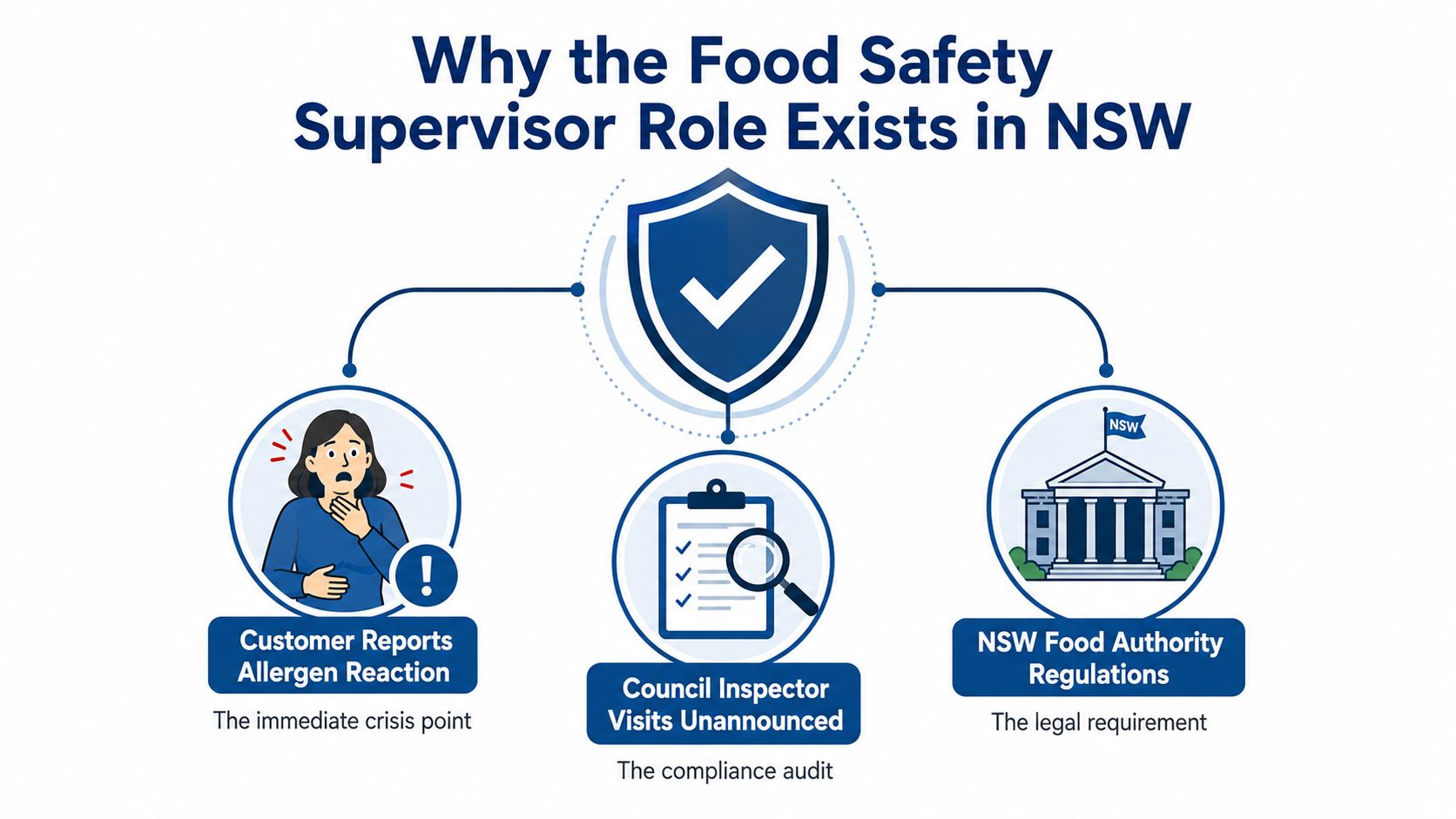
The Food Safety Supervisor role exists because food safety decisions happen in real time. A cook may reach for the wrong utensil, a ready-to-eat meal may share a surface with raw ingredients, or a staff member may overlook a cleaning step during a busy service. Someone must recognise the risk and give a clear direction before the mistake becomes an incident.
NSW formalised the role through the Food Amendment (Food Safety Supervisors) Act 2009. The legislation defined a supervisor as someone holding a certificate issued within the previous 5 years, who doesn't supervise another premises and has authority to oversee safe food handling at the business premises. Current NSW guidance requires certain hospitality and retail food service businesses to appoint at least one trained FSS per premises, with recertification every 5 years. NSW legislation sets out the legal foundation for the role.
The shift captain on the kitchen floor
Think of the FSS as a shift captain for food safety. They don't replace the chef, venue manager or business owner, but they make sure the team follows safe methods while food is being received, stored, prepared, cooked, cooled and served.
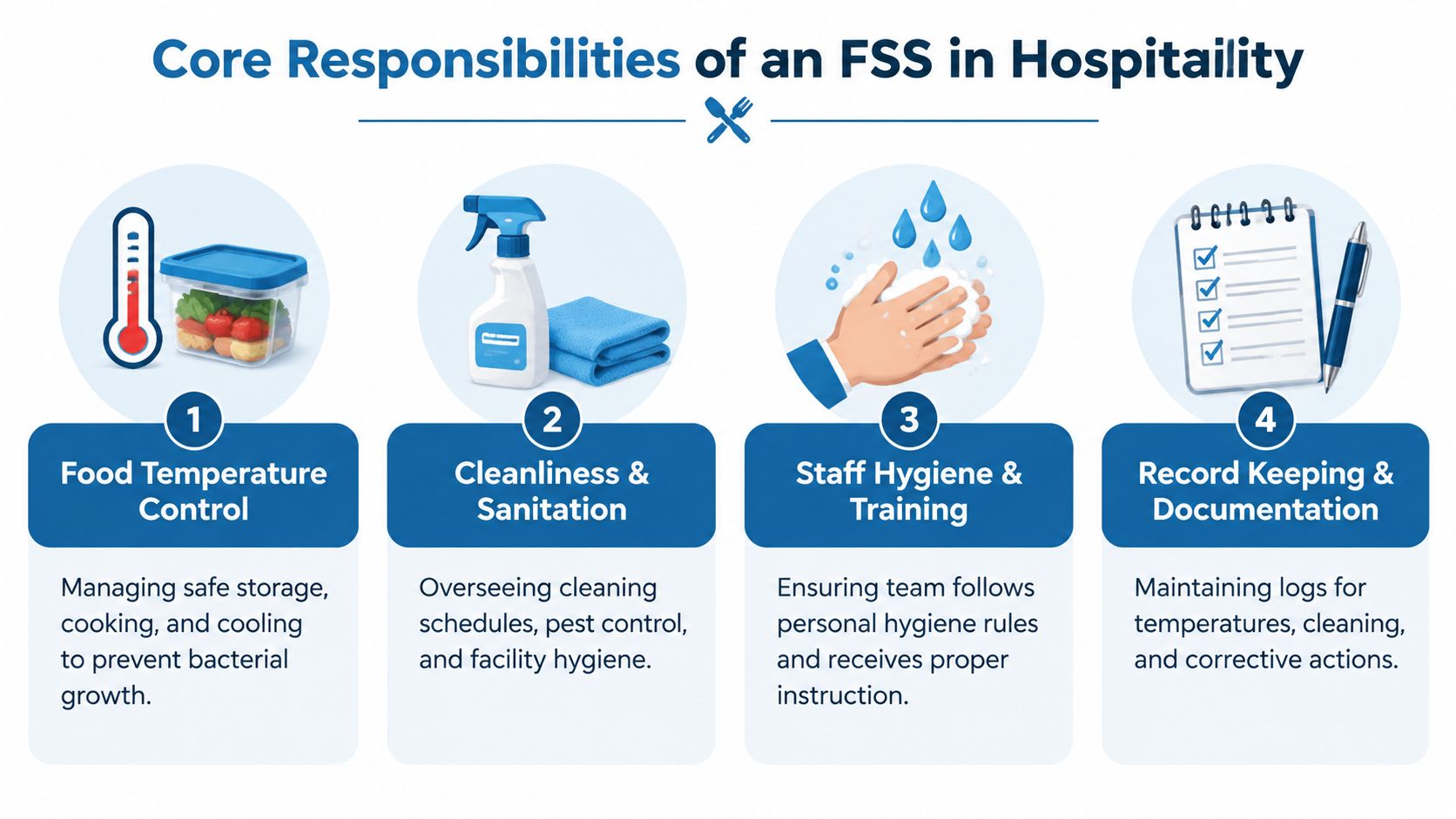
Their practical focus includes:
- Temperature control: Checking that food is handled and stored safely.
- Separation: Keeping raw and cooked or ready-to-eat foods apart.
- Allergen management: Preventing allergen cross-contact through ingredients, equipment and work surfaces.
- Corrective action: Stopping, isolating or correcting a process when something appears unsafe.
The same organised approach that helps a new venue prepare its operations can support food safety planning. A broader marketing and delivery launch plan can help owners think through staffing, suppliers and opening procedures, while food safety supervision keeps the kitchen's high-risk decisions under control. Managers should also avoid confusing food safety duties with other hospitality obligations, such as responsible alcohol service, which is covered separately in responsible service of alcohol guidance.
By the end of this guide, you'll be able to identify the legally responsible person, check whether your business has the required coverage, understand the supervisor's daily work and choose an approved training pathway.
The Legal Definition of a Food Safety Supervisor
What makes someone the legally responsible Food Safety Supervisor (FSS) in NSW? The answer rests on two connected requirements: a current certificate and the authority to direct safe food handling.
The national starting point is Food Standards Code Standard 3.2.2A. Category one and category two businesses must appoint a certified FSS before engaging in prescribed activities. The supervisor must be reasonably available to advise and supervise food handlers and must hold a certificate obtained within the past 5 years, as Food Standards Australia New Zealand explains in its national food safety supervisor requirement.
Legally, an FSS is a person who holds a food safety supervisor certificate issued within the immediately preceding 5 years, and who has the authority and ability to manage and give direction on safe food handling. A person may have extensive hospitality experience without holding the certificate or formal authority the role requires. In practical terms, the business needs someone who can make a food safety decision and direct staff when a risk appears.
NSW applies this framework through its own food safety programme. Certain hospitality and retail food service businesses must appoint at least one trained FSS for each premises. Training must be approved and delivered through a Registered Training Organisation, commonly known as an RTO. Managers can use the NSW food safety handlers certificate information to distinguish general food handler training from the supervisor pathway.
FSS Legal Framework at a Glance
| Requirement | National Standard 3.2.2A | NSW Specific Rule |
|---|---|---|
| Appointment | Category one and two businesses appoint a certified FSS before prescribed activities | Certain hospitality and retail food service businesses appoint at least one trained FSS per premises |
| Availability | The supervisor must be reasonably available to advise and supervise food handlers | The nominated supervisor must be able to oversee safe handling at the relevant premises |
| Certificate | Certificate issued within the past 5 years | Certificate remains current through recertification every 5 years |
| Authority | The person must have authority and ability to direct safe food handling | The supervisor must have practical authority at the business premises |
| Training | Certification comes through approved competency-based training | Approved RTO-delivered training supports NSW certification |
A certificate works like a licence with an expiry date. The business may still display the supervisor's name, but an expired document no longer supports compliance. NSW guidance also requires businesses to keep a copy of the certificate on the premises. During an inspection, the manager should be able to retrieve it promptly and show that the nominated person remains authorised to direct food safety work.
NSW learners may consider the Food Safety Supervisor Course FSS, which provides nationally recognised training with practical learning across NSW.
Core Responsibilities of an FSS in a Hospitality Business
An FSS owns decisions, not just paperwork. During a compliance walkthrough, I'd ask the supervisor to show how the business controls hazards, how staff learn those controls, which records prove the controls are working and what happens when a process fails.
Food handling and storage
The first responsibility is controlling food from delivery to service. The supervisor checks storage practices, monitors temperatures, separates raw products from ready-to-eat foods and manages allergens through clear handling procedures. Allergen control deserves direct attention because cross-contact can occur through shared utensils, benches, containers or preparation steps.
A supervisor also needs to notice when a procedure is technically written down but practically ignored. For example, a labelled container doesn't protect a customer if staff use the same utensil across ingredients or fail to clean a preparation surface between tasks. Practical kitchen contamination prevention strategies can help managers turn broad rules into visible work practices.
Training and supervision
The FSS gives new staff a safe starting point. They demonstrate handwashing, explain cleaning routines, reinforce separation between raw and ready-to-eat food, and correct unsafe behaviour while the work is happening. Short shift briefings can be more useful than relying on a long induction that staff forget during service.
Hospitality managers often combine food safety supervision with other skills development, such as barista training in Australia. The compliance principle remains the same. Staff need clear instruction, practical observation and timely correction.
Records and incident response
Records help the supervisor verify that procedures happened. Keep the current FSS certificate, cleaning records, temperature records and supplier traceability documents organised and accessible. When illness is reported or contamination is suspected, the supervisor should preserve relevant information, isolate affected food where appropriate, escalate internally and understand when the NSW Food Authority must be notified.
Practical rule: A record should help you reconstruct what happened, who checked it and what action followed.
The FSS's role isn't limited to hospitality. For readers working across regulated industries, TP Training also provides Prepare Work Zone Traffic Management Plan Course Pwz Red Card training, but that course addresses a different workplace responsibility and doesn't replace food safety supervision.
FSS Training Course Structure and Certification Process
A compliant training pathway has four connected parts. You need the right units, an approved provider, competency-based assessment and the correct certification process. Completing a general online food hygiene module doesn't automatically make someone an FSS.
Start with the required competency
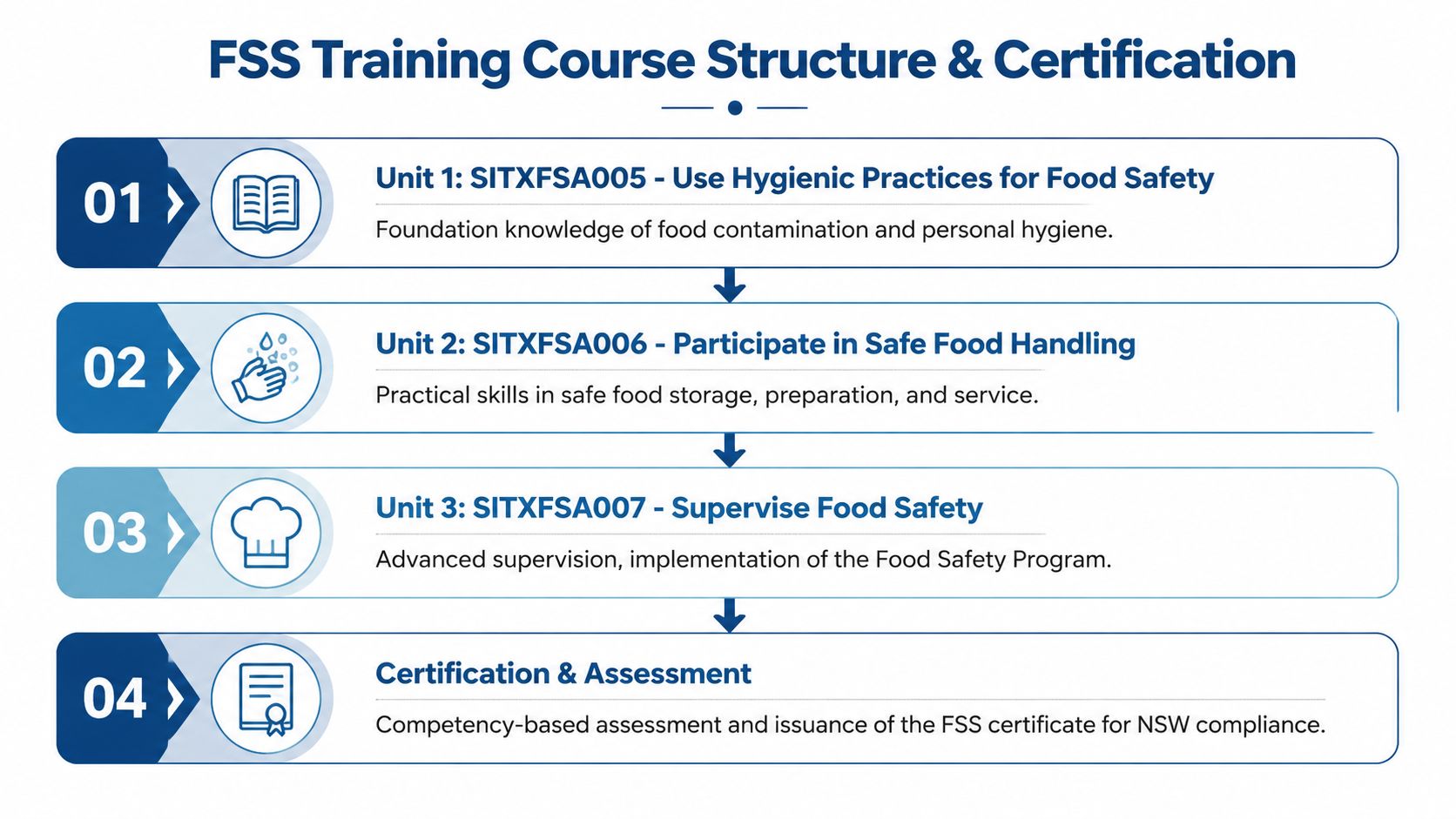
FSS training is tied to nationally recognised units delivered by an approved RTO. The course structure commonly draws on the SIT12 Training Package, including SITXFSA005, SITXFSA006 and, where higher-risk supervision skills apply, SITXFSA007. The units build from hygienic practice to safe food handling and then to supervision.
The learning may use face-to-face, online or blended delivery. Online theory can support knowledge development, but practical assessment still requires the learner to demonstrate the relevant skills. Managers should ask the provider how practical observation is completed before enrolling a staff member.
Check the provider before booking
Only an RTO approved to deliver the required units can issue nationally recognised training evidence. Authorities advise businesses and food handlers to verify the provider through the national training.gov.au RTO search and training information. This check protects the business from relying on a certificate that doesn't meet the relevant training requirements.
The learner should receive clear assessment instructions before the course begins. A written knowledge assessment checks understanding of contamination, hygiene, safe handling and supervisory duties. A practical observation checks whether the learner can apply safe procedures in a realistic work setting.
Complete assessment and keep the evidence
After successful assessment, the RTO issues a Statement of Attainment for the completed units. The NSW certification process then includes the required Food Authority notification and certificate arrangements. Keep the Statement of Attainment, certificate copy and notification evidence with the business compliance records.
A certificate remains valid for 5 years, after which recertification is mandatory under the NSW and national framework. The simple steps for creating and managing a Unique Student Identifier can help learners prepare their enrolment details, but it doesn't replace checking that the provider is approved.
How TP Training's Food Safety Supervisor Course Fits NSW Compliance
A useful course should match the legal requirement and the practical demands of a working hospitality venue. TP Training delivers the nationally recognised SITXFSA005 and SITXFSA006 units, which are mapped to the food safety supervision framework in Standard 3.2.2A. That gives a manager a clear way to compare the training content with the duties the nominated supervisor will perform.
The practical component matters. Hospitality managers attending Sydney training centres need to understand how the assessment will test workplace behaviour, not only written knowledge. A trainer should be available to explain the handling steps, answer questions and support the learner through the evidence required for assessment.
What an employer should retain
After training, organise a compliance file containing:
- Training evidence: The Statement of Attainment and FSS certificate.
- Current details: The supervisor's name, role and relevant business information.
- Renewal tracking: The certificate issue date and expiry date.
- Operational records: Food safety logs and procedures that show the supervisor's directions are being applied.
TP Training's course information describes practical, nationally recognised FSS training with experienced trainers and hands-on learning across NSW. The pathway is relevant when a new supervisor joins a café, club or aged-care kitchen, and when an existing supervisor approaches the 5-year recertification point. Employers can also review the broader RSA, RCG, Food Safety Supervisor and barista training information when planning several hospitality training needs, while keeping each qualification's legal purpose separate.
The important test is simple. Can the person direct safe food handling at the premises, and can the business prove that their training and certificate are current? If the answer to either question is unclear, the manager has a compliance task to resolve.
Common Mistakes Employers Make With FSS Compliance
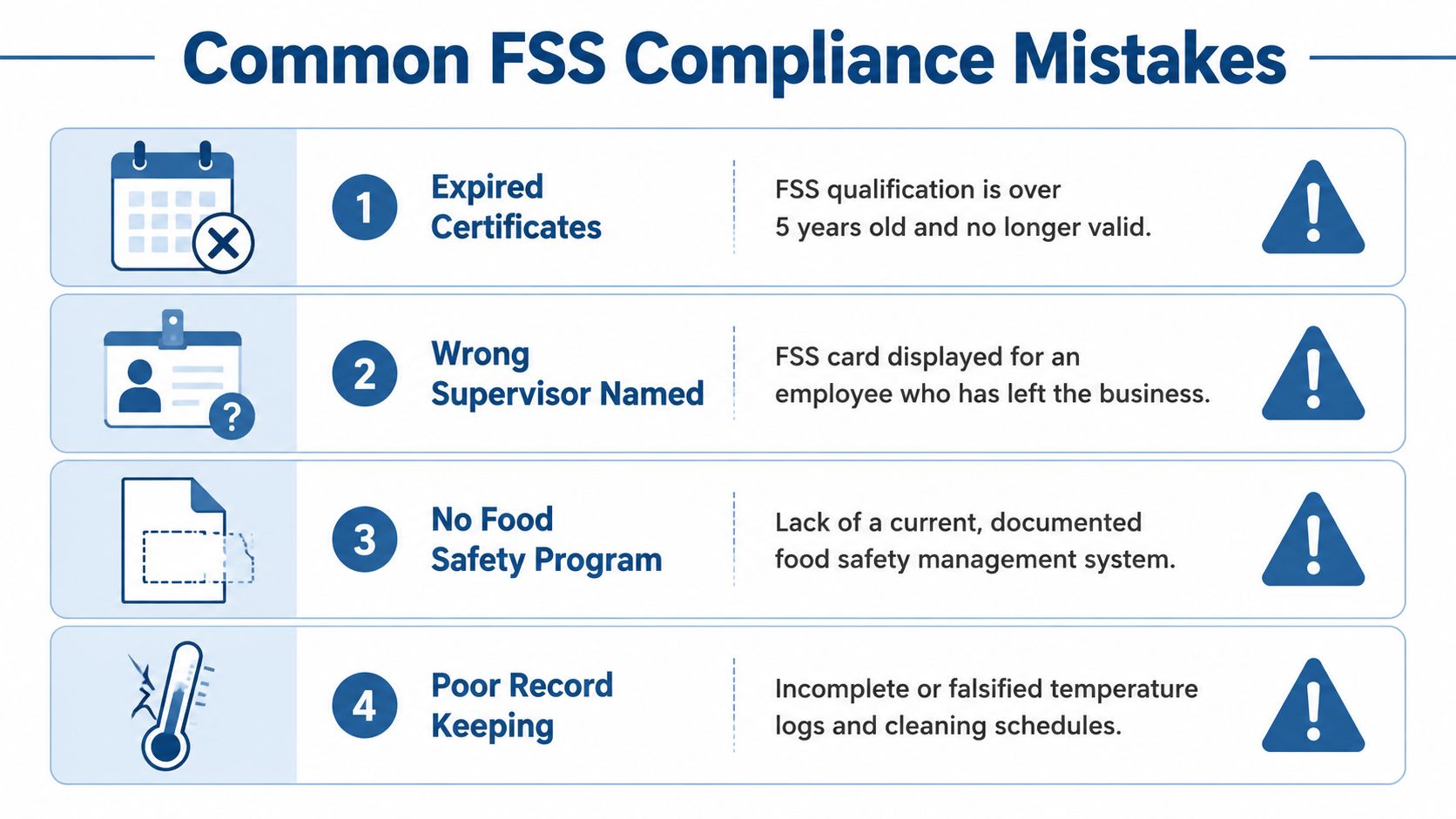
Could your business stop an allergen incident or answer a council officer's questions today? An FSS should not be treated as a name on a noticeboard. The role works more like the person holding the site's food safety map. They must be identifiable, available and able to direct staff when a risk appears.
Errors that appear during an audit
- Expired certificates: A certificate beyond its 5-year validity period cannot support the current nomination. Record the expiry date in the business calendar and arrange renewal before coverage is lost.
- The wrong person is displayed: If the named supervisor has left, the displayed certificate does not show that the current team has an authorised FSS. Update the nomination and remove obsolete documents.
- No coverage during absence: If the only supervisor is on leave, confirm who can oversee food handling during the relevant activities. A senior cook does not automatically become the FSS.
- Missing records: Incomplete temperature checks, cleaning schedules or corrective-action notes make it difficult to show that controls operate in practice. Keep records on-site and easy to retrieve.
- Confusing food handler training with FSS certification: A food handler may understand hygienic work without holding the separate certificate and authority required of an FSS. Check the actual Statement of Attainment and certificate, rather than accepting a general training claim.
Run a short self-audit
Stand in the kitchen and ask the supervisor to locate the current certificate, temperature records, cleaning schedule and process for handling an allergen concern. Then ask a staff member who they contact when an ingredient or handling step is uncertain.
The answers show whether the FSS arrangement works in practice. If everyone depends on one absent manager, coverage is weak. If records are blank, inconsistent or stored elsewhere, the business cannot verify that its controls are being followed. Correct these gaps before an inspector, customer complaint or suspected contamination event exposes them.
Employers managing several training needs may also encounter unrelated qualifications such as Cpccldg3001 Perform Dogging Licence Course And Training In Sydney. Keep those records separate from food safety documentation so staff and inspectors can identify the relevant evidence quickly. A clean file makes the FSS role visible, supports immediate action and helps show that the business is managing food safety rather than displaying a certificate.
Key Takeaways and Next Steps for Aspiring Supervisors
The answer to what is a food safety supervisor comes down to four anchors:
- A legally recognised person: The FSS is the nominated person with the authority and ability to direct safe food handling.
- Current training: Their certificate must have been issued within the previous 5 years, with renewal through an approved RTO when required.
- Practical availability: They must be reasonably available to advise and supervise food handlers during prescribed activities.
- Employer accountability: The business keeps the certificate copy and related records available, while maintaining accurate personnel and compliance details.
Use those anchors as a working checklist. First, confirm whether your premises has a nominated FSS. Next, check the certificate issue and expiry dates, verify that the person still works at the premises and confirm that the business can produce the certificate and food safety records.
If there's a gap, book the required units through an approved provider, complete the knowledge and practical assessments, retain the Statement of Attainment and follow the NSW Food Authority notification process. Don't wait for a certificate to expire in a drawer. Put the renewal date into the manager's compliance calendar and review coverage whenever staff responsibilities change.
For an NSW-specific pathway, a Sydney-based course can give a new supervisor practical guidance on the required units, assessment evidence and 5-year recertification cycle. The final decision should rest on provider approval, course scope and whether the training prepares the learner to direct safe food handling at the actual premises.
TP Training provides practical, nationally recognised Food Safety Supervisor training with experienced trainers and hands-on learning across NSW. Visit TP Training to review the NSW FSS pathway and take the next step towards current, documented food safety supervision.

You may also like

Safety & Health Policy: A Guide for Australian Employers

Asbestos Removal Requirements in NSW: The Complete Guide