Working at Heights Refresher Training: A Complete Guide
You're back on a site after a long break. The harness looks familiar, but the lanyard is different, the anchor point has moved, and the work area isn't set up quite as it was last time. A shortcut that once felt automatic can become a serious mistake when equipment, procedures, or site expectations have changed.
That's why working at heights refresher training matters. It isn't just a certificate check. It's a practical reset that helps you inspect equipment properly, make sound decisions around fall hazards, and perform the critical steps without waiting for someone to prompt you.
Table of Contents
- Why a Quick Refresher Matters More Than Most Workers Realise
- What Working at Heights Refresher Training Actually Covers
- Why the Two-Year Cycle Exists
- How Often You Should Renew and Who Sets the Rule
- Core Competencies and Practical Assessments on the Day
- Course Formats and How to Choose the Right One
- Booking and Preparing for Your Next Course with Confidence
- Putting It All Together for Safer and Longer Careers
Why a Quick Refresher Matters More Than Most Workers Realise
A returning worker may know the theory but still reach for an old habit. They might lean slightly beyond a safe position on a ladder, clip onto an unsuitable point, or adjust a harness as though it were the model used on their previous site. None of these actions necessarily feels dramatic in the moment. The danger is that small errors can combine quickly when someone is working on a roof, scaffold, working platform, or exposed edge.
Habits drift. Anchor points get replaced, fall-arrest equipment is updated, access routes change, and a principal contractor introduces a different exclusion-zone procedure. Even a worker who has always taken safety seriously can lose confidence in the finer details of inspection, connection, clearance, and rescue planning.
Rebuilding the response before it is needed
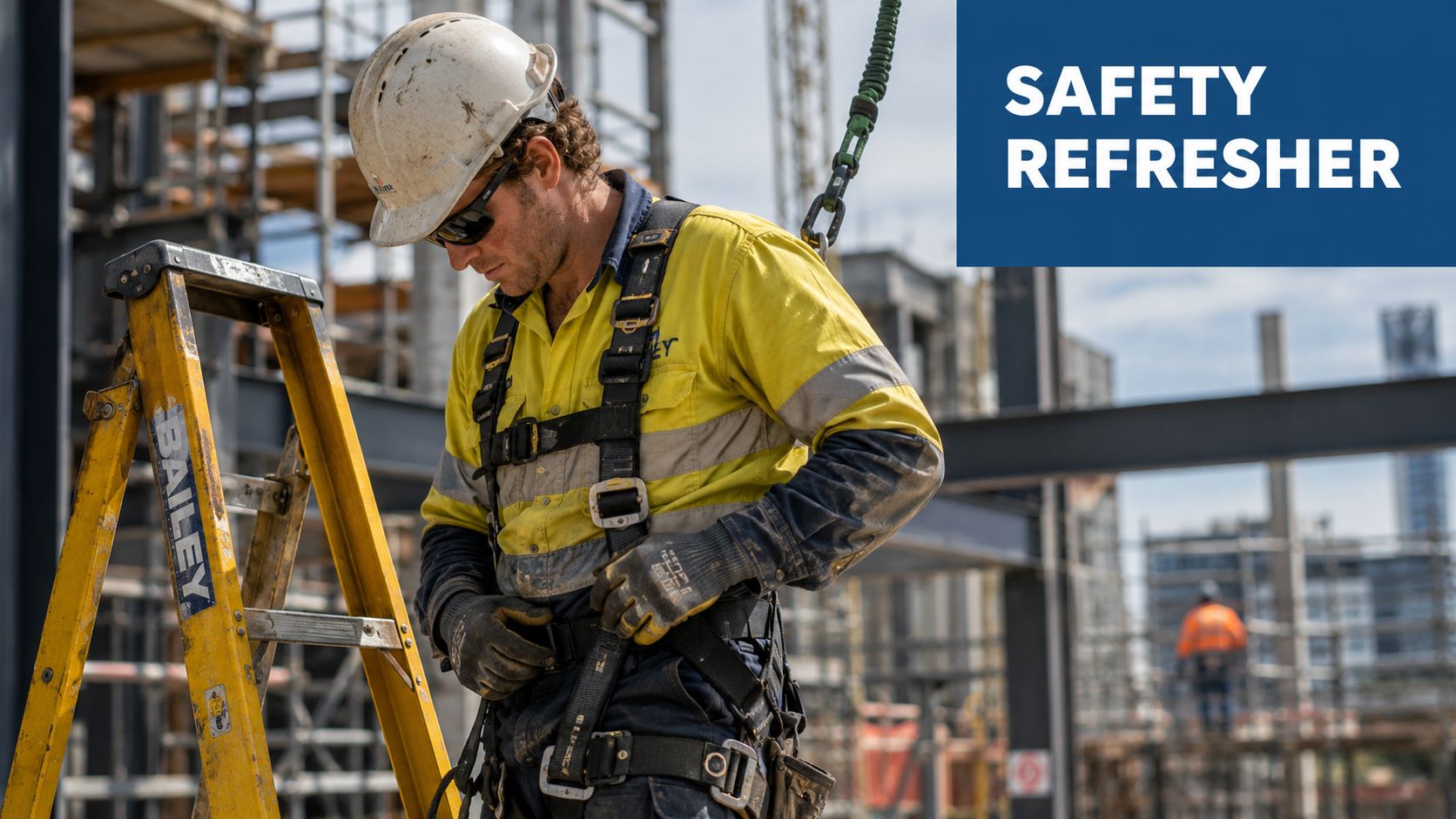
The practical value of a refresher is muscle-memory maintenance. A worker should be able to identify the hazard, choose the control, inspect the equipment, connect correctly, and communicate the rescue plan in the right order. Those actions need to remain dependable when the work is noisy, rushed, exposed to weather, or shared with other crews.
Safe Work Australia's national evidence shows why employers take this seriously. Falls from a height caused 29 worker fatalities in 2023, representing 15% of all worker fatalities that year, and the figure was 71% higher than the 17 deaths recorded in the previous year. These figures are reported in Safe Work Australia's national WHS statistics.
Practical rule: If you haven't performed a hands-on height-safety assessment for a while, don't rely on memory alone. Rehearse the complete process under assessment conditions.
A refresher gives the worker and assessor a controlled opportunity to find those weak points. The aim isn't to embarrass anyone or re-teach every basic concept from scratch. It's to restore reliable performance before a real task exposes a gap.
What Working at Heights Refresher Training Actually Covers
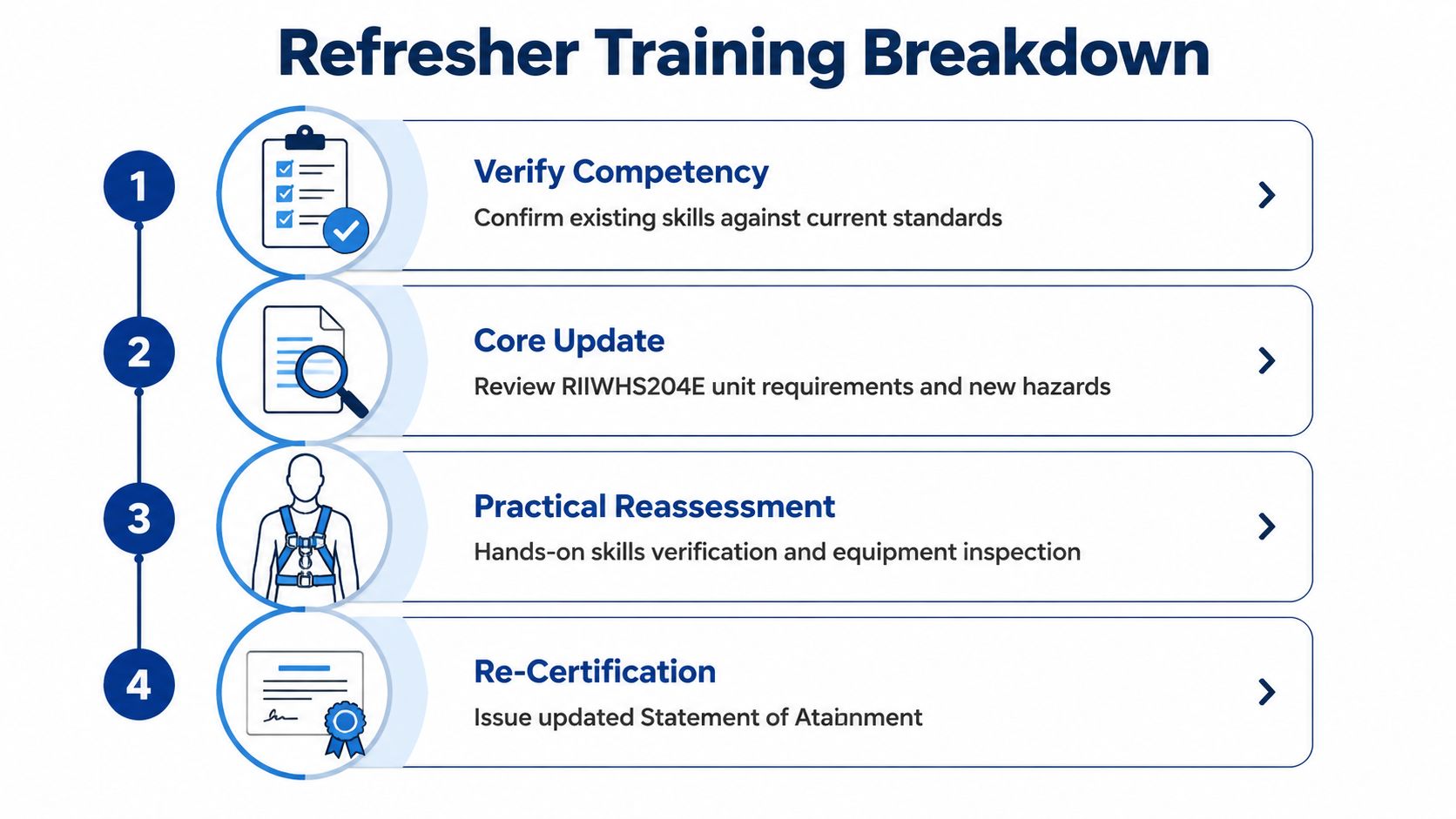
Working at heights refresher training is a targeted re-competency course for workers who have already completed height-safety training. In Australia, it's commonly built around RIIWHS204E Work safely at heights, the current unit listed by Training.gov.au, which was first released on 23 September 2020 and superseded RIIWHS204D.
A refresher assumes you've completed the original training. Rather than treating you as a first-time learner, it checks whether you can still apply the required controls in practice. The assessor will usually focus on the decisions and actions that protect you during a real job.
The main areas you'll revisit
Expect the course to connect theory with practical demonstrations. Typical areas include:
- Hazard identification: Recognise edges, penetrations, fragile surfaces, falling-object risks, weather exposure, access problems, and nearby plant or traffic.
- Equipment inspection: Check harnesses, lanyards, connectors, energy absorbers, and other fall-protection equipment for damage, wear, contamination, or missing information.
- Harness use: Put on a full-body harness, adjust it correctly, and confirm that the fit supports safe movement and connection.
- Anchor selection: Choose an appropriate anchor point for the planned system rather than clipping onto whatever is closest.
- Work-area controls: Establish exclusion zones and consider how people below, adjacent crews, tools, and materials could be affected.
- Rescue readiness: Explain how a fallen worker will be recovered and demonstrate the relevant response steps.
The course isn't a general site induction. It's focused on maintaining height-safety competency, with practical assessment at its centre. Successful completion is generally recorded through a Statement of Attainment for the relevant unit, subject to the training provider's assessment process.
Workers comparing practical, nationally recognised learning options can review Courses as part of their training planning. For related access and temporary-works skills, the basic scaffolding course in NSW and Sydney provides a separate training pathway and shouldn't be confused with height-safety refresher competency.
Why the Two-Year Cycle Exists
A worker clips on, climbs to the work area, and then discovers that a familiar step is harder to recall than expected. The two-year refresher cycle helps prevent that gap between having completed training and being able to perform safely under site conditions. It is an industry practice, not a universal expiry date written into the RIIWHS204E unit itself.
The cycle works like maintenance for muscle memory. Employers and training providers use it to check that workers can still apply the controls, equipment knowledge, and response skills required at height, rather than relying on an old certificate alone.
Falls remain a serious WHS concern. Safe Work Australia's analysis recorded 232 worker deaths across the eight years from 1 July 2003 to 30 June 2011, equal to 11% of all worker deaths in that period. It also recorded 29 deaths in 2010–11, at a rate of 0.25 fatalities per 100,000 workers. Across those years, the reported rate changed little, remaining around 0.8 to 0.9 serious claims per 1,000 employees in most years. These figures and the reporting period are set out in the Safe Work Australia WHS evidence base.
| Reporting Period | Worker Fatalities from Falls | Serious Injury Claims |
|---|---|---|
| 1 July 2003 to 30 June 2011 | 232 | Around 0.8 to 0.9 per 1,000 employees in most years |
| 2010–11 | 29 | 0.25 fatalities per 100,000 workers |
| 2023 | 29 | Not specified in the cited national summary |
Why sites and insurers care about currency
The reason for a current record is broader than a calendar reminder. Safe Work Australia's model WHS Regulations include duties and control measures for fall risks, including training workers to use and maintain fall-protection equipment. Its working at heights guidance from Safe Work Australia links that training to the employer's responsibility to manage the hazard.
A principal contractor may require recent evidence before granting site access. An employer may also set an earlier refresher after an incident, equipment change, or revised safe system of work. Insurers can review training records after an incident or during premium reviews, so an outdated record can cause an operational problem even when the unit has no statutory expiry.
The two-year point is therefore a competency-maintenance interval. It gives workers a regular opportunity to restore correct habits, check current controls, and demonstrate practical performance before those skills are tested during real work.
How Often You Should Renew and Who Sets the Rule
Australian WHS law doesn't set one universal expiry date for RIIWHS204E. Training.gov.au lists the unit as current, but the practical renewal expectation often comes from employers, principal contractors, site rules, insurers, and training-provider entry requirements.
Use the practical timeline
The common approach is straightforward:
- Refresh around every two years: This is the widely used industry cycle for working at heights re-assessment. It's intended to keep practical skills current.
- Check your evidence: Some providers accept previous height-safety evidence within a longer window, including evidence from the last five years, subject to their own eligibility rules. This doesn't mean every site will accept an older document.
- Renew earlier when circumstances change: A recent incident, extended time away from height work, new harness equipment, a different anchor system, or a revised site procedure can justify an earlier assessment.
Who has the final say
Safe Work Australia develops model WHS laws and guidance, while states and territories administer their own WHS systems. Your employer can set a stricter internal requirement, and a principal contractor can make recent evidence a condition of site access. A site's safe work method statement, permit process, or insurer condition may also require a particular training date or assessment record.
That's why two workers with the same unit may face different booking requirements. One site might accept an existing Statement of Attainment with an employer verification process. Another might require a practical refresher before the worker can enter a controlled height area.
The safest decision rule is simple: if two years have passed since your last practical assessment, or the equipment and work conditions have changed, book the next refresher and confirm the site's evidence requirements first. Guidance about certificate currency varies across safety disciplines, so workers should treat this explanation of first aid certificate duration as a separate issue, not as a rule for height-safety training.
Core Competencies and Practical Assessments on the Day
The assessor isn't looking for a memorised speech. They're watching whether you can plan and perform the work safely with minimal prompting. A typical assessment moves from the pre-task decision through to equipment use and emergency response.
You may start with the work area. Identify the fall hazards, consider the surface and access route, account for people below, and explain which control will prevent or minimise the risk. The assessor may then provide equipment for inspection, expecting you to use a checklist rather than rely on a quick visual glance.
| Competency | Practical Assessment Task |
|---|---|
| Pre-task hazard identification | Review a work scenario and identify edges, penetrations, fragile surfaces, access hazards, and falling-object risks |
| Fall-arrest equipment selection and inspection | Complete an equipment checklist for a harness, lanyard, connectors, and energy-absorbing components |
| Harness fitting and adjustment | Perform a harness fit check, including correct connection and adjustment |
| Anchor-point selection | Complete an anchor selection exercise based on the work position and planned system |
| Fall-clearance planning | Explain the clearance distance needed below the worker and identify possible impact hazards |
| Rescue response | Take part in a controlled descent or dynamic rescue scenario |
| Emergency management | Explain the response to a suspended worker, including suspension-trauma considerations |
What competent performance looks like
You should be able to select equipment that suits the task, identify defects, fit the harness securely, connect to the correct anchor, and explain how the system limits the consequences of a fall. Clearance calculations matter because a fall-arrest system needs adequate space to work without allowing the worker to strike the ground, a lower level, or another obstruction.
The rescue exercise tests more than technical handling. It checks whether you know who raises the alarm, how the site controls the area, how the worker is recovered, and what happens after suspension. The details must align with the equipment and procedure used in the training environment.
For a broader view of height-related work planning, the high-rise training guide 2026 offers useful context around specialised work at heights. It isn't a substitute for Australian RIIWHS204E assessment, but it can help workers understand why access methods, equipment selection, and rescue planning must match the task.
Workers using powered access equipment should also keep the distinction clear between height-safety competency and machine-specific training. An elevated work platform training resource relates to operating that equipment, while the refresher described here focuses on safe work at heights.
Course Formats and How to Choose the Right One
The right refresher format depends on your previous assessment, current duties, equipment, and what your employer or site will accept. Choose it like selecting a rescue system: match the arrangement to the work, not just the shortest available option.
| Format | Duration | Best Suited To | Practical Assessment |
|---|---|---|---|
| Full refresher | Typically one full day in person | Workers whose last assessment was more than two years ago, or whose duties and equipment have changed | Theory review plus hands-on re-assessment |
| Express refresher | Shorter in-person session | Workers with current evidence who need focused confirmation of competence | Practical re-assessment, equipment inspection, and targeted knowledge checks |
| Online theory plus in-person practical | Online theory followed by a practical session, often around half a day for the practical component | Shift workers, FIFO rosters, and regional workers managing travel | Must include an in-person practical assessment |
Match the format to the risk
A full refresher suits workers who are unsure about their previous assessment, have been away from height work, or have moved into a role with different anchor systems and rescue arrangements. The additional time lets the trainer examine decisions, not only watch a demonstration.
An express session may suit a worker whose Statement of Attainment is accepted by the provider and whose employer needs a current practical check. Confirm that it covers the equipment and systems used on your site before booking.
Online theory can reduce travel for shift workers, FIFO rosters, and regional crews. It does not replace hands-on assessment. A purely online course doesn't meet the practical assessment requirements associated with RIIWHS204E in Australia. Ask where the practical session occurs, which equipment is supplied, and what evidence you will receive.
A resource on operating an elevating work platform relates to machine-specific training. The refresher here focuses on safe work at heights, including the decisions and practical behaviours that must hold up on site.
If you are considering online delivery, read this guide to working at heights training online and confirm the arrangement with your employer before paying or committing to a date. A course that fits the roster but fails the site's evidence or practical requirements will not protect your ability to work.
Booking and Preparing for Your Next Course with Confidence
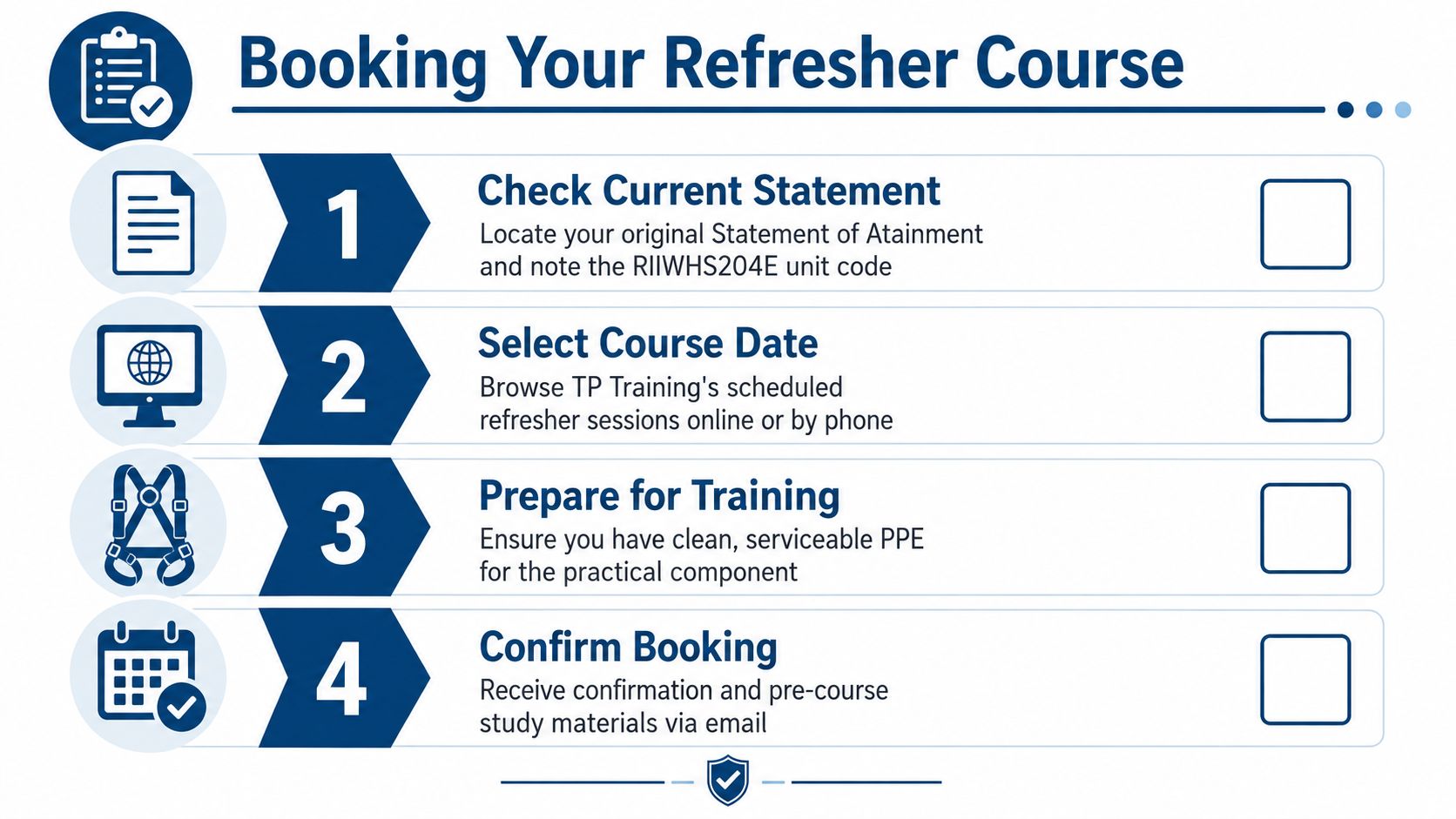
Start with your paperwork. Find your existing Statement of Attainment and confirm that it shows RIIWHS204E Work safely at heights, or the superseded RIIWHS204D where the provider and site accept it. If you can't find the document, ask the training provider or employer what evidence they'll require before enrolment.
TP Training runs refresher sessions weekly across Victorian and Queensland campuses, with on-site group bookings available for crews. Select a date through the online calendar, review the confirmation email, and read the pre-course SMS reminder so you know the arrival instructions and any preparation requirements.
Prepare the night before
Bring the items that let the trainer verify your identity and training history:
- Photo identification: Take the ID requested in your booking information.
- USI number: Have your Unique Student Identifier available for enrolment and reporting.
- Existing certificate: Bring your Statement of Attainment or other accepted evidence.
- Practical clothing: Wear closed-in boots and long pants suitable for harness work.
- Personal essentials: Pack water and arrive ready for physical movement and outdoor conditions.
TP Training supplies the practical PPE listed for its session, including a harness, hard hat, and lanyard. Don't assume every provider supplies identical equipment, so check the course confirmation if you prefer to use your own serviceable PPE.
Plan your travel before the day. Check the campus address, parking arrangements, public transport options, and the requested arrival time. A typical session may move from registration and theory review into equipment inspection, harness fitting, anchor selection, practical demonstrations, and assessment. Arriving early gives you time to settle in rather than beginning with avoidable pressure.
For help managing your student details, use these steps for creating and managing a USI.
Putting It All Together for Safer and Longer Careers
A height-safety refresher protects more than your site access. It helps preserve the practical habits that support your health, your income, and your ability to keep working safely as equipment and jobs change.
Three points matter most:
- Refresher training maintains muscle memory: You practise the actions that must be reliable under pressure, including inspection, fitting, connection, clearance planning, and rescue response.
- The two-year cycle is a practical benchmark: It's commonly used by Australian employers and providers, even though RIIWHS204E doesn't carry one universal statutory expiry date.
- The evidence must match the site: Your employer, principal contractor, regulator, insurer, and training provider may apply different conditions, so check before you arrive at the job.
Common questions from returning workers
What if my certificate is older than five years?
Don't assume you can enter a refresher course. Some providers use a five-year evidence window, but eligibility varies. Contact the provider and employer, explain your history, and ask whether you need to complete the full training pathway again.
Is the refresher valid nationally?
A Statement of Attainment for a nationally recognised unit is evidence of completion across Australia, but site acceptance still depends on current unit status, employer policy, state or territory requirements, and the principal contractor's rules.
Can I claim the cost through my employer or trade body?
Possibly, but that depends on your employment arrangement, workplace policy, membership terms, or funding conditions. Ask before booking and keep your invoice and completion evidence.
Does it count as CPD?
Some employers and professional organisations may recognise relevant safety training as continuing professional development. Confirm the rules of the organisation that records your CPD, because recognition isn't automatic.
Treat the refresher as a career control, not a compliance chore. A current assessment gives you stronger evidence of competence, helps you approach changing work conditions with confidence, and supports the people who rely on you to come home safely.
TP Training provides practical, nationally recognised training with experienced trainers and hands-on learning across NSW, including working at heights refresher options for workers maintaining current competency. Visit TP Training to review the available training pathways and arrange your next step before your site access or assessment currency becomes a problem.

You may also like
CPR Course Penrith: Book Your Training Today
Safety & Health Policy: A Guide for Australian Employers