

Construction Labourer Jobs: Duties and Pathways Explained
The construction industry employed about 1.37 million people in February 2026, and Jobs and Skills Australia records median weekly earnings of $1,600 across the sector (Jobs and Skills Australia construction industry overview). Those two numbers sit behind almost every labourer job ad you'll read this week, and they explain why the old advice of "get your White Card and you'll walk into work" no longer holds on its own.
Construction labouring is the front door to that industry. The work is physical, it's outdoors, and it runs on rosters that start before sunrise. The first decision you make isn't which employer to ring. It's which kind of labourer you're going to be, because the tickets differ by role and so does the ceiling on what you'll earn in five years.
The people who do well here don't treat the job as a holding pattern. They arrive with a card in hand, they know which part of a site they want to work on, and they use the first year to earn the licence that moves them off the shovel. The people who struggle usually did the opposite. No ticket, no reliable transport, and no plan for the wet weeks when outdoor work stops.
Table of Contents
- Construction Labourer Jobs at a Glance
- What a Construction Labourer Does Day to Day
- Requirements Employers Check Before Hiring
- Safety Expectations Employers Test For
- How Competitive Labourer Jobs Are Right Now
- Career Pathways From Labouring to Skilled Roles
- Confirm Your Training Before You Apply
Construction Labourer Jobs at a Glance
| Role | Typical duties | Usual entry requirement |
|---|---|---|
| General site labourer | Site clearing, carrying materials, cleaning up, supporting trades | White Card and site PPE |
| Building and plumbing labourer | Assisting bricklayers, plumbers and carpenters, formwork and scaffolding support | White Card and manual handling skills |
| Civil construction labourer | Earthworks, drainage, spotting for plant, roadworks support | White Card and traffic control Blue Card |
| Demolition and asbestos labourer | Dismantling structures, removing and disposing of materials, asbestos controls | White Card plus task-specific asbestos training |
That right-hand column is the part many readers skim past, and it's the part that matters. The role you pick sets the first ticket you need, and the first ticket sets which employers will even open your application.
How the roles differ on the ground
Civil construction work is outdoor and plant-heavy. You'll spend months on a road corridor or a subdivision, spotting for excavators, handling drainage pipe, and standing in weather that doesn't care about your roster. The work front moves constantly, so the site looks different every fortnight.
Building labouring is steadier. You'll support the same trades on the same site for months, which means you learn the sequence of a build properly, but it also means repetitive lifting and long stretches near scaffolds and formwork.
Demolition carries the strictest controls of the four. Before a wall comes down there's a survey, an exclusion zone, and dust suppression running. Asbestos removal sits inside that world and is treated as task-specific work, not general labouring.
Jobs and Skills Australia counts about 49,400 people employed nationally as Construction and Demolition Labourers, with 71.7% working full time against 64.2% across total Australian employment, and a median age of 34. New South Wales holds the largest share at 14,700 workers, or 29.7% of the occupation (Jobs and Skills Australia occupation profile).
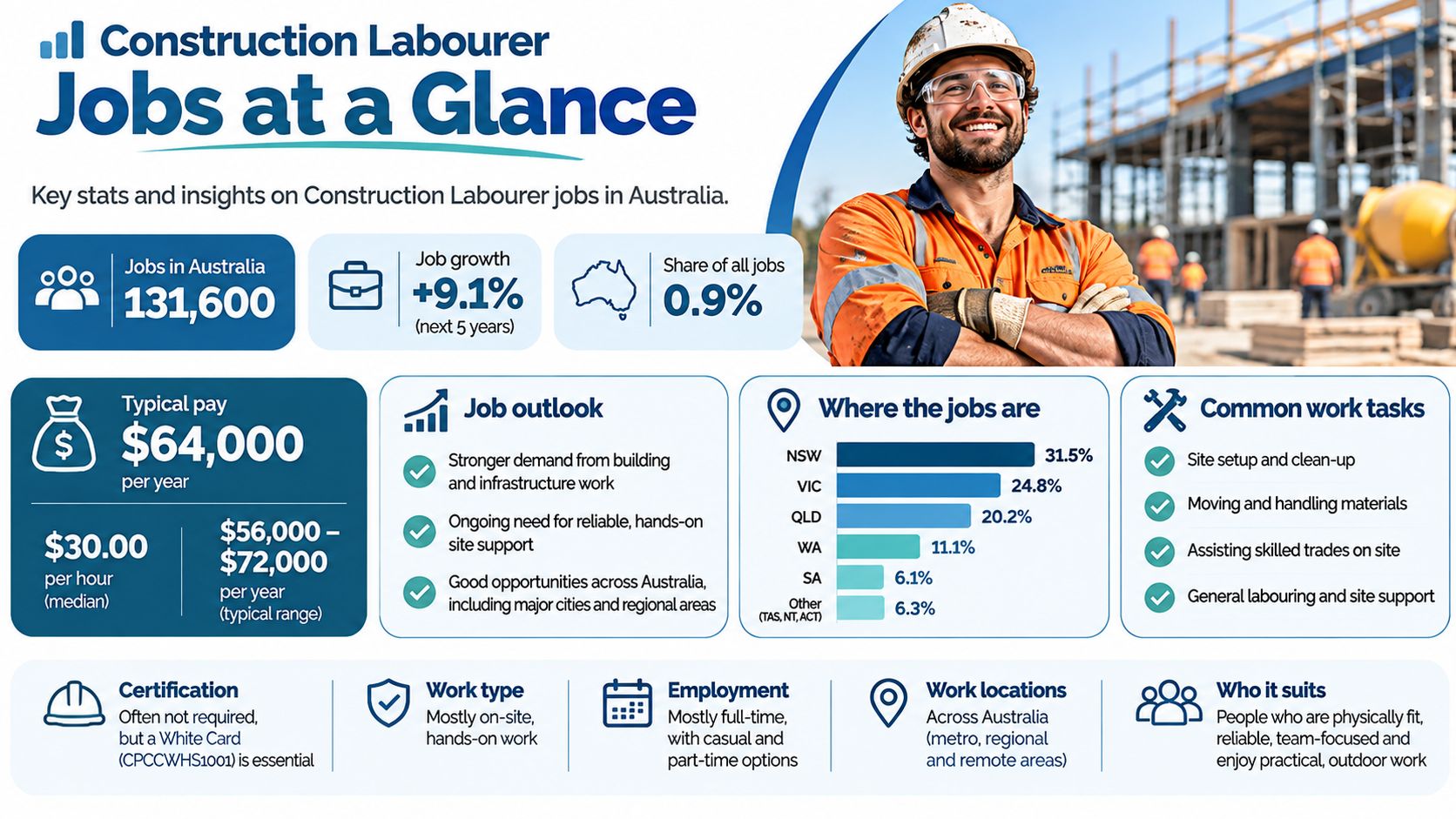
If you're still weighing which of these paths fits, hands-on construction careers for STARs on HiredBySkill lists trade and construction roles you can scan against your training options before you commit money to a course.
Three questions settle the choice faster than any careers quiz:
- Outdoors or on one site? Civil work suits people who like changing locations and machinery. Building work suits people who want a fixed site and a predictable crew.
- Can you carry a full-time physical roster? At 71.7% full time, this isn't a casual side gig. Ask yourself about your back, your knees and your sleep.
- Are you ready for the White Card first? Almost every path starts there, and nothing else you do counts until it's done.
What a Construction Labourer Does Day to Day
Think of a labourer as part of the pit crew. The trades are the ones in the spotlight, laying bricks or running conduit, and the labourer keeps everything they need arriving on time, in the right place, and safely. When the crew functions, nobody notices. When it doesn't, the whole site stalls.
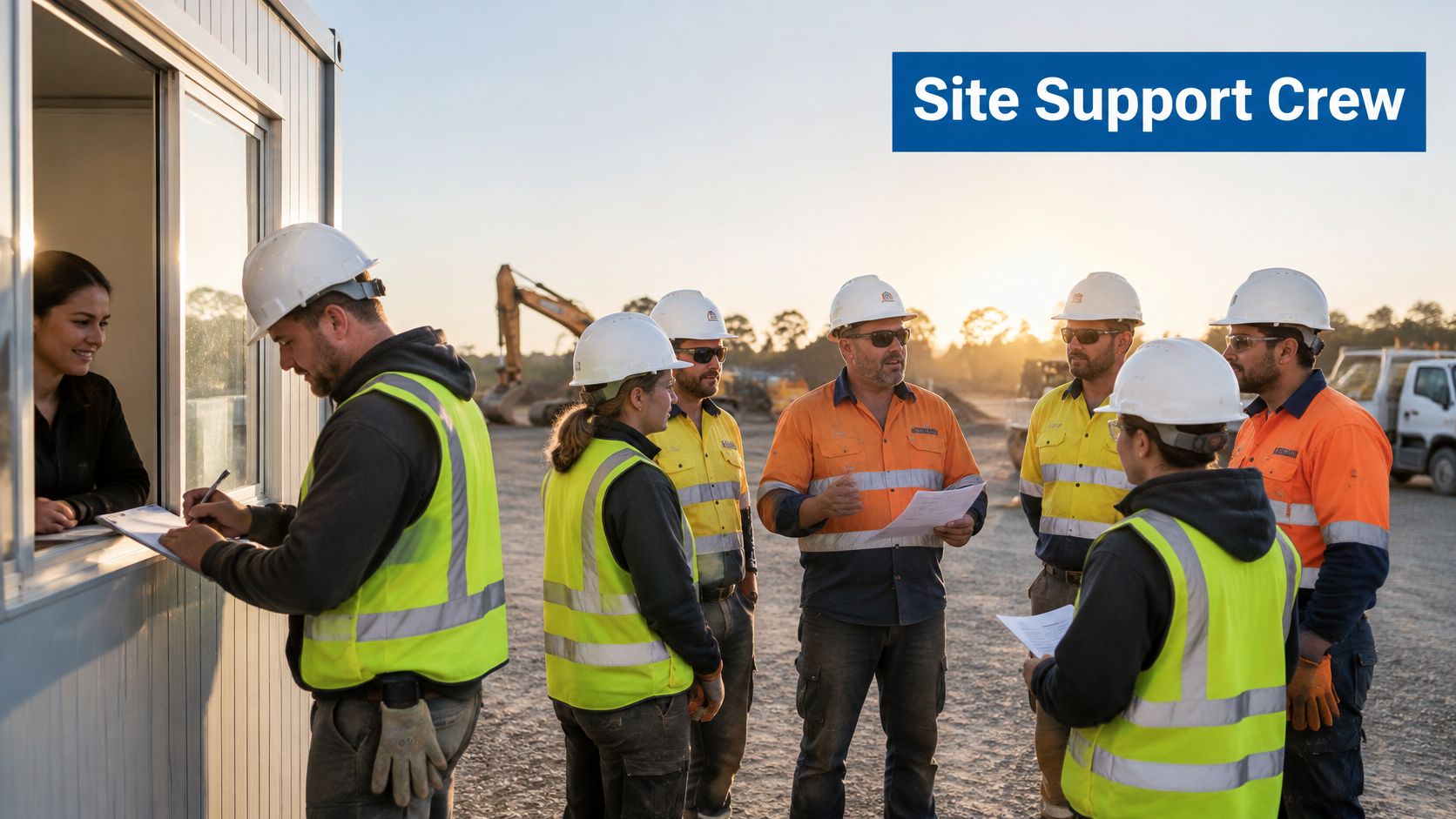
Your day starts before the tools come out. You sign in, get your induction checked if you're new, and stand in the toolbox talk where the supervisor runs through the day's hazards and who's working where. Then comes the pre-start check on plant and equipment, because nothing gets operated until someone has walked around it.
From sign-in to knock-off
- Arrival and sign-in. Card shown, site rules confirmed, and any visitor or subcontractor logged.
- Toolbox talk and pre-start. Hazards named, exclusion zones set, and the day's sequence agreed with the trades.
- Materials and site prep. Materials carried and stacked, concrete mixed and placed under trade direction, formwork and scaffolding support set up.
- Active support work. Spotting for excavators, helping demolition crews strip out a structure, or keeping the work area clear so people aren't tripping over offcuts.
- Clean-up and handover. The site is left safe for the next shift, and anything damaged or missing gets reported rather than ignored.
The tasks change as the work front moves, sometimes several times in a day. That means you'll take instructions from more than one supervisor and switch jobs without much warning.
Jobs and Skills Australia describes the occupation as operationally broad, covering site preparation, erecting and repairing structures, excavation, site clearing, demolition and possible asbestos removal, with construction as the main employing industry and men making up 96.0% of the workforce (Jobs and Skills Australia construction and demolition labourers).
What a good day looks like
The measure that counts: the crew finishes on programme, nobody is hurt, and the trades had what they needed the moment they needed it. That's a good day, not a dramatic one.
Asbestos removal and silica-generating tasks sit outside general labouring. They follow their own controls and their own competency requirements, which is why on-site safety fundamentals is worth reading before you accept a role that involves dust or demolition.
Requirements Employers Check Before Hiring
Four tickets come up again and again in NSW job ads, and each one opens a different door. Check them in this order.
- White Card (construction induction). This is the entry requirement for almost every construction site in the country. No card, no gate code, no exceptions.
- Traffic control Blue Card. Roadworks and civil sites need people who can direct vehicles and pedestrians legally. This is the ticket that gets a labourer onto a live corridor rather than a fenced compound.
- Forklift licence, TLILIC0003. Material yards and warehouses run on forklifts, and the licence is a two-day face-to-face course with a final assessment at most providers.
- EWP Yellow Card, RIIHAN301E. If you're working at height on an elevating work platform under 11 metres, this is the competency employers ask for, and it's usually a one-day course.
Not every site needs every ticket. A demolition crew won't care about your forklift licence, and a warehouse won't ask about traffic control. Match the ticket to the role, not the other way around.
The gear and the habits behind the tickets
Personal protective equipment is mandatory on construction and traffic management sites. At TP Training we provide it for our construction and traffic management courses, so you're not hunting for steel caps the night before.
Then there are the requirements nobody prints on a certificate. Physical fitness for lifting, carrying and repetitive work. Reliable transport to sites that start at 6am and sit in outer suburbs. A tolerance for heat, rain and dust. Willingness to submit to site drug and alcohol testing. And enough literacy to read signage, SWMS documents and written instructions without guessing.
The one that catches people out: transport. A lot of entry-level roles fall through because the applicant can't get to a site before the first light. Sort the vehicle or the carpool before you sort the ticket.
Employers are also screening for something less tangible. Jobs and Skills Australia reports that references to critical thinking and problem-solving in construction-trade job advertisements have more than tripled over the past decade, which reflects a workforce expected to interpret instructions, spot hazards and make practical calls as conditions change (Jobs and Skills Australia Jobs and Skills Report 2026).
Where dust and demolition are part of the work, the 10830Nat 11084Nat Crystalline Silica Exposure Prevention Asbestos Awareness Combo Courses cover both hazards in one nationally recognised program.
When you start applying, a clear one-page resume that names your tickets, your location and your availability will do more than a long list of duties. build a resume with ParakeetAI if you want a structure to work from before you send it out.
Safety Expectations Employers Test For
Construction is a comparatively high-risk place to earn a living. The industry accounted for 12% of serious work-related injury or illness claims in 2023–24 and recorded the second-highest incidence rate at 17.7 serious claims per 1,000 workers (Jobs and Skills Australia construction industry insights). That benchmark is why a supervisor will treat you as part of a risk control system from day one, not as a spare pair of hands.
The exposure comes from variety. A labourer moves between excavation, material handling, plant interaction, structural work and demolition, so the risk changes as the work front and the equipment change.
| Hazard | Control a labourer applies |
|---|---|
| Struck-by from mobile plant | Stay out of the swing zone, make eye contact with the operator, never walk behind a reversing machine |
| Trench and excavation collapse | Never enter an unsupported trench, and report any wall that looks like it's spalling |
| Manual handling injury | Use the lifting aids on site, share the load, and plan the carry before you start it |
| Silica dust from cutting and grinding | Wet-cut or use on-tool extraction, and wear the right respiratory protection fitted properly |
| Asbestos in demolition and site clearing | Stop work when unexpected material appears, and leave removal to trained, controlled crews |
| Falls from edges and scaffolds | Check the edge protection is in place before you work near it, and never remove a guard rail for access |
What to show an employer
You don't need years of experience to demonstrate that you understand risk. You need to be able to talk about it plainly.
- Exclusion zones. Explain why they exist and what happens when someone drifts into one.
- Hierarchy of controls. Show that you know eliminating a hazard beats relying on a mask or a pair of gloves.
- The limits of PPE. PPE is the last line of defence, not the first, and it fails when it's the wrong size or poorly maintained.
- Stop-work and reporting. Say clearly that you'd stop and report something unexpected rather than work around it.
If silica is likely to be part of your work, crystalline silica exposure prevention explains the practical controls in more detail. Supervisors notice the applicant who can describe a hazard and its control without prompting.
How Competitive Labourer Jobs Are Right Now
Construction work is still available, but getting hired depends more on the role and the tickets you bring. Employment across the broad Labourers group grew by just 0.2% over the year to 2025, while online vacancies for labourers fell 2.4% in the 12 months to December 2025, according to Jobs and Skills Australia's Australian Jobs 2026 report.
Labourer vacancies still made up around 6% of all online vacancies, as reported in the same Jobs and Skills Australia report. That is a substantial share, but it does not mean every applicant has an equal chance. Employers can compare people on relevant tickets, availability and readiness for the work.
Construction employment grew more than 30% over the decade to 2026, yet growth over the latest year was only 0.9%, according to Jobs and Skills Australia's Australian Jobs 2026 report. A growing industry can still have uneven hiring: some roles attract many applicants, while others require specific training.
Where a ticket still changes the answer
- General labouring: This is often the most crowded option. A White Card lets you meet the construction induction requirement, but it may not distinguish you from other applicants.
- Building and plumbing labouring: Reliability and safe manual handling matter. Experience working around trades can also help show you understand the pace and routines of a site.
- Civil construction: Traffic control training can suit work managing vehicles and pedestrians near roadworks. If you want to operate machinery, choose a plant course for the equipment named in the job ad.
- Plant operation: A relevant operator course is the next step towards applying for machine-specific roles. Check which machine the employer needs before choosing a ticket.
Choose the sub-market first, then match the training to the work: the White Card is the starting point for construction sites, while traffic control or plant training can prepare you for more specific duties. Compare the ticket requirements in job ads before enrolling. To practise explaining your experience and availability, try online mock interview practice.
A short course does not guarantee a job. It can, however, show an employer that you have prepared for the role and meet a stated requirement.
Career Pathways From Labouring to Skilled Roles
Victoria's workforce projections point to two possible steps beyond general labouring. Building and plumbing labourers have projected median annual earnings of $70,210, a 70.8% retention rate, and about 3,700 new workers expected between 2025 and 2028. For earthmoving plant operators, the projection is $77,412 in median annual earnings and 2,300 new workers (Victorian Government construction skills and workforce snapshot).
| Pathway | Typical role | Median annual earnings | Retention rate |
|---|---|---|---|
| Building and plumbing labourer | Supports trades on building and plumbing sites | $70,210 (Victoria projection; Victorian Government workforce snapshot) | 70.8% (Victoria projection) |
| Earthmoving plant operator | Runs excavators, loaders and rollers | $77,412 (Victoria projection) | Not published in the projection |
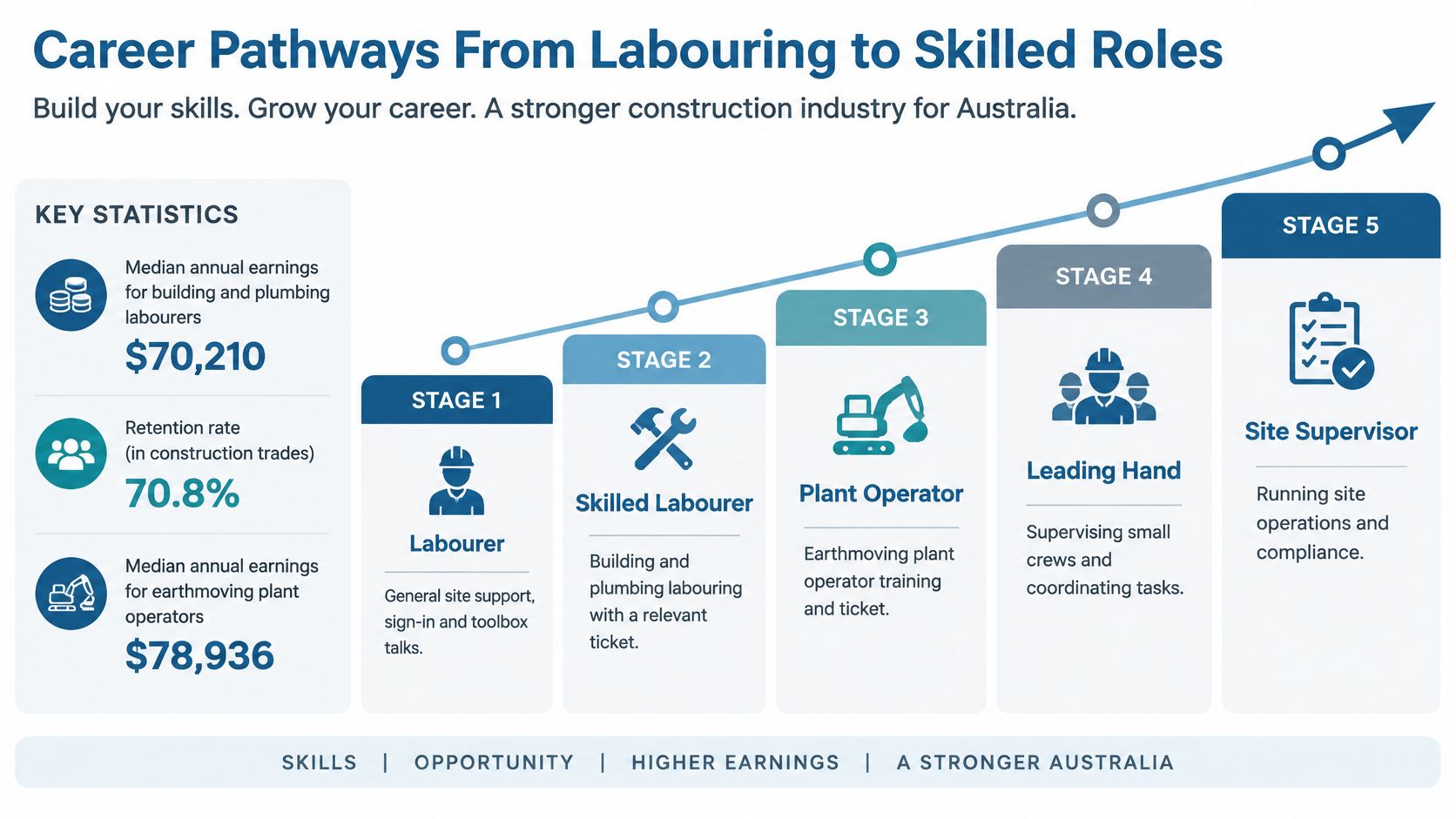
The retention figure means roughly three in ten people do not stay in building and plumbing labouring. Physical demands and project-based hiring can shape how long people remain in the role. A planned next step can help you choose which experience and training to build.
The progression, in order
First, build site experience and reliability. Turn up consistently, follow site rules and handle routine tasks carefully. Six to twelve months of steady general or building labouring can give you a foundation for applying to more specialised roles.
Second, match a ticket to the work you want. For civil construction, plant-operation training can prepare you for equipment roles such as excavator or loader operation. For work involving raised access, an EWP course may fit better. Choose the ticket by the job you are aiming for, rather than collecting qualifications without a target.
Third, move into plant operation or a trade apprenticeship. The work shifts from following instructions to taking responsibility for equipment, task quality and coordination with others. Plant operators also need to understand site plans and work safely without constant direction. Civil construction plant operations courses relate to the plant-operation pathway.
Fourth, work towards leading-hand or supervisor duties. These roles involve more than keeping production moving. They can include running inductions, checking safe work method statements, coordinating a small crew and completing site paperwork.
What the numbers don't promise
Median earnings are not starting wages. They describe the midpoint across workers at different stages, so a new entrant should not assume they will earn the median. The projections above are for Victoria, not NSW, and do not give an entry-level rate for either state. Compare hourly rates in current Sydney job ads before accepting a role.
Hiring also changes with the construction cycle. Construction vacancies fell 22% over the year to 2026 while remaining 23% above February 2020 levels. Those figures point to a changing market, so plan training around the role you want to build towards, not just the number of ads this quarter.
Confirm Your Training Before You Apply
Here's the decision, stated plainly. The White Card comes first for almost every construction role, and the second ticket depends entirely on the role you chose from the table at the start. Get the order wrong and you'll pay for a course that no employer in your target market asks about.
Before you enrol, verify three things.
- Read three current NSW job ads in your target sub-market. Write down every ticket they list. If two of the three ask for traffic control and none ask for a forklift licence, that's your answer for now.
- Confirm the provider is a registered training organisation. Construction courses, including the White Card, must be delivered by a registered provider listed on training.gov.au. Check the registration before you pay, and check the course code matches what the ads ask for.
- Compare length, location and packaging. A course you can't physically get to is a course you won't finish. Look at whether a combined package covers your first two tickets in one block.
One provider option, assessed against those tests
TP Training delivers short courses and fast qualifications across White Card, Traffic Control, First Aid and Civil Construction, running out of centres in Penrith, Burwood, Auburn, Parramatta and Sydney CBD. We're accredited by SafeWork NSW, and we offer combo packages that bundle courses such as Traffic Control and White Card, with discounted rates and packages available on contact. The White Card course runs seven hours and costs $95.

Work out which card you need before booking anything, because the White Card in NSW is only the first step in a longer sequence. The second ticket should be the one that appears most often in your shortlist of ads.
Your action for this week is narrow and specific. Enrol in the first course on your list, then apply for entry-level labouring roles that name that exact ticket in the ad. Not the ones that sound interesting. The ones where your certificate is already on the requirements list, so the only thing left to assess is you.
Construction work rewards people who arrive prepared, and TP Training runs the short courses that get you through the gate, from White Card and Traffic Control through to Civil Construction plant tickets at centres in Penrith, Burwood, Auburn, Parramatta and Sydney CBD. If you're ready to stop reading about construction labourer jobs and start applying for them, visit TP Training to check course dates and book the ticket your target role asks for.

You may also like

4 Construction Jobs Sydney Workers Can Start in 2026

10 Problem Solving Methods That Actually Work