CBD First Aid Courses in Sydney: Costs and Booking
Your first aid certificate says you're trained to manage an emergency. So what do you do when a worker on a Sydney CBD site tells you they took CBD oil an hour ago and they're due on a forklift?
That question falls into a gap. Standard first aid training covers bleeding, burns, CPR and anaphylaxis, and it does that well. It doesn't cover what to do when the substance involved is a cannabidiol product, a THC-containing medicine, or something sold as CBD that isn't.
The practical answer isn't a dressing or a dose. CBD first aid is a decision problem: is this person safe to keep working, do they need an ambulance, and who do you call if they don't? The guide below matches each Sydney CBD first aid course to a job and a risk level, then separates CBD-only products, THC-containing products and synthetic cannabinoids so you know exactly where the 000 threshold sits.
Table of Contents
- Which Sydney CBD First Aid Course Fits Your Job
- What the First Aid Session Covers Hands On
- What a First Aider Does
- Driving and Safety-Critical Work After CBD
- Who Needs This Training and How Employers Apply the Duty
- Certificate Recognition and Refresher Timing
- Costs, Pre-Study and Booking Steps
Which Sydney CBD First Aid Course Fits Your Job
Start with the job, not the certificate name. The table below answers the question people bring to a booking desk, and it takes about ten seconds to read.
| Course | Who it suits | Session length | Main coverage |
|---|---|---|---|
| Provide First Aid Course | Office, construction, warehouse and hospitality workers, and appointed first aiders | 1 day | Emergency response and first aid for common workplace injuries |
| Provide CPR Course | Staff who need resuscitation skills or a refresher between full courses | 4 hours | CPR technique and rescue breathing |
| Childcare First Aid Course | Early childhood and childcare staff | 1 day | First aid for infants and children |
Provide First Aid Course. One day, and the default choice for anyone whose name sits on the workplace first aider list. It runs the full sequence: scene safety, calling 000, airway and breathing checks, recovery position, CPR, choking, bleeding control, burns, anaphylaxis and handover to paramedics. Choose it if you may have to take charge before an ambulance arrives.
Provide CPR Course. Four hours, resuscitation only. It suits a worker who already holds a current first aid certificate and needs the CPR refresher, or a second person on a shift who only needs resuscitation skills. It doesn't cover bleeding control, burns or anaphylaxis, so it can't replace the full course for an appointed first aider.
Childcare First Aid Course. One day and built around infants and children, where compression depth, hand position and the approach to choking all differ from the adult version. Choose it if you work in early childhood education and care rather than a general workplace.
The Unit Codes on Your Certificate
Course outlines still circulate with HLTAID001 and HLTAID003. Both are superseded. The current national codes are HLTAID011 Provide First Aid, HLTAID009 Provide Cardiopulmonary Resuscitation and HLTAID012 Provide First Aid in an Education and Care Setting. Confirm the code with your trainer before you enrol, especially if an employer has written a unit code into a procedure.
Our instructors cover White Card, Traffic Control, RSA, RCG, Food Safety and First Aid training, so a city-centre booking can be worked around a shift roster. If your job is on a site rather than a floor, the guide to first aid training for construction workers explains how site hazards change the kit and the training mix.
What the First Aid Session Covers Hands On
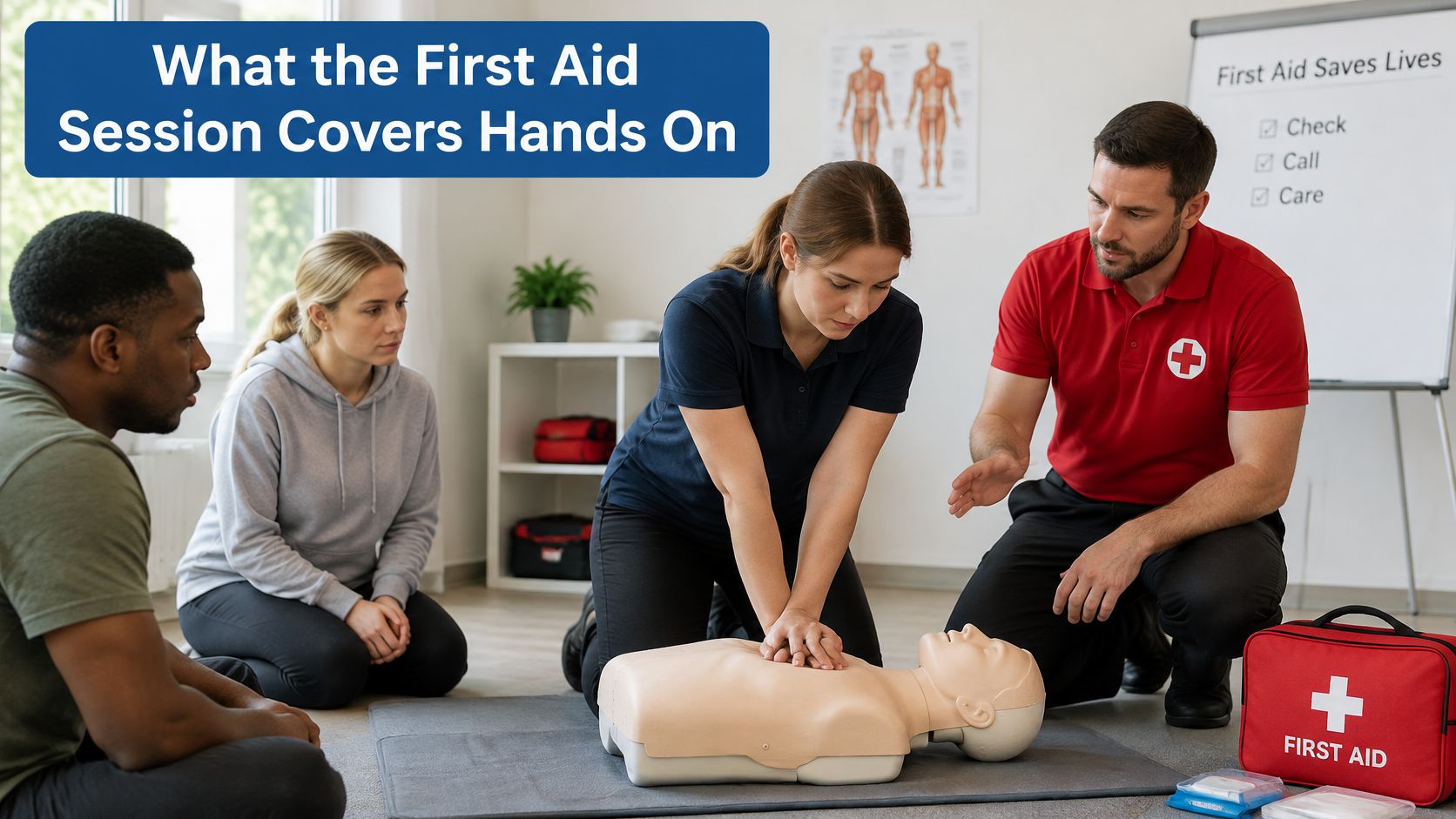
A course name tells you very little about what the day feels like. You'll spend most of it on the floor, not in a chair, and you'll repeat skills until the sequence stops requiring thought.
Here's the room you'll walk into.
The Skills in the Order You Meet Them
- Scene safety and calling 000. Before touching anyone, you check for traffic, live power, fumes and other casualties. Dispatch will ask for your location, what happened, how many people are hurt and what condition they're in.
- Responsiveness and breathing. Talk and squeeze the shoulders, then look, listen and feel for normal breathing for up to ten seconds.
- Recovery position for an unconscious casualty who is breathing, with monitoring that continues until paramedics take over.
- CPR on adults, children and infants, with compressions at 100 to 120 per minute, a depth of about one third of the chest, and a 30:2 ratio of compressions to breaths.
- Choking, handled differently for a coughing adult and a small child.
- Bleeding control with gloves, direct pressure and a pressure dressing, then checking for seepage rather than lifting the dressing to look.
- Burns cooled under running water for at least 20 minutes, with clothing and jewellery removed before swelling starts.
- Anaphylaxis recognition and assistance with a prescribed adrenaline auto-injector.
- Staying with the casualty and giving paramedics a clear handover.
One Scenario That Ties It Together
Say a labourer opens his forearm on a steel edge at a loading dock. The first aider gloves up, applies direct pressure with a sterile pad, sends a second worker for the kit and the register, and keeps the arm raised above the heart. Pressure holds, so there's no 000 call, but the wound needs stitches, so transport is arranged.
Back in the room, the incident gets written up: time, mechanism, first aid given, who was notified. That record is part of the skill, and trainers mark it like any other step.
A certificate proves you attended. The explanation you give out loud, step by step, is what proves you can act.
By the end of the day you'll have performed every skill under a trainer's eyes and justified the order you did them in. A refresher on CPR training face shields is worth reading before your next session if you've ever hesitated over barrier use.
What a First Aider Does
Nothing in a first aid response changes because CBD is involved. CBD is not a first-aid treatment for injuries, burns, bleeding, poisoning, cardiac arrest or anaphylaxis, and it never displaces the steps that do work: scene safety, calling 000, airway and breathing, CPR and AED, haemorrhage control, cooling a burn, and adrenaline for anaphylaxis.
The 000 threshold comes first, before any product detail. Call an ambulance for unconsciousness, breathing difficulty, seizures, chest pain, an irregular heartbeat, hallucinations, paranoia, or behaviour that suggests a drug reaction.
Then work out which situation you're in. The Alcohol and Drug Foundation's cannabidiol fact sheet records no CBD-overdose deaths, while synthetic-cannabinoid overdose can be fatal. Those are different emergencies with the same label on the bottle.
| Situation | First-aid response |
|---|---|
| Unconscious and not breathing normally, or cardiac arrest | Start CPR, use an AED where indicated and call 000 immediately |
| Unconscious but breathing, product unknown | Call 000, place in the recovery position and keep monitoring breathing |
| Seizure, chest pain, irregular heartbeat or breathing difficulty | Call 000 and follow the dispatcher's instructions |
| Suspected synthetic cannabinoid with hallucinations or paranoia | Call 000 and keep the person away from workplace hazards |
| Drowsy, confused or dizzy after CBD but breathing normally | Stop driving and safety-critical work, supervise, call the Poisons Information Centre and escalate if worse |
| Suspected CBD ingestion with no symptoms | Record the product and amount, then call the Poisons Information Centre for advice |
For suspected ingestion that doesn't meet the 000 threshold, the Poisons Information Centre gives free advice 24 hours a day, seven days a week from anywhere in Australia. In NSW the number is 131 126. Have the packaging, the estimated amount, the time and the symptoms ready.
Never force anything into someone's mouth and never induce vomiting. Medicinal cannabis is prescribed by a doctor through defined access arrangements, so a first aider records and reports, and doesn't advise anyone to stop or adjust a prescribed treatment. Anaphylaxis and asthma presentations are worth revising through asthma and anaphylaxis training.
Driving and Safety-Critical Work After CBD
"Can I work or drive after CBD?" is a supervision question before it's a medical one. CBD can cause drowsiness and fatigue, and medicinal cannabis guidance advises patients not to drive or operate machinery during treatment. Many Australian products also contain THC, and drug-driving rules differ between states and territories, so a CBD-only label isn't a guarantee.
A worker can feel completely normal and still be unsuitable for a forklift, a raised work platform, a crane or a traffic-control position.
Practical rule: if someone reports CBD use and can't be cleared for a safety-critical task, the task gets reassigned. Not debated on the spot.
- Move them away from the hazard if it can be done safely: off the plant, out of the traffic lane, away from the edge.
- Keep them supervised. Don't send a drowsy worker to sit alone in a crib room.
- Arrange transport that doesn't involve their own driving, whether that's a colleague, a taxi or public transport.
- Call 000 if symptoms worsen, and record what you observed rather than what you assumed.
Mixing alcohol with any drug increases crash risk, and the depressant effects show up as slowed reactions and sleepiness rather than obvious intoxication. For fleets running trucks or vans, the fleet guide to CBD compliance covers the policy side of the same question.
Who Needs This Training and How Employers Apply the Duty
The groups who end up in a first aid course are broader than many expect. Very few of them are there because they want to be a paramedic.
- Office workers in CBD buildings, who are often the closest person to a colleague who collapses in a lift lobby or a meeting room.
- Construction and civil crews, where the hazards are moving plant, sharp edges, heat and height.
- Warehouse and logistics staff, who deal with forklifts, pallets, manual handling and loading docks.
- Hospitality teams, facing burns, scalds, slips and knife injuries in a fast, hot environment.
- Career changers and job seekers, who need a recognised certificate before an employer will put them on a roster.
Work health and safety duties don't name a number of first aiders. They require the business to provide first-aid equipment, facilities and trained people based on a risk assessment of its own hazards. That's why the answer changes from one site to the next.
Two Workplaces, Two Different Answers
A ten-person accounting office in the Sydney CBD has low-risk tasks, a lift, a kitchen and a defibrillator in the lobby. A small number of appointed first aiders is a defensible answer, supported by a kit and a clear route to 000.
A forty-person civil crew working beside live traffic is a different problem. The risk assessment needs trained people on every shift, coverage for each work area, and a plan that assumes the nearest ambulance is minutes away, not seconds.
The Crew That Made the Decision Easy
Picture a twelve-person roadworks crew near a Sydney CBD intersection, plus three office staff who handle the paperwork. The traffic exposure drives the decision: injuries here are likely to involve vehicles, and the first aider may be working in a live lane.
Two or three crew members go to the one-day first aid course and become the appointed first aiders. The rest take the four-hour CPR refresher so every shift has resuscitation skills on hand. The office staff learn where the kit lives and who to call, which is a briefing, not a certificate.
Book early, and track each person's expiry date on a shared calendar rather than a folder nobody opens. If some of your crew work alone even briefly, the lone worker safety policy checklist is worth working through before you settle on numbers per shift.
What the Certificate Doesn't Cover
A certificate alone doesn't meet the duty. The business also needs a stocked first aid kit checked against the site hazards, a written response plan, an unobstructed route for paramedics and a record of every incident. Our guide to first aid training in the workplace goes through how those pieces fit together.
Self-check: if you're appointed to respond to injuries, or your risk assessment names first aid as a control, the course is likely required rather than optional.
Certificate Recognition and Refresher Timing
These are nationally recognised courses, so a certificate from a registered training provider is accepted across Australian workplaces, not just in the suburb where you studied. For first aid courses, we issue a temporary certificate immediately, which means a worker can start on site while the formal document is processed.
That matters most when a job offer lands before the paperwork does. The temporary certificate is evidence of completion, and most employers accept it while the full certificate arrives.
| Course | Typical validity |
|---|---|
| Provide First Aid Course | 3 years |
| Provide CPR Course | 12 months |
| Childcare First Aid Course | 3 years |
Confirm the validity period and certificate type with your trainer for each course, because some employer policies ask for a shorter cycle than the standard one.
The Sixty-Day Habit
Record the expiry date on the worker's file the day the certificate arrives, and book the refresher about sixty days before it lapses. That buffer absorbs a full course, a sick day and a roster change without ever leaving someone on site with an expired certificate.
Childcare services and some high-risk sites often ask for current CPR alongside first aid, so check your employer's requirement before choosing. If you're unsure when your CPR falls due, this explainer on how often CPR should be refreshed sets out the timing.
Costs, Pre-Study and Booking Steps
Budget before you commit. The three courses differ in both fee and time off the roster.
| Course | Cost (AUD) | Pre-study required |
|---|---|---|
| Provide First Aid Course | $90 | Yes, sent after enrolment |
| Provide CPR Course | $75 | Confirm with trainer |
| Childcare First Aid Course | $120 | Confirm with trainer |
The Provide First Aid Course runs one day and costs $90, with pre-study sent after enrolment. The Provide CPR Course runs four hours and costs $75, and the Childcare First Aid Course runs one day and costs $120. Confirm the pre-study requirement and current fee with the team before you pay.
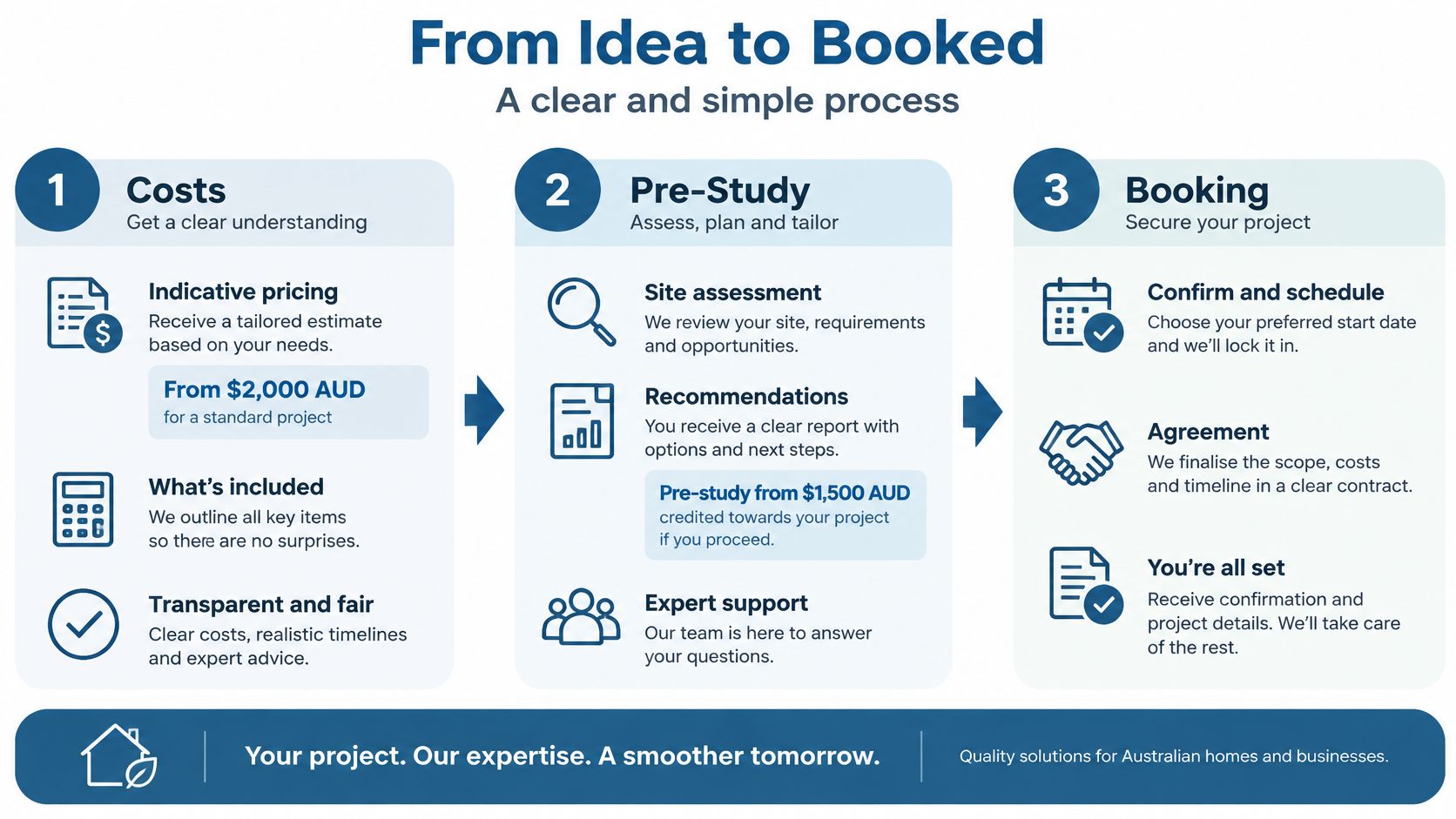
Seven Steps from Choosing to Booked
- Match the course to the role using the comparison table at the top of this guide.
- Open the course calendar and pick a Sydney CBD date that suits your roster. Calendars are also published for our traffic cards, White Card, dangerous goods driver licence, food safety, RSA and RCG courses, so you can stack several tickets into one block of leave.
- Enrol and check your inbox for course materials and pre-study modules.
- Complete the pre-study before the course day. First Aid, Security Officer Training and Food Safety all require it, and materials are sent after enrolment. The in-person session assumes you've done the reading.
- Bring photo identification and any documents listed in your confirmation email.
- Attend the session and complete the practical assessment, which is where the skills get signed off.
- Collect your temporary certificate on the day, then file the expiry date where someone will see it.
Session times can shift between intakes, so ask the team if a time you want isn't showing. And if you're still deciding between the one-day course and the four-hour refresher, describe the role and the hazards. It's cheaper than paying for a course that doesn't match the job.
TP Training runs first aid, CPR and childcare first aid courses from our Sydney CBD, Penrith, Burwood, Auburn and Parramatta centres, taught by trainers who work through the same emergency sequence you'll rely on at work. If you want to compare dates, session lengths and fees before committing, visit TP Training and pick the course that matches your role and risk level. Bring your roster and your questions, and we'll help you book the right one the first time.

You may also like
MSMWHS217 Gas Test Atmospheres: A Practical Guide
What Is Friable Asbestos? Risks, Examples and Rules