Traffic Control Responsibilities in NSW Explained
NSW traffic control responsibilities are three separate authorised functions: directing traffic, implementing a traffic control plan, and preparing or inspecting that plan. The person holding the STOP/SLOW bat is only one part of the safety system.
At first light on a Sydney arterial, drivers may see one controller at the roadside, bat raised, while traffic queues past a work crew. But that safe gap depends on more than the controller's signals. A suitable plan must guide the setup, the signs and barriers must be in place, and someone must keep checking that the arrangement still fits conditions.
Traffic control is safety-critical during road closures or partial closures for construction, maintenance, roadside works, public events and emergency responses. A practical way to understand the job is to follow the work zone from setup to pack-down, then separate the controller's authority from the duties held by the planner, implementer and supervisor. If you're also learning how to check a site before work begins, this workplace inspection checklist offers a useful companion.
Table of Contents
- What Traffic Control Responsibilities Actually Cover
- Three NSW Roles and the Card That Matches Each
- Live Shift Tasks From Pre Start to Pack Down
- Signage Communication and PPE on the Work Zone
- Who Must Act When the Setup Is Unsafe
- Choose the Card That Matches the Duty
What Traffic Control Responsibilities Actually Cover
At a roadworks site, the controller's visible task is to direct road users. The wider role includes setting up, managing and removing temporary traffic-control schemes and signs; directing vehicle and pedestrian movements; operating traffic-control devices; communicating by radio; conducting site checks; and monitoring traffic behaviour and flow. The Jobs and Skills Australia occupation profile for road traffic controllers describes those functions as part of an established Australian occupation.
The work continues for as long as the disruption does. A controller follows instructions from authorised crew leaders, supervisors, managers, inspectors or officials, watches how road users respond, and reports changes that could make the arrangement unsafe. When the work finishes, the temporary controls must be removed safely too. A controller shouldn't assume the job is over just because the queue has cleared.
That distinction matters because a person can be exposed to danger before the first vehicle is stopped and again during pack-down. A sign facing the wrong way, a barrier gap, or a poor view of approaching traffic can undermine the control point. For a broader look at how harm can arise on active sites, this construction site injury case provides useful context.
The National Road Safety Strategy's workplace road-safety guidance reports that, in 2018, vehicle collisions accounted for 44 of the 144 reported work-related fatalities nationally, with another 45 involving vehicles in another way. The guidance also frames traffic safety as a shared responsibility between workers and employers. That's why the controller's role must be understood as part of a coordinated system, not a substitute for planning, supervision or suitable controls.
Three NSW Roles and the Card That Matches Each
| Role | Common card | Authorised duty | Must not do |
|---|---|---|---|
| Traffic Controller (TCR) | Blue Card | Direct traffic under an approved work zone traffic management plan | Design, vary or informally rewrite the plan |
| Implement Traffic Control Plans (IMP) | Yellow Card | Install and maintain the approved measures beside the workplace | Treat sign placement as optional or redesign speeds and layouts |
| Prepare Work Zone Traffic Management Plan (PWZ) | Red Card | Design, amend or inspect the plan | Leave crews to invent controls when conditions change |
The SafeWork NSW traffic-control training-card guidance separates the work into competency-defined functions. The table's card names are common shorthand; the important point is that each authority covers a different duty.
Think of the roles as a sequence. The PWZ practitioner considers site hazards and traffic conditions and documents the controls. The IMP worker puts the approved arrangement in place and maintains it near the work. The TCR applies the approved instructions at road level. Each role depends on the others, but one worker shouldn't casually take over another role's decisions.
For example, a Blue Card holder may notice that an advance sign appears out of place. That observation matters, but it doesn't make the controller the person authorised to redesign the layout. The controller should report the mismatch so the responsible implementer or manager can address it under the appropriate authority. Likewise, a long queue isn't permission for an implementer to rewrite speed controls on the spot.
Plans need to work for the people expected to use them. Safe Work Australia's workplace traffic-management guide says plans should be developed by a competent person, tested on site by both their preparers and implementers, and made available to workers. In NSW, appointment to direct traffic is tied to the work site and its purpose, not a general power over the road.
If your duties may include both setting up a scheme and directing traffic, understand the difference before accepting a roster. This traffic management plan course information can help clarify how plan-related training connects to field responsibilities. For a different kind of workplace protection, readers comparing site roles may also find this overview of security training for protecting commercial properties useful.
Live Shift Tasks From Pre Start to Pack Down
Before a vehicle is stopped, the implementer and controller need a shared understanding of the approved arrangement. The implementer checks the scheme on the ground, including whether advance signs face the right way, barriers run as planned, the control point has adequate sight distance, and plant is parked in the approved area. The controller reads the same scheme, checks the radio channel with the other controller and crew leader, and confirms the required PPE.
Those checks give the crew a chance to identify a mismatch before workers or road users are exposed. The Transport for NSW guide to traffic control at work sites describes duties such as checking signs against the traffic guidance scheme, operating a two-way radio, maintaining incident reports and responding to changing traffic, weather, road and worksite conditions.
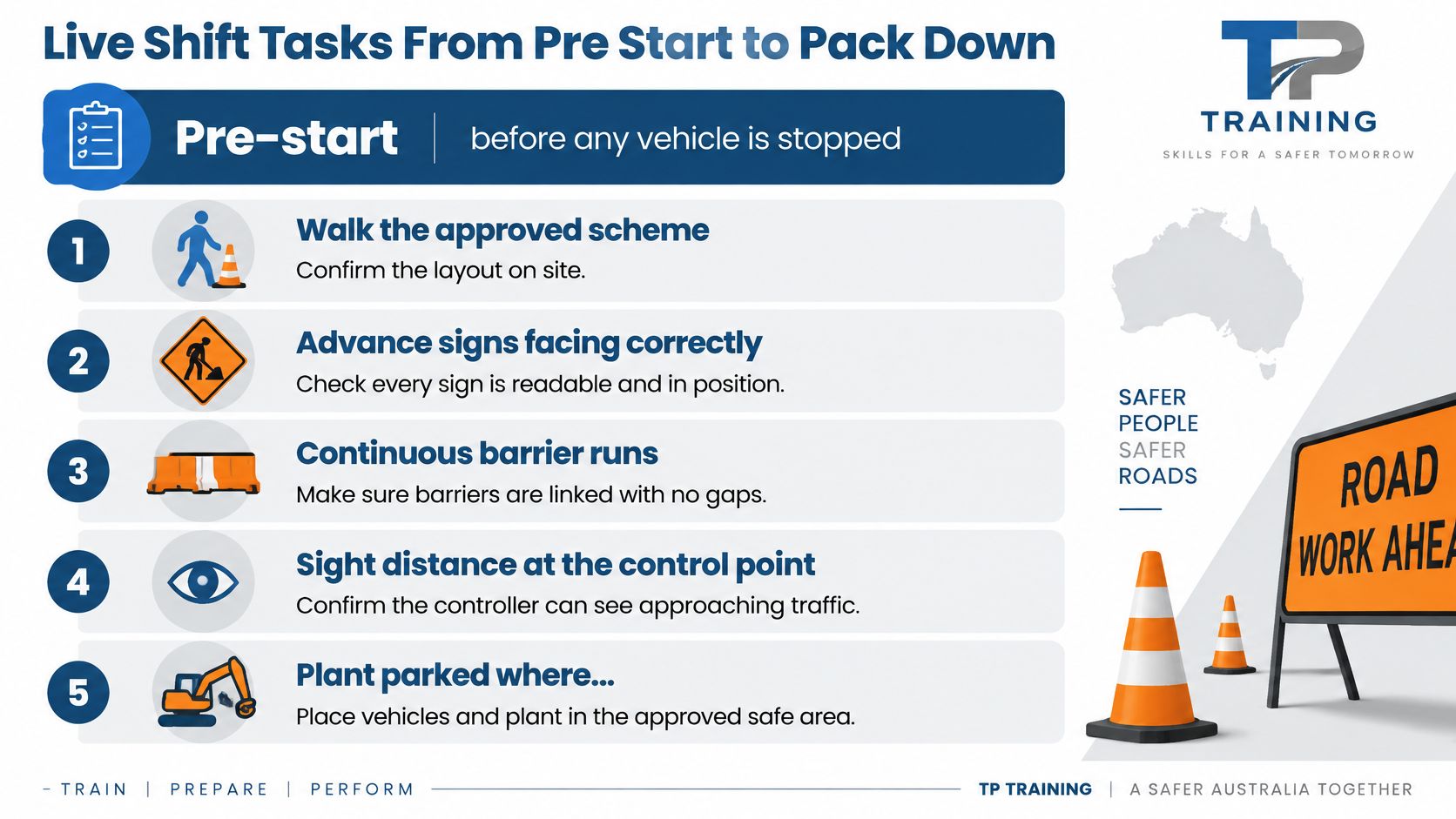
Five checks during active control
Confirm the scheme and your position. Before stopping the first vehicle, check that you're at the control point shown in the approved arrangement. Your position needs to support clear signals and the sight line required to respond to approaching traffic.
Direct people within the approved layout. Use the STOP/SLOW bat or another accepted device as the scheme requires. If pedestrians need to pass the work area, guide them through the designated route rather than creating a new one.
Call out changing conditions. A school-time rush may lengthen a queue during suburban resurfacing. Tell the other controller and crew leader over the radio; don't shift the stop point or change the layout on your own.
Record problems and incidents. Report a near miss, unsafe condition or incident through the site's process. Distraction, speeding and abuse toward controllers are examples of issues to communicate, not reasons to abandon clear radio procedures.
Keep watching after traffic moves. A queue clearing doesn't mean the hazard has passed. Drivers may accelerate, or plant may move across the work area. Continue monitoring until the risk has changed safely.
A lunchtime shower provides another practical example. If rain reduces visibility, the controller reports the change. The Traffic Manager compares actual conditions with the plan and decides whether an authorised adjustment is suitable or whether work needs to pause. The controller doesn't invent a new layout to compensate.
For examples of how arrangements can vary across work sites, see these traffic management examples. Use them to build understanding, but follow the approved scheme for the actual site rather than copying a layout from elsewhere.
Pack-down deserves deliberate attention too. The crew removes protection in the planned sequence, and the controller stays at the control point while lanes are still shared by workers and moving traffic. Pass observations and near misses to the supervisor so the site has a record of what changed and how the team responded. Controllers help maintain separation between people and vehicles, but they don't replace the employer's responsibility to identify hazards and provide suitable controls.
Signage Communication and PPE on the Work Zone
Signs, radios and PPE each support a different part of safe work. A controller's job is to check what's happening against the approved arrangement, communicate clearly and remain visible in the position the plan permits.
Signs show the approved arrangement
Check signs against the traffic guidance scheme, including advance warnings, the control point and any named pedestrian or side-street provisions. A missing sign or one turned away from approaching traffic needs to be reported so the implementer can correct it. Moving it without notice may create a new mismatch with the plan. This guide to traffic management signs can help readers recognise the signs used around work zones.
Radios keep the crew coordinated
Use the site's agreed radio channel and plain, direct language. Tell the other controller or crew leader what has changed, where it's happening and what requires attention. Then give road users instructions that match the control device and approved scheme. If congestion, an incident or an unsafe condition occurs, make the required report rather than relying on shouted instructions near live traffic.
PPE supports visibility and safe movement
Wear the required site PPE throughout the shift, including setup checks and pack-down. High-visibility clothing helps road users and the crew see the controller, while closed-toe shoes and other required equipment support safe movement around the work area. Don't use visibility gear as a substitute for a safe position, suitable barriers or the right layout.
At TP Training, PPE is mandatory and provided for Construction and Traffic Management courses. Students attending Traffic Control courses must bring appropriate identification worth 100 points and be prepared to wear hi-vis clothing and closed-toe shoes. TP Training also provides the necessary Traffic Control equipment for practical training.
If you're learning to recognise the devices and equipment used on site, this resource to compare traffic control products offers examples of the broader traffic-safety category. Product familiarity doesn't replace the need to follow the approved scheme or the relevant road-authority requirements.
Who Must Act When the Setup Is Unsafe
Drivers often see the controller first, so the person holding the bat may be blamed when a work zone is unsafe. But a dangerous setup can start earlier, with inadequate barriers, incorrect speed controls, poor sight distance or a plan that doesn't suit the site. SafeWork NSW's 2026 fatality notice about a traffic controller struck by a vehicle reinforces the need for work systems to account for drivers who speed or fail to stop, and to eliminate the need for workers to stand in live traffic where reasonably practicable.
| What is wrong | Who must fix it | Controller's limit |
|---|---|---|
| Signs, barriers or sight distance don't match the approved plan | Implementer, with the site supervisor | Stop directing into the hazard, report by radio, and don't move devices ad hoc |
| The plan is defective for the stage or road | PWZ practitioner amends or inspects; Traffic Manager authorises the change | Follow the last approved instruction or stand down; don't redesign |
| Drivers speed or fail to stop | Traffic Manager can stop work; barriers and layout must anticipate non-compliance | Don't remain in live traffic where a barrier or different control is reasonably practicable |
| Queue, weather or plant movement makes the scheme unsafe | Controller reports; Traffic Manager compares conditions with the plan and updates or stops work | Assess and call it; don't invent a new speed or layout |
Stop, report and keep within your authority
SafeWork NSW distinguishes between implementing a traffic-control plan, implementing or monitoring traffic-management measures, and preparing a plan. Its fatality notice also makes clear that a controller shouldn't be treated as solely responsible for a work zone made unsafe by a defective plan or poorly installed controls.
If the setup appears unsafe, don't continue directing people into the hazard. Report what you can identify over the radio, follow the site's escalation process, and move out of an exposed position if that's necessary to protect yourself. Record the concern and the action taken. Calling out a hazard isn't the same as redesigning the work zone.
The Traffic Manager's assurance role continues after setup. Responsibilities include arranging inspections, maintaining approved measures, checking for congestion and risks to people using or working near the road, updating the plan when conditions or work staging change, and keeping qualification records current. The manager also needs authority to stop work where continuing could cause a traffic incident or breach a road-authority direction. Transport for NSW's technical requirements state that a traffic-management plan is required for temporary traffic management, so site decisions should stay traceable to a risk-assessed plan.
A supervisor and principal contractor also have a role in the system of work. For a clearer view of employer duties around workplace safety, see this guide to the responsibilities of employers. The practical rule for a controller is simple: identify the problem, communicate it, document it and stay within the authority of your role.
Choose the Card That Matches the Duty
Choose training by the work you'll perform, not by the name colleagues use for a card. If you'll direct road users under an approved plan, the Traffic Controller pathway is the relevant starting point. If your duties include putting the approved measures in place and maintaining them, you need the Implementer pathway. Plan design, amendments and inspections sit on the separate PWZ pathway.
| Pathway and card | Course length | Listed price |
|---|---|---|
| Traffic Controller, Blue Card | 1 day | $282 |
| Traffic Management Implementer, Yellow Card | 1 day | $360 |
| Blue and Yellow combined | 2 days | $450 |
| Prepare Work Zone Traffic Management Plan, Red Card | 3 days | Not stated |
The prices and durations for the Blue Card, Yellow Card and combined course are listed by TP Training. The Red Card pathway is listed as a 3-day course; a price isn't stated here. Don't assume that a Blue Card alone authorises you to install a scheme, or that experience directing traffic qualifies you to rewrite a plan.
TP Training provides practical, nationally recognised Traffic Controller Course Blue Card training with experienced trainers and hands-on learning across NSW. For Traffic Control courses, bring appropriate identification worth 100 points and be ready to wear hi-vis clothing and closed-toe shoes. PPE for Construction and Traffic Management courses is provided by TP Training.
If your roster only requires you to direct traffic, choose the controller pathway. If you're expected to direct traffic and implement plans, the combined option matches both duties. If you're responsible for preparing, amending or inspecting plans, choose the Red Card pathway. Before starting work, confirm that the card authority matches the tasks you've been assigned.
TP Training offers practical Traffic Control training across the Blue, Yellow and Red Card pathways, helping learners connect site tasks with the authority each role requires. Visit TP Training to explore the course options and choose training that matches the work you'll be doing.

You may also like
Most Dangerous Jobs in Australia: 10 High-Risk Roles

RSA Training Online in NSW That Employers Accept