Owner Builder Online Course: Your Complete NSW Guide
If your NSW residential building work exceeds A$10,000, you generally need an owner-builder permit, and work valued above A$20,000 also requires approved owner-builder education or equivalent qualifications and experience. The online course matters only when it fits your eligibility, white card, ownership, permit and insurance requirements.
You're probably looking at renovation quotes, adding up labour and materials, and wondering whether managing the project yourself will give you more control. That decision shouldn't start with a course checkout page. It should start with the NSW compliance chain, because completing training doesn't automatically authorise construction, replace approvals or remove your responsibilities on site.
The practical question is simple: will this particular course produce the evidence NSW expects, and are you ready to apply for the permit afterwards? Treat the course as the middle of the process, not the finish line.
Table of Contents
- Why the Owner Builder Online Course Matters in NSW
- Checking If You Qualify Before You Enrol
- The Five Units of Competency NSW Expects
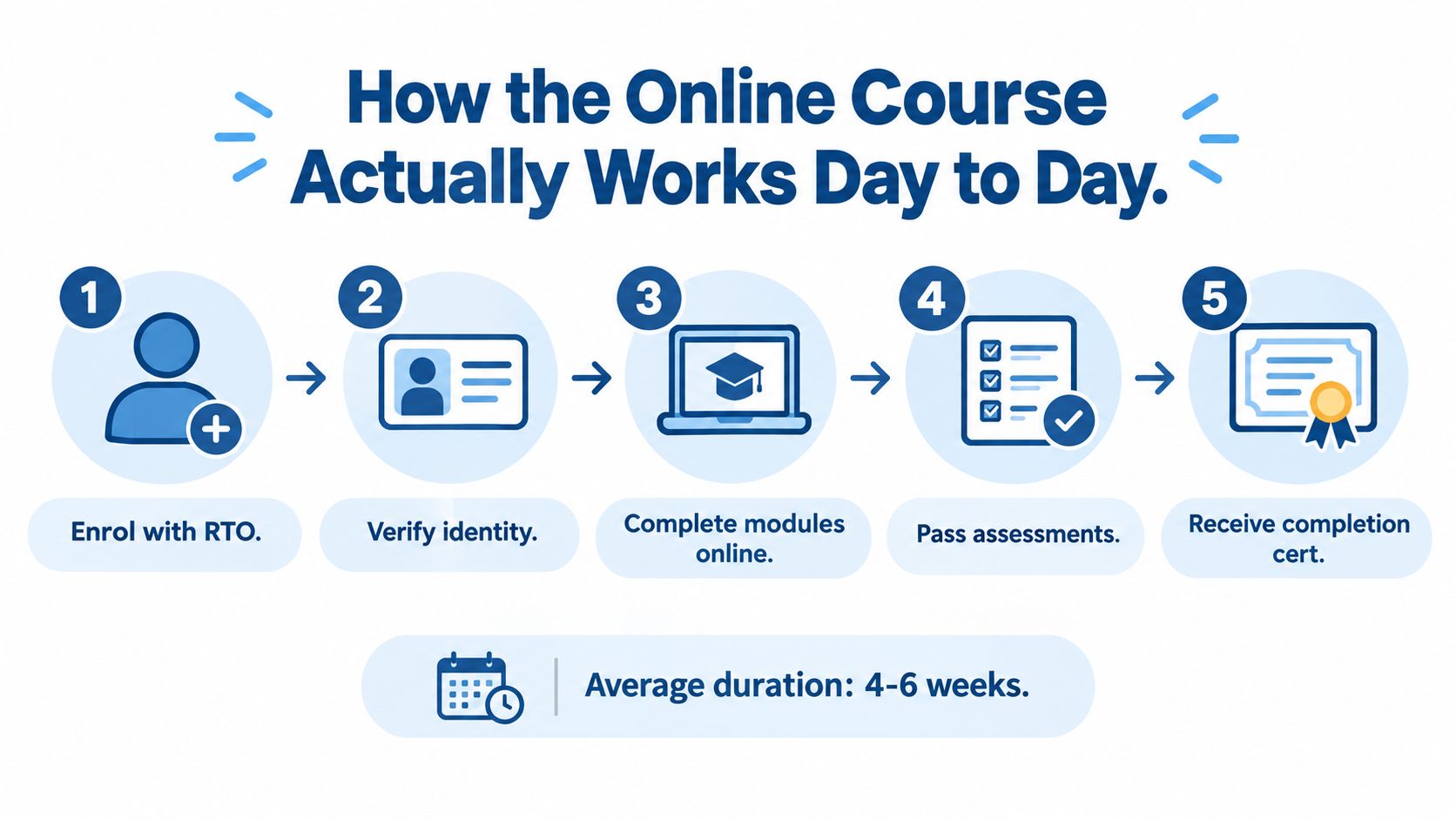
- How the Online Course Actually Works Day to Day
- Documents to Gather Before and During the Course
- Choosing a Provider That Will Pass the Permit Check
- What to Do After the Course to Stay Compliant
Why the Owner Builder Online Course Matters in NSW
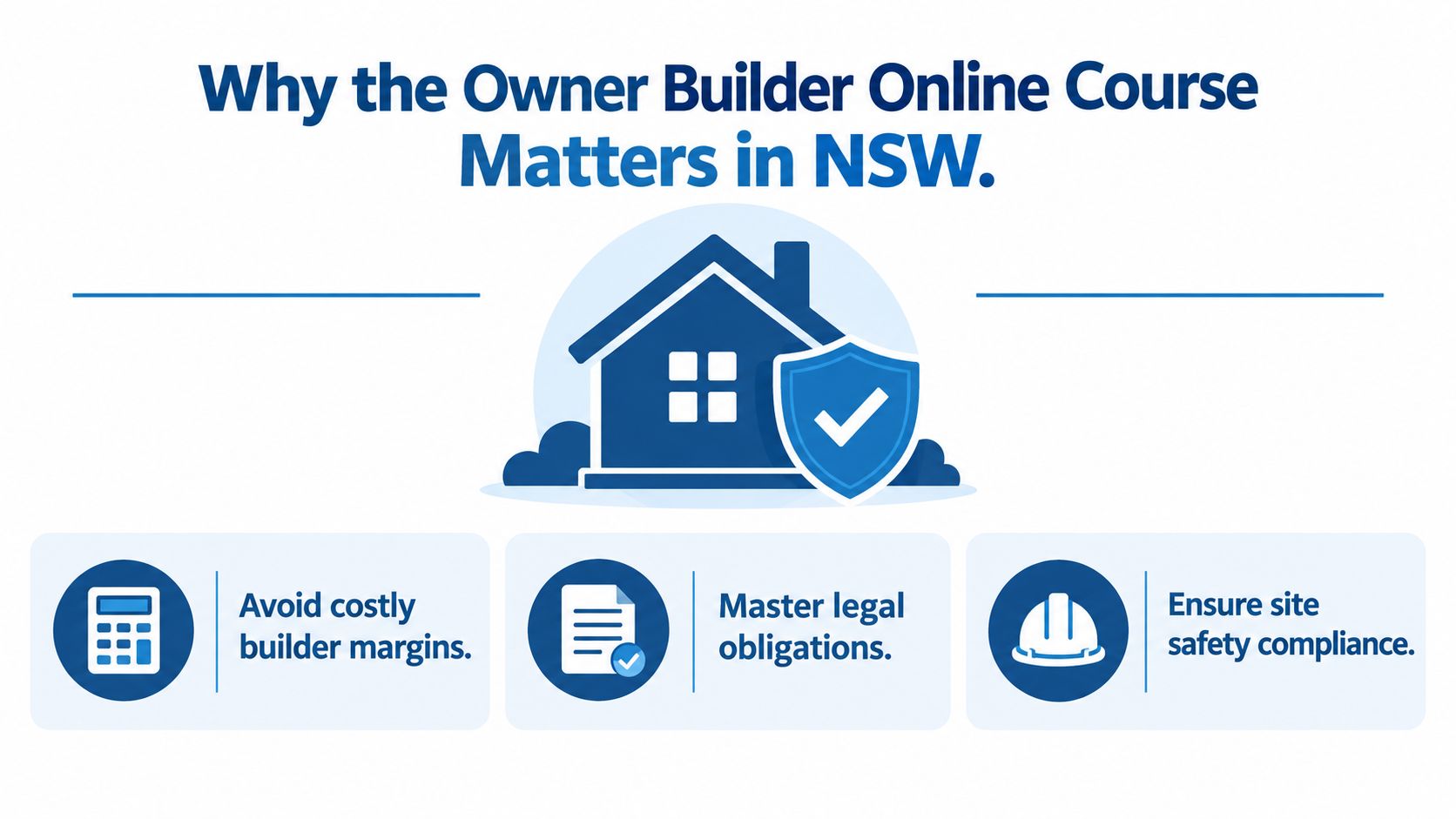
The owner-builder online course becomes relevant when the value and structure of your project move it into NSW's regulated pathway. An owner-builder permit is generally required when residential building work on your property exceeds A$10,000, provided you aren't using a licensed builder to supervise the work. For work valued above A$20,000, NSW also requires approved owner-builder education. These requirements are set out in NSW Government guidance on when an owner-builder permit is needed.
That threshold is where many homeowners misjudge the situation. They think of a renovation as separate jobs, such as demolition, carpentry, electrical work and plastering. The regulator looks at the regulated building work and the way it's being managed, not merely at the number of invoices sitting in your folder. If you're supervising the project rather than appointing a licensed builder, you need to establish the correct pathway before work starts.
Practical rule: Don't enrol because the course is convenient. Enrol because your project, property and proposed role make the NSW owner-builder pathway appropriate.
The education requirement is made up of five units of competency covering work health and safety, plans and specifications, estimating and costing, contracts and legal responsibilities. The training gives you a structured understanding of the obligations you take on when you coordinate trades and control the site. It won't turn you into a licensed electrician, plumber or structural engineer. It should help you recognise when qualified professionals, approved plans and inspections are required.
The best online format is practical. You should be able to connect a lesson about plans to a real drawing, a safety module to a site hazard and a contracts module to the written agreement you'll use with a trade. That practical approach is consistent with the wider role of vocational training in Australia, where recognised learning should prepare people for actual workplace responsibilities.
A completion certificate alone isn't enough. NSW expects approved education evidence, and the permit application remains a separate step. That's why this course is the hinge between planning a project and lawfully supervising it.
Checking If You Qualify Before You Enrol
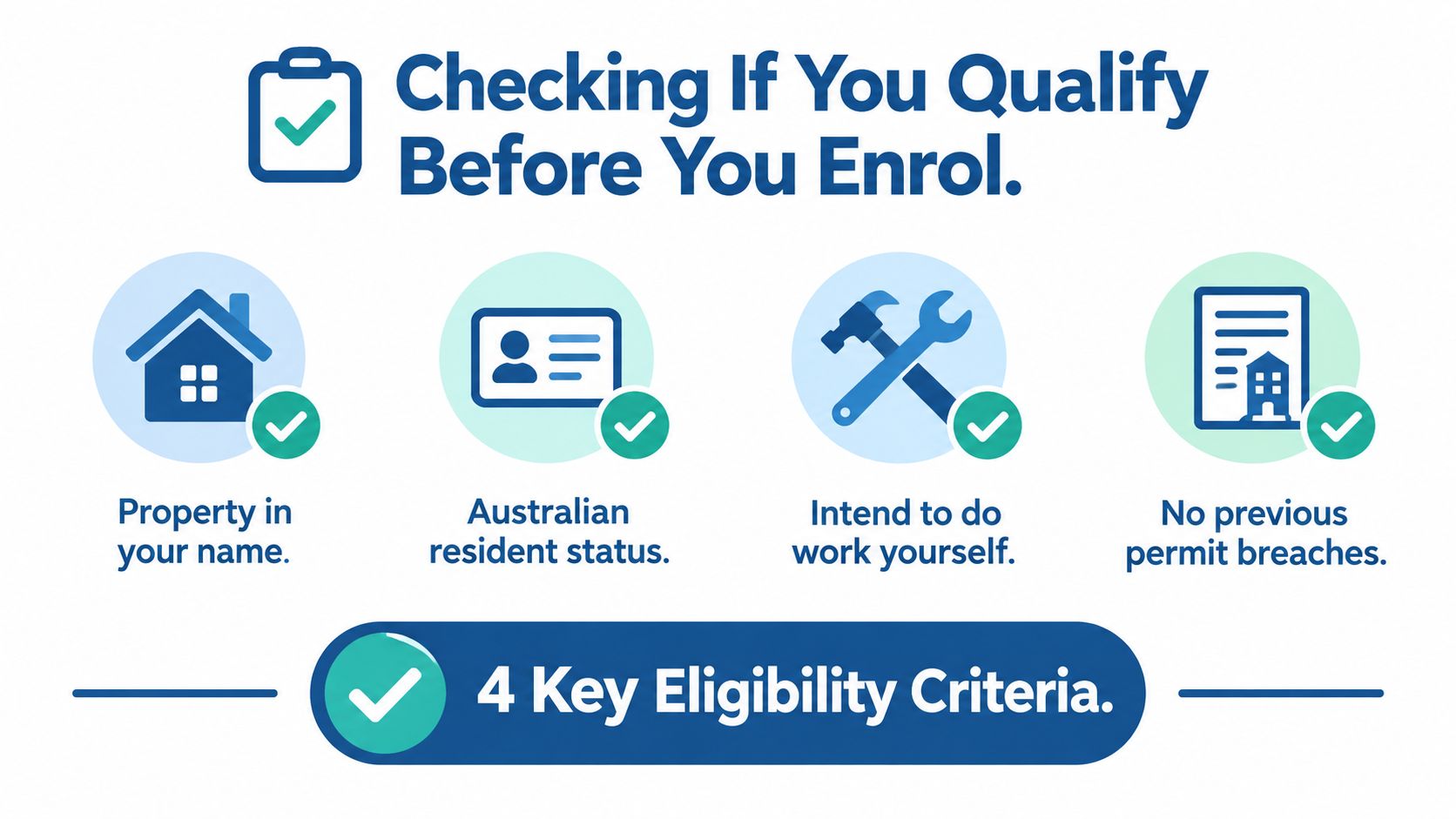
Before paying for an owner-builder online course, check whether you can use the qualification for a NSW permit. The fastest way is to test four points against your documents, not your assumptions.
Confirm ownership and applicant status
The property must be one you own or jointly own for relevant work above the NSW threshold. The applicant also needs to be an individual who is at least 18 years old, rather than a company or trust. NSW's owner-builder permit application guidance explains these conditions and places the education requirement within the wider permit framework.
Check the title position before enrolling. If your name isn't connected with the property in the way the application requires, finishing a course won't repair that problem. Gather a current title document or other ownership evidence and resolve any uncertainty with the relevant NSW authority before committing to training.
Confirm the property and project fit
The NSW owner-builder permit pathway applies to eligible residential work involving a single dwelling, dual occupancy or secondary dwelling that requires development consent or is a complying development. Your project also needs to fit the owner-builder rules, rather than being treated as commercial construction or work that should remain with a licensed builder.
Don't assume that calling a building a granny flat, shed or extension automatically settles the issue. The approval pathway, intended use and ownership position all matter. If the project is complex, clarify the approval requirements before choosing a course.
Check the white card first
NSW requires a current general construction induction card, commonly called a white card, for every owner-builder permit application. The card isn't replaced by owner-builder education. It's a separate construction-induction requirement that needs to be current when you apply. The white card guidance for NSW construction work explains why this evidence needs to be arranged separately.
Use this quick check before enrolling:
- Ownership: Confirm that you own or jointly own the relevant property.
- Age and identity: Confirm that you're an individual applicant aged at least 18.
- Project type: Confirm that the work involves an eligible residential dwelling and the correct approval pathway.
- White card: Confirm that you hold a current general construction induction card.
If one checkpoint fails, pause. Fix the eligibility gap first, then select training that maps directly to NSW's requirements. A fast course taken too early is still wasted money.
The Five Units of Competency NSW Expects
NSW's approved owner-builder education requirement isn't a generic awareness session. Fair Trading identifies five units of competency that together address the risks and responsibilities of supervising residential construction. You should check the exact unit codes before enrolling, because a provider's marketing description may sound relevant while leaving out a required unit.
What each unit contributes
CPCCWHS2001 deals with work health and safety. It's the unit that frames your responsibility for identifying hazards, controlling risks and managing the site safely when other people are working under your direction.
CPCCCM2002 covers safe manual handling. Owner-builders often underestimate how quickly moving materials, unloading deliveries and handling tools can create injuries. This unit deals with the physical work that still occurs even when you're coordinating rather than performing every trade.
CPCCCM2012 addresses working safely at heights. Roof work, ladders, platforms and scaffolding introduce fall risks that require more than common sense. You need to understand the controls before allowing the work to proceed.
CPCCCM2008 covers safe rigging practices. Lifting and moving loads can damage property or injure workers when equipment, loads or communication are poorly managed.
CPCCOB2001 focuses on reading and interpreting plans and specifications. That skill helps you compare what's drawn with what's being built, identify inconsistencies and raise questions before a mistake becomes embedded in concrete, framing or services.
| Unit Code | Unit Name | Why NSW Cares |
|---|---|---|
| CPCCWHS2001 | Work health and safety | Establishes safe site management and risk-control responsibilities. |
| CPCCCM2002 | Carry out manual handling safely | Addresses handling materials, tools and loads without creating avoidable injury risks. |
| CPCCCM2012 | Work safely at heights | Covers controls for roof, ladder, scaffold and elevated work. |
| CPCCCM2008 | Carry out basic rigging work | Builds awareness of safe load movement and rigging practices. |
| CPCCOB2001 | Read and interpret plans and specifications | Helps you understand project documents and identify construction discrepancies. |
A provider should show this mapping clearly in writing. If the sales page only promises “owner-builder knowledge” or “renovation skills”, ask for the units included and the evidence issued at completion. The relevant trade licensing requirements in Australia also reinforce a basic principle: training and licensing are not interchangeable, and each has a defined purpose.
TP Training provides practical, nationally recognised Courses training with experienced trainers and hands-on learning across NSW. For owner-builders, the deciding factor remains whether the selected program is approved for the NSW permit pathway and includes the required units.
How the Online Course Actually Works Day to Day
A legitimate online course starts with enrolment through the registered training organisation, identity checks and learner administration. You'll usually need photo identification and a Unique Student Identifier, or USI, before the provider can properly create and verify your training record. Keep your details consistent across your ID, USI and enrolment account.
The learning portal then releases the units, either together or in an organised sequence. Expect a mixture of written material, videos, knowledge checks and practical-style activities. Good activities ask you to interpret a plan, identify a hazard or apply a safety control rather than just memorise definitions.
Study around the project, not instead of it
Online delivery gives you flexibility, but it doesn't make the learning effortless. Read the scenarios with your own project in mind. If a module discusses plans, have your drawings available. If it covers safety, walk through the proposed work area and note access, storage, edges, plant and other hazards.
Assessments commonly combine multiple-choice questions with short written responses and uploaded tasks. Follow the portal's instructions carefully, save your work before submission and read any assessor feedback. A resubmission is useful only if you correct the underlying answer rather than changing a few words.
A realistic routine is short, regular study sessions with a fixed place for your notes and documents. Treat the portal like a compliance file, not entertainment you can return to whenever you remember. Class scheduling software illustrates the broader importance of organised training administration, even though your owner-builder learning will be completed online.
The course ends when the RTO assesses every required unit as competent. The document you need is the relevant statement of attainment, not merely an informal email saying you finished. Before you submit anything to the regulator, check your name, unit codes and completion details.
The common avoidable problems are administrative. Learners let access lapse, leave one assessment incomplete or discover that their USI information doesn't match the RTO record. Put reminders in your calendar, download permitted records and contact the provider as soon as a portal issue appears.
Documents to Gather Before and During the Course
Your paperwork should be organised before you begin. NSW permit applications become slower when applicants discover that their course evidence, ownership documents or white card details are scattered across email accounts and phone photographs.
Create a digital folder for the property and a physical folder for site use. Use clear filenames, keep the original documents and don't rely on a single portal remaining accessible forever.
Pre-course records
Keep the ownership evidence that supports your application, such as a current title search or other relevant property record. Add your photo identification, white card details and USI information. These documents serve different purposes, so don't assume one can replace another.
During enrolment, make sure your legal name and date of birth are entered exactly as they appear on your identification. A mismatch can delay identity verification and create unnecessary corrections in your training record.
Training and project evidence
Save the statement of attainment when it arrives. Also retain the course completion information, unit-level results and assessor communications. If the learning portal permits downloads, store them immediately. Screenshots can help demonstrate your own study history if access later becomes difficult, although they don't replace the official RTO document.
Your project file should grow alongside your training file. Keep approved plans, specifications, quotes, contracts, invoices, variations, inspection records and photographs. A dated photograph can help show what was concealed before the next stage, while written records clarify who performed particular work and under what arrangement.
- Ownership file: Store title and property records together.
- Training file: Keep the statement of attainment and unit results.
- Safety file: Retain your white card evidence and site safety records.
- Project file: Keep plans, contracts, invoices, variations and inspection documents.
The USI record-keeping guidance is useful when you're setting up the learner administration side. For regulated work, keep copies in both digital and printed form. Your future self, a certifier or a prospective buyer shouldn't have to reconstruct the project from text messages.
Choosing a Provider That Will Pass the Permit Check
The provider's marketing page isn't the regulator's checklist. A course can be easy to access and still be unsuitable for a NSW owner-builder permit if it doesn't deliver the approved units or issue the correct evidence.
Start with registration. Confirm that the organisation is a registered training organisation and check its details on the national training register before paying. Then ask for the exact unit codes, the delivery scope and the document issued after competency is achieved.
Compare the promise with the permit requirement
| Evaluation Filter | What the Provider Should Show | What NSW Checks at Permit |
|---|---|---|
| RTO status | Registered training organisation details and a verifiable registration record | Whether the submitted training evidence is from an acceptable provider |
| Unit alignment | The five required competency codes and names | Whether the education requirement has been completed |
| White card handling | A clear statement about whether it's separate, recognised or directed elsewhere | Current construction-induction card evidence |
| Completion evidence | Statement of attainment details and issuing process | Training evidence matching the application |
| Administration | USI, identity checks, assessment and record-access information | Applicant and supporting documents that can be verified |
A provider should also explain what the course does not cover. White card training remains a separate requirement, and a course that bundles unrelated promises creates confusion. Ask whether the program is specifically designed to meet the NSW owner-builder permit education requirement under the Home Building Act 1989 framework.
Provider test: If the business won't give you the unit codes and evidence type before payment, don't buy the course.
Be cautious with unregulated “owner-builder awareness” products. A polished dashboard, instant access or a low price doesn't prove that NSW will accept the result. Region-specific provider information shows that online training is often marketed around fast completion and pass rates, but those marketing measures don't establish permit approval or successful project delivery. The sensible benchmark is explicit mapping to NSW's five units and the white card prerequisite, as reflected in available provider information.
Look for a registration number, clear USI instructions, named unit codes, assessment information and a direct explanation of the statement of attainment. If those details are missing, call before enrolling. You can also ask how recently the provider has supported NSW owner-builder applicants, but treat an anecdotal answer as supporting information, not proof of regulatory acceptance.
For the project side, homeowners preparing for construction can also review preparing for an owner builder project to understand why insurance and planning need attention before work begins.
What to Do After the Course to Stay Compliant
The statement of attainment is the handover point from education to administration. It doesn't authorise you to start work. You still need to complete the permit and building-approval pathway that applies to your project.
Submit the owner-builder permit application through the appropriate NSW channel with your identity, ownership, white card and approved education evidence. Check every name, address and project description before lodging. A discrepancy between the course record and permit application can create delays that have nothing to do with your construction plans.
Deal with trades and insurance
If you contract a trades business for home building work costing more than A$20,000 including GST, that business must hold home building compensation insurance. NSW SIRA explains that an owner-builder doesn't need to take out that insurance for work they personally do, while contracted trades businesses must meet the relevant insurance requirement. Read the NSW SIRA information for owner-builders before signing contracts.
Ask each relevant trade for evidence before work starts, and keep it with the contract. Don't treat a verbal assurance as a substitute for a certificate or other acceptable evidence. Your project records should show who performed the work, what the scope was and how the insurance requirement was addressed.
You also need the correct planning and construction approvals before commencing. Depending on the project, that may involve a development consent, complying development pathway, construction certificate or other approval. Arrange the required surveyor and inspections, and confirm the inspection stages that apply to your work. Footings, framing and lock-up are common points at which homeowners need to coordinate access and documentation, but your certifier's requirements control the actual process.
Keep the long-term obligations visible
NSW generally limits an owner-builder to one owner-builder permit within a five-year period, so treat the decision as a substantial commitment rather than a trial run. The NSW owner-builder permit transaction guidance confirms the permit's role in allowing an owner-builder to supervise or perform eligible residential work on their own land without holding a builder's licence.
Maintain the project file through completion. If you sell the property within the applicable disclosure period, owner-builder work must be disclosed in the sale documentation, and unresolved defects can become a serious commercial and legal problem. Finish properly, obtain the required certificates, keep inspection records and make disclosure decisions with qualified legal or conveyancing advice.
Final compliance check: Course evidence, permit, approval, insured trades, inspections and project records must all line up. Missing one link can undermine the whole pathway.
An online course is useful because it gives you the required foundation before you take control of the site. It's not a shortcut around approvals, licensed trades, insurance or inspection obligations. If you approach it as one component of the compliance chain, you'll make a better enrolment decision and avoid starting a project on an invalid assumption.
TP Training provides practical, nationally recognised training across NSW, including construction-induction and workplace-safety pathways relevant to homeowners preparing for site responsibilities. Review the available options and contact TP Training to discuss the training evidence you need before moving ahead with your owner-builder project.

You may also like

High Risk Work Solutions in Australia: A Practical Guide
Basic Fatigue Management Course Guide for NSW Workers