
Operate Truck or Trailer Mounted Attenuators (TMA) Guide
You’re in the cab before sunrise, waiting for the traffic-control crew to finish the first set-up. The amber beacons are pulsing across the windscreen, workers are moving ahead with cones, and vehicles are already passing through the live lane. Your task looks simple from a distance, but the TMA behind your truck connects heavy-vehicle standards, traffic control, work-zone planning and civil construction safety.
Operating a truck or trailer mounted attenuator isn’t just a matter of driving slowly and holding position. You need to understand the equipment’s limits, the host vehicle’s compliance, the traffic environment and the people working in front of you. This guide explains how Operate Truck or Trailer Mounted Attenuators (TMA) work fits into Australia’s safety framework, how to judge whether a TMA is justified and how to build a credible pathway towards competent operation.
RIIRTM301E Operate Truck or Trailer Mounted Attenuators Training Course (TMA)
Table of Contents
- Standing Behind Live Traffic and Why TMAs Exist
- What a Truck or Trailer Mounted Attenuator Actually Does
- The Australian Compliance Framework Every Operator Should Know
- Truck Mounted Versus Trailer Mounted Attenuators in Practice
- Building a Workplace Safety Culture Around TMA Operations
- When a TMA Is the Right Choice and When It Is Overkill
- Your Training Pathway From Prerequisite to Qualified Operator
- Turning Safety Standards Into Long Term Career Opportunity
Standing Behind Live Traffic and Why TMAs Exist
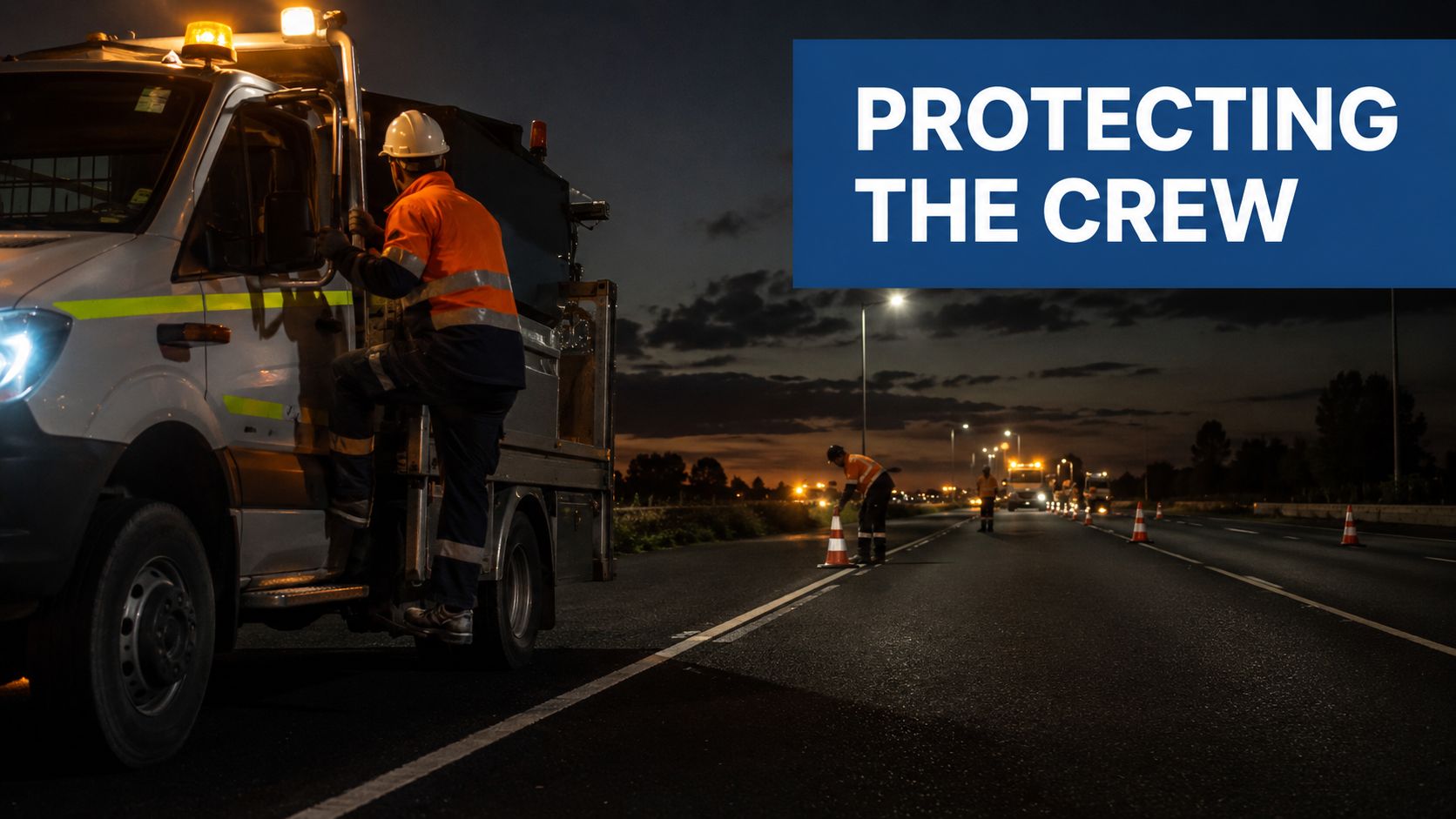
At 5 am, the road feels almost empty. You climb into the cab of a support vehicle parked 50 metres behind a moving traffic lane, check the mirrors and watch amber beacons reflect from the damp asphalt. Ahead, traffic controllers are placing cones while workers prepare to enter the protected area.
Then a heavy vehicle appears in the distance. It’s travelling faster than the rest of the traffic, and for a few seconds you can’t tell whether the driver has seen the signs, the cones or your vehicle. This is the moment that separates routine traffic management from high-risk work. Your vehicle must remain correctly positioned, the work crew must stay within the planned protection zone and every person needs to understand what happens if a driver fails to respond.
The final layer of protection
A TMA is designed as a sacrificial barrier. If a vehicle enters the work area, the attenuator can absorb or redirect crash energy before that energy reaches workers on foot, equipment or the main work vehicle. It doesn’t make an unsafe work zone safe by itself, and it can’t correct poor traffic control, inadequate spacing or a vehicle that doesn’t meet the required specifications.
Australian guidance describes TMA use in road construction, maintenance, traffic control and incident response as a practice that has steadily increased and become a regular method of protecting workers near roads. The national competency RIIRTM301E formally recognises the task and covers both truck-mounted and trailer-mounted attenuators under national guidelines. You can also see how this role connects with wider construction controls in risk management guidance for construction work.
The operator is part of a live protection system. Traffic controllers manage road users, supervisors manage the work method, spotters watch movement and the TMA operator maintains the protective position. If one part fails, the rest of the crew may have very little time to respond.
Worksite reality: The attenuator is the last line of defence, not permission to accept a poorly planned work zone.
A competent operator learns to read the road as well as the machine. You need to notice speed changes, queue build-up, lane shifts, poor visibility, merging traffic and the behaviour of individual drivers. That’s why TMA operation belongs to a specialised high-risk-work skill set rather than ordinary truck driving.
What a Truck or Trailer Mounted Attenuator Actually Does
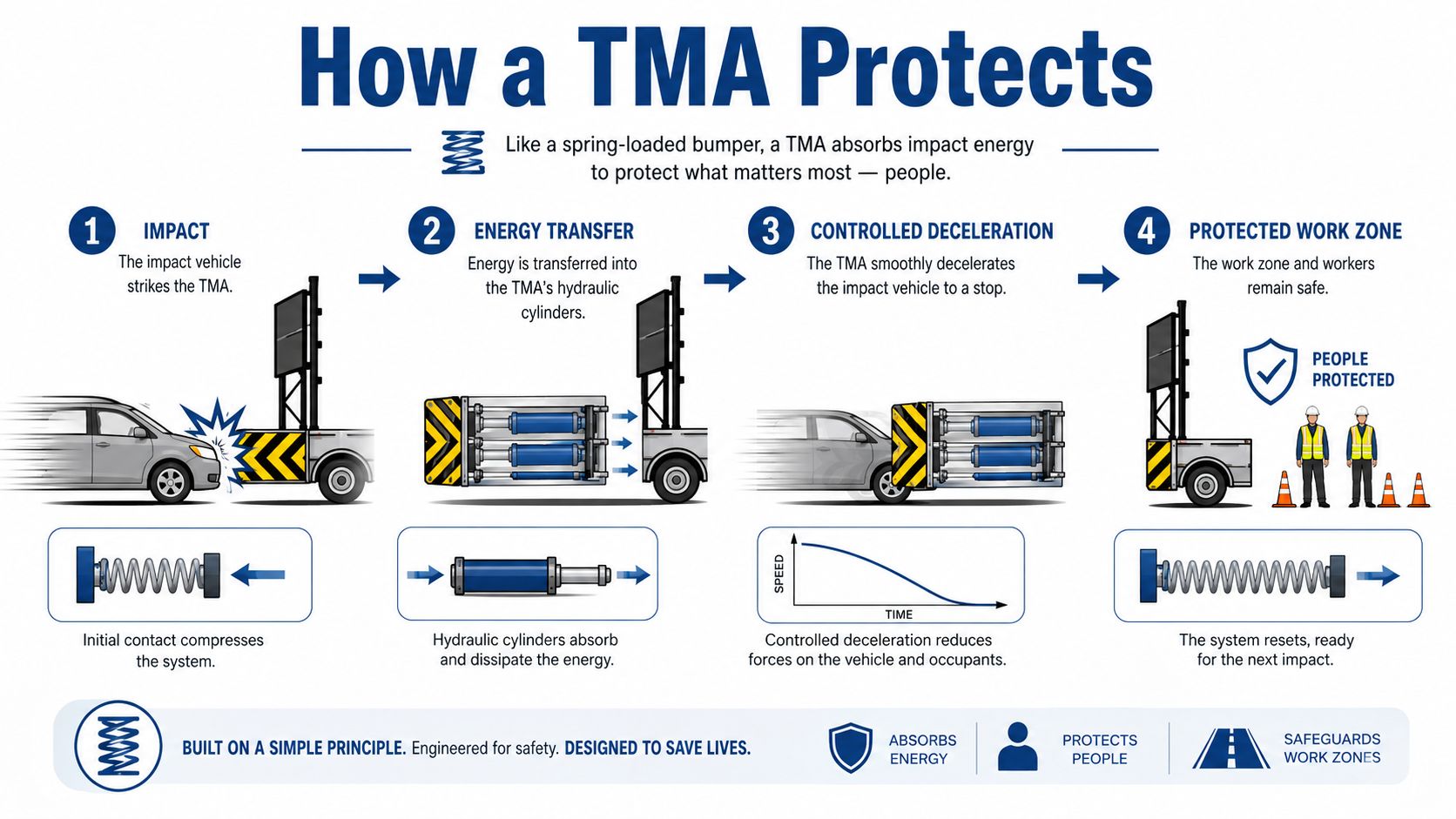
Think of a TMA as a large spring-loaded bumper. A small spring compresses when you push against it and releases that force over a short distance. A crash attenuator applies the same broad principle at a much larger scale, using engineered components that deform or absorb energy in a controlled way.
A truck-mounted attenuator is attached to the rear of a host truck. A trailer-mounted attenuator is towed behind a suitable vehicle. In either arrangement, the module is placed between an errant vehicle and the people or equipment inside the work zone. During an impact, the TMA is intended to manage the collision rather than allowing the striking vehicle to stop abruptly against the protected vehicle or crew.
Turning physics into operator decisions
The engineering only works when the operating conditions match the approved design. Australian guidance commonly rates TMAs to a design speed of 100 km/h, and accepted MASH-compliant units are intended to absorb rear-end impacts at up to 100 km/h within specified crash-test conditions. Those limits come from the Victorian TMA guidelines, not from a general promise that every crash will be controlled safely.
For the operator, that means:
- Hold the planned shadow position: Stay behind the work area at the distance specified by the traffic-management arrangement. Don’t drift forward because the crew feels too far away.
- Stay aligned with the hazard: Keep the host vehicle squarely behind the protected activity unless the approved method requires another position.
- Respect the equipment match: The TMA, host vehicle mass, mounting system and work environment must be compatible.
- Watch changing conditions: A design speed doesn’t remove the need to respond to queues, lane changes, weather, visibility and driver behaviour.
The crash-test philosophy behind standards such as MASH and NCHRP Report 350 is important because it tests how safety hardware performs under defined conditions. It doesn’t turn a TMA into an indestructible shield. The operator still needs to know the approved device, the host vehicle requirements and the limits of the work method.
For people entering the field, Riirtm301E Operate Truck Or Trailer Mounted Attenuators Training Course Tma provides practical, nationally recognised training with experienced trainers and hands-on learning across NSW.
The Australian Compliance Framework Every Operator Should Know
You arrive at a roadwork site before sunrise, the TMA is connected, and live traffic is already moving past the work area. Before selecting a gear or entering the shadow position, you need to confirm that the vehicle, equipment, traffic arrangement and your competency all meet the project’s requirements. TMA work is a safety-and-compliance role, not merely a driving task.
Australian road agencies apply national standards alongside state and territory rules. AS/NZS 3845.2:2017 covers truck or trailer mounted attenuators as permanent and temporary road safety devices. It addresses crashworthiness, testing, manufacture, erection, maintenance and repair evaluation after a crash. These requirements place TMA operations within a controlled technical system.
The NHVR treats fitting a TMA to a heavy vehicle as a modification under the Heavy Vehicle National Law. An Approved Vehicle Examiner must approve the modification. The mounting arrangement must not make the vehicle unstable or unsafe, or interfere with an advanced safety system. Once deployed, the vehicle may have a rear overhang of up to 7.6 m and an overall length of up to 15 m, subject to the applicable requirements in the NHVR truck-mounted attenuator vehicle standards guide.
| Layer | Example requirement |
|---|---|
| Equipment standard | The TMA must meet recognised crashworthiness and testing requirements. |
| Vehicle modification | An Approved Vehicle Examiner must approve the mounting arrangement. |
| Vehicle compatibility | Mass, stability, braking, clearance and safety-system interference must be checked. |
| Traffic management | The device must operate within an approved work-zone or incident-response arrangement. |
| Operator competency | The operator needs the appropriate licence, induction and TMA competency. |
| State authority rules | The relevant road authority may restrict accepted equipment or deployment methods. |
| Work health and safety | Principal contractors and supervisors must manage the broader risk system. |
Your paperwork should match what you see on the ground. South Australian safety guidance requires TMA operators to be trained and competent, hold a current heavy vehicle licence of a suitable class, carry a General Construction Induction Card, complete RIIRTM301E and hold minimum traffic-control qualifications such as RIIWHS302E Implement Traffic Management Plan. Other jurisdictions may set different conditions, so check the road authority and project rules before mobilisation.
Traffic planning connects the TMA to the wider civil works system. The person preparing or implementing the arrangement must understand how the device interacts with signs, cones, buffers, tapers, lanes and emergency access. Prepare Work Zone Traffic Management Plan Course Pwz Red Card training from TP Training covers this planning context through practical, nationally recognised training with experienced trainers and hands-on learning across NSW.
Truck Mounted Versus Trailer Mounted Attenuators in Practice
Truck-mounted and trailer-mounted attenuators perform a similar protective function, but crews shouldn't treat them as interchangeable. Their behaviour depends on the host vehicle, attachment method, braking arrangement, available space and the rules of the road authority controlling the project.
A truck-mounted unit forms part of the host vehicle. That can make the combination easier to control during some movements, but it also means the truck's licence class, mass, dimensions, mounting approval and braking performance become central to the deployment decision. The modification must be engineered and approved, and the operator needs to understand how the deployed equipment changes the vehicle's geometry.
A trailer-mounted unit introduces a separate connection between the tow vehicle and the attenuator. That connection, the trailer brakes, anti-rotational systems and break-away arrangements all need attention. Earlier Australian guidance required anti-rotational damper systems and break-away cables that activate the braking system if damping fails. It also identified a minimum recommended tow or host vehicle mass of 4,536 kg, while some impact attenuators had minimum host vehicle tare masses of 7.3 tonnes and about 9.07 tonnes. A recommended host GVM of at least 15 tonnes was identified for critical requirements in that guidance. These details show why a trailer unit can't be connected to any available vehicle.
| Factor | Truck mounted | Trailer mounted |
|---|---|---|
| Connection | Fixed to the host truck through an approved mounting arrangement. | Towed through a trailer coupling and associated braking systems. |
| Manoeuvrability | Can feel more integrated during approved movements, but rear overhang remains important. | Requires careful attention to tracking, coupling behaviour and turning space. |
| Vehicle requirements | Host mass, stability, modification approval and licence class are critical. | Tow vehicle mass, braking compatibility and trailer equipment are critical. |
| Regional acceptance | May be accepted where the authority specifies truck-mounted protection. | May be restricted or prohibited by a road authority. |
| Operational check | Inspect mounting points, deployment controls and vehicle clearance. | Inspect coupling, safety systems, brakes, damper and break-away cable. |
Western Australia provides a clear example of regional variation. Main Roads WA states that TMAs must be used only with a compliant host vehicle and lists accepted crashworthy units. It explicitly prohibits trailer-mounted attenuators because of concerns about gating into adjacent lanes, attachment difficulty and manoeuvrability. The Traffic Control Combo Course Blue Yellow Card is a separate practical, nationally recognised training option with experienced trainers and hands-on learning across NSW, but the course choice must still match the equipment and role requirements on the specific site.
RIIRTM301E Operate Truck or Trailer Mounted Attenuators Training Course (TMA)
Building a Workplace Safety Culture Around TMA Operations
A TMA crew often reveals the quality of the whole civil construction site. If the operator is rushed, the traffic controller is working without support, the supervisor stays in the vehicle or near misses disappear into informal conversations, the problem isn’t limited to one machine. It shows that the site’s safety system isn’t functioning consistently.
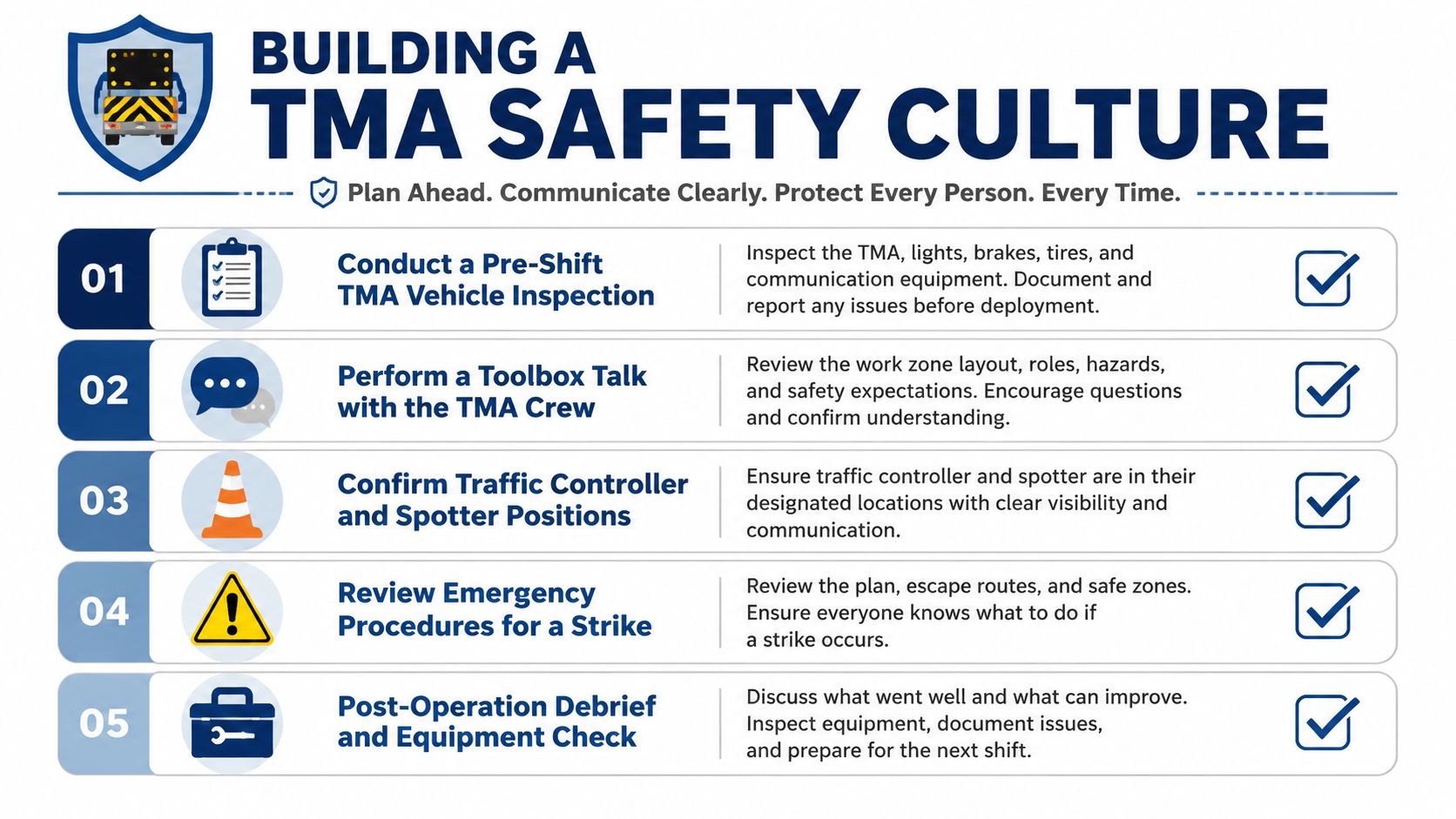
Start with the pre-start. The operator, traffic controllers, spotters and supervisor should agree on the work-zone layout, communication method, emergency response and conditions that require the operation to stop. They should also inspect the host vehicle and attenuator, confirm the device is correctly deployed and check that the planned position remains achievable once traffic begins to flow.
What good practice looks like on shift
A toolbox talk should be specific to the shift, not a recycled conversation about general safety. Discuss the approach speed, lane arrangement, visibility, radio channel, escape routes and the action to take if a vehicle enters the buffer. Workers should know who can call a stop and how that instruction reaches the operator.
Use a simple culture checklist:
- Pre-start inspection: Record the condition of the vehicle, mounting points, lights, controls and attenuator components.
- Crew briefing: Confirm the traffic plan, communication signals and the limits of the operator’s position.
- Spotter arrangement: Place spotters where they can see relevant movement without standing in an unprotected location.
- Near-miss reporting: Log sudden lane incursions, hard braking, confusing signs and unsafe driver behaviour.
- Supervisor presence: Make sure a responsible supervisor is available during live operations, not only during set-up.
- Post-incident review: Inspect the equipment, preserve relevant information and involve the operator in understanding what happened.
Better investigation: Ask what conditions made the event possible before asking which individual made the final mistake.
Fatigue policy also matters. A tired operator may miss a vehicle drifting across a lane or fail to recognise that the work zone has changed. Supervisors should provide realistic breaks, manage shift demands and make it acceptable for workers to report that they’re not fit for the task.
The wider crew may need first aid, working-at-heights training, high-risk work licences or asbestos awareness, depending on the adjacent work. Those qualifications don’t replace TMA competency, but they help create a consistent safety culture across the corridor.
When a TMA Is the Right Choice and When It Is Overkill
A TMA decision starts with the work method, not with whichever unit is available. On an Australian site, the supervisor must connect traffic control, heavy-vehicle requirements and civil-work conditions. Consider the operating speed, traffic volume, exposure time, buffer space, lane arrangement and whether a shadow vehicle suits the approved plan.
Line marking on a rural highway with a 100 km/h design environment may require engineered impact protection. Bridge deck work can leave workers with little escape space if a vehicle enters the work area. Pothole patching in a live lane creates a similar exposure, because a small crew may be working close to moving traffic while the work vehicle occupies part of the road.
The same control will not suit every job. A short activity on a low-speed road, with effective separation, clear sight lines and an approved traffic plan, might be controlled with signs, cones or a stationary shadow vehicle. That option is not automatically safer because it is simpler or cheaper. The control must match the site risk, the work method and the available recovery space. A site-specific elevated-work-platform risk assessment illustrates the same principle: select controls for the conditions workers face.
Australia does not have one simple public threshold that tells smaller contractors when speed, traffic volume, exposure time and lane layout require a TMA. Austroads describes TMAs as improving responder and road-user safety around incident sites. National and state guidance also addresses crashworthiness, site conditions, erection practices, maintenance and post-crash repair. The Austroads incident-response TMA guidance reflects more operationally specific deployment.
Before the TMA rolls out, ask:
- What vehicle or worker could enter the work area, and how much time would the crew have to escape?
- Does the selected TMA and host vehicle match the road speed, site layout and approved crash conditions?
- What evidence shows this is the safest workable control, rather than familiar equipment?
A TMA is overkill when it adds complexity without improving protection. It is inadequate when the work presents a credible high-speed intrusion and the plan depends on hope.
Your Training Pathway From Prerequisite to Qualified Operator
A new operator usually begins with the vehicle and traffic-control prerequisites, not the attenuator itself. For a truck-mounted unit, you’ll need a suitable heavy-vehicle licence, typically an MR-class licence, along with a General Construction Induction Card, often called a White Card. You’ll also need the current traffic-control credentials required by the state, employer and project.
The sequence matters because TMA operation sits inside a wider work method. A person who understands traffic plans, stop-slow control, site communication and emergency procedures can apply the TMA competency with better context than someone who treats the unit as an isolated vehicle attachment.
A practical order for building competence
Begin with access to the worksite. Obtain the appropriate heavy-vehicle licence and construction induction. Confirm your identity, licence status and any employer requirements before booking specialist training.
Build traffic-control capability. Courses such as TLIF3060 Implement traffic management plans and RIIWHS205D Control traffic with a stop-slow bat are commonly completed before operating the TMA. They help you understand how your position affects the people controlling and moving traffic around you.
Complete the TMA competency. RIIRTM301E covers operating a truck or trailer mounted attenuator under national guidelines. The assessment should connect classroom knowledge with practical vehicle checks, deployment, positioning, communication and response to changing site conditions.
Practise under supervision. A certificate doesn’t replace experience. Keep a clear log of supervised operation, record the equipment used and ask an experienced supervisor to review your positioning, observation habits and decision-making.
Your employer may also require site inductions, equipment familiarisation and third-party verification. Refreshers should follow the organisation’s system, project risk and equipment changes. Don’t assume that a long gap away from roadwork has no effect on competence.
Complementary courses can strengthen your career stack. HLTAID011 Provide First Aid, 11084NAT Asbestos Awareness and high-risk work licence units for relevant plant can support work across civil construction environments. Training choices should follow the roles you want, not a random collection of tickets.
You can review how related traffic-control credentials fit together through the traffic control combo course information. The important point is to book in an order that gives you the knowledge to use each later competency safely.
Turning Safety Standards Into Long Term Career Opportunity
RIIRTM301E can open the door to broader traffic-management and civil construction work, but the certificate is only the starting point. Employers need people who can show current statements of attainment, explain the equipment they’ve operated and demonstrate that they can work within a traffic plan without constant prompting.
A clean record of supervised hours helps make that capability visible. Keep copies of training records, site inductions, equipment familiarisation notes and supervisor feedback. Record the type of attenuator, host vehicle, work environment and responsibilities you performed, without claiming tasks you weren’t authorised or competent to complete.
The habits that move operators forward
Strong operators arrive prepared, complete inspections properly and speak up when the work method no longer matches the road. They don’t hide a near miss because they’re worried about blame. They report it, help the supervisor understand the conditions and use the lesson to improve the next shift.
That approach can lead towards senior traffic supervision, TMA training, site safety work and broader project coordination. Progress depends on experience, employer requirements and demonstrated competence, not on one course alone. It also depends on maintaining the supporting qualifications that keep you employable across changing sites.
Career principle: Treat every logbook entry and pre-start record as evidence of the professional you’re becoming.
Traffic-management work can involve early starts, exposed roadside conditions and sustained concentration. People who build reliable habits around fatigue, communication and equipment care become valuable because supervisors can trust them near live traffic. Broader traffic-control career information is available in this Australian traffic controller salary and career guide.
Start by checking the licence and induction requirements for the jobs you want. Then complete the traffic-control prerequisites, book RIIRTM301E with a reputable registered training organisation and arrange supervised site experience before you treat the certificate as the end of the journey.
RIIRTM301E Operate Truck or Trailer Mounted Attenuators Training Course (TMA)
TP Training provides practical, nationally recognised training across NSW, including TMA, traffic control, work-zone planning and related workplace safety courses. Visit TP Training to review the relevant course options and begin planning your pathway into competent, compliant TMA operation.

You may also like
Safety & Health Policy: A Guide for Australian Employers

Asbestos Removal Requirements in NSW: The Complete Guide