
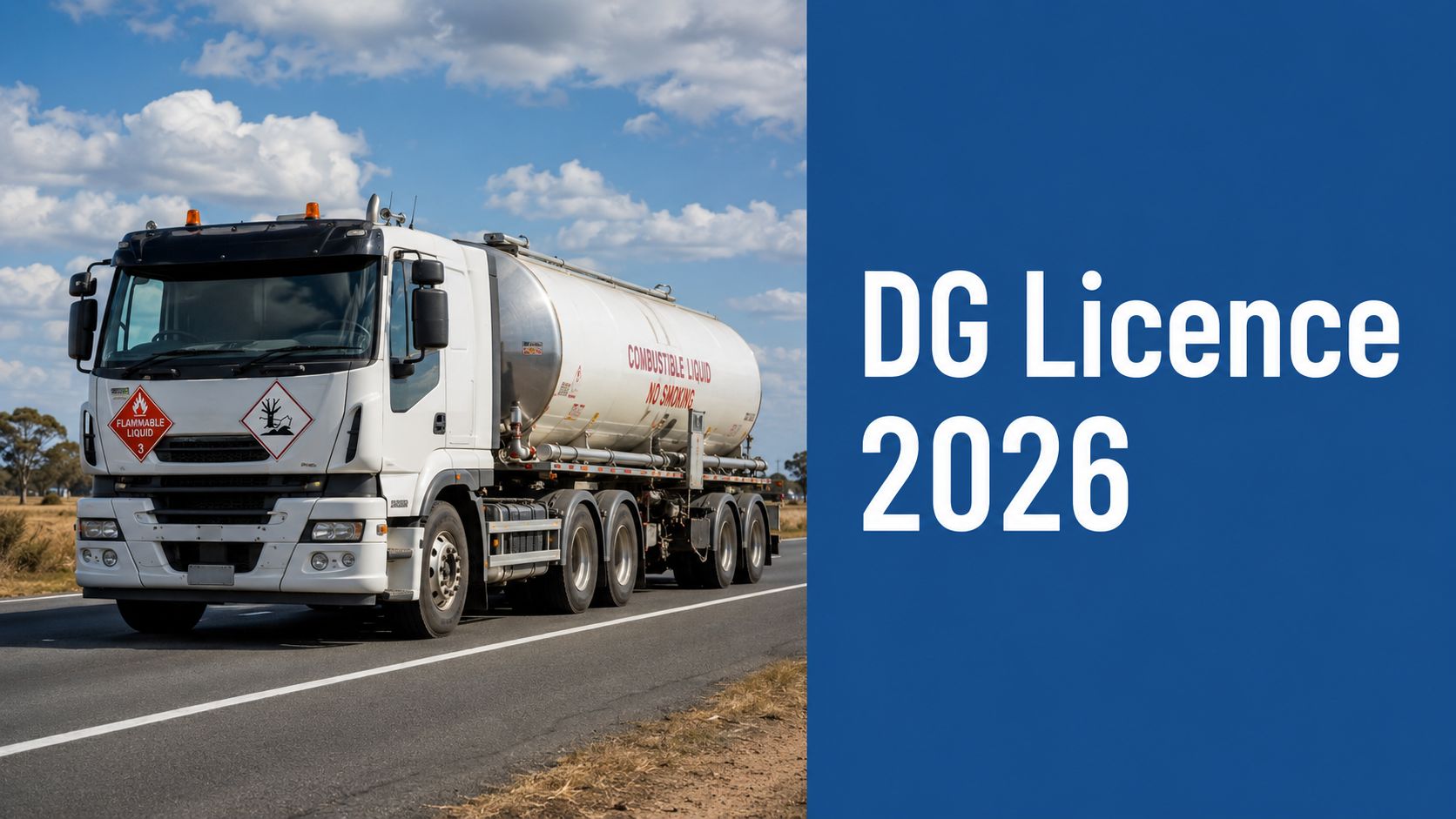
Dangerous Goods Driver’s License Course: 2026 NSW Guide
You've been asked to move fuel, chemicals, gases or another regulated load, and the first question is usually not “What are dangerous goods?” It's “Do I need the NSW driver licence, and what has to happen before I can apply?” The answer depends on the quantity, container arrangement, your driving record, medical fitness and whether you can demonstrate practical competence under the TLILIC0001 assessment process.
This guide focuses on that licensing journey. It explains the 500-litre and 500-kilogram trigger, the intermediate bulk container rule, the training evidence required by the NSW EPA, the time limit after training, and what assessment day feels like in practice. It also separates the driver licence from the vehicle approval, because confusing those two requirements can create expensive delays.
Table of Contents
- Who Needs a Dangerous Goods Driver Licence in NSW
- What the TLILIC0001 Course Covers and How Assessment Works
- The NSW Licensing Pathway From Training to EPA Approval
- Licence and Vehicle Fees Explained
- Common Pitfalls and How to Prepare Before You Book
- Getting Started With the Right Training Provider
Who Needs a Dangerous Goods Driver Licence in NSW
A driver can hold the right vehicle licence and still be unable to carry a regulated bulk load. In NSW, the licensing decision starts with the load and its container arrangement, not the job title. A dangerous goods driver licence is generally required when a road vehicle transports dangerous goods in a receptacle larger than 500 litres or more than 500 kilograms, subject to the applicable requirements. Service NSW explains the driver licence threshold and application requirements.
The threshold operates within the NSW dangerous goods framework, including the Dangerous Goods (Road and Rail Transport) Regulation 2022. It is separate from the ordinary driver licence authorising someone to operate the truck. Check intermediate bulk containers carefully. The exemption threshold is 3,000 litres total capacity, provided no container is filled or emptied on the vehicle. Transfer activity can therefore change the licensing position even when the total capacity appears to fit within the exemption.

The threshold is about transport conditions
Common regulated loads include Class 2 gases, Class 3 flammable liquids, Class 6 toxic substances and Class 8 corrosives. The classification affects segregation, placarding, documentation and emergency response. The driver must make decisions based on the product, packaging, quantity and transport conditions, rather than rely on a general safety induction.
Work that can involve threshold-level loads includes:
- Fuel delivery: Tankers and bulk containers may trigger the licensing requirement.
- Chemical manufacturing: Drivers can move corrosive, toxic or flammable products between facilities.
- Agricultural supply: Fertilisers, chemicals and fuel require accurate classification and transport planning.
- Waste transport: Industrial and hazardous waste movements require correct documentation and emergency preparation.
A smaller load may not trigger the EPA-issued driver licence, but the work can still require dangerous goods knowledge. Handling, documentation, placarding and emergency procedures remain relevant to drivers and other workers involved in the operation.
The practical check is whether the vehicle regularly carries dangerous goods above the NSW threshold, or whether the job involves bulk containers or transfer activity. Confirm the product, quantity and container arrangement with the consignor or transport manager before booking training. A job description alone will not settle the licensing question.
If the operation requires the qualification, the Dangerous Goods Drivers License Course is one NSW training option, with nationally recognised instruction and practical learning delivered by experienced trainers across NSW.
What the TLILIC0001 Course Covers and How Assessment Works
A driver can understand the theory and still struggle on assessment day if the paperwork, load decisions or calculations do not line up. TLILIC0001, Licence to Transport Dangerous Goods by Road, is a nationally recognised unit delivered by a registered training organisation. It assesses applied competence, not attendance. The national requirements include at least 16 hours of supervised training and assessment over two or more days. The NSW EPA outlines the driver training and assessment pathway.
The Mandatory Assessment Instrument, usually called the MAI, sets the assessment structure. Candidates work through classification, load quantities, segregation, placarding, documentation, vehicle checks and emergency response. Depending on the RTO, tasks may involve workplace scenarios, oral or written questions and practical demonstrations. Expect a controlled operational assessment, not a classroom attendance exercise.
What candidates are expected to demonstrate
Theory questions require accurate use of the ADG Code. Candidates must interpret classifications, quantities and transport controls, then apply that information to a proposed load. Calculations may involve aggregate quantities and the Class 1 explosive equivalence requirements included in the assessment process. The resulting load plan must also support correct segregation and placarding decisions.
The practical assessment may include:
- Vehicle preparation: Completing relevant pre-trip and safety checks.
- Load compliance: Checking the load arrangement against transport and segregation requirements.
- Documentation: Reviewing transport information and identifying missing or inconsistent details.
- Emergency response: Choosing and demonstrating appropriate actions in realistic scenarios.
- Communication: Answering questions clearly and explaining why a particular control is required.
Assessment is competency-based. Candidates must demonstrate each required element consistently and safely rather than achieve a percentage score. A correct answer about classification will not compensate for an unsafe practical demonstration, incomplete documentation or an unresolved calculation error.
| Component | Format | What Is Assessed |
|---|---|---|
| Knowledge and calculations | Written and oral questioning | Classification, quantities, load decisions and transport controls |
| Vehicle and load checks | Practical demonstration | Pre-trip inspection, load arrangement and compliance checks |
| Documentation | Scenario-based review | Required information, placarding and operational records |
| Emergency response | Practical scenario | Safe decisions, communication and response procedures |
| MAI evidence | Supervised assessment | Consistent performance across the required competency elements |
Most RTOs conduct language, literacy and numeracy screening before enrolment or assessment. The purpose is to identify support needs, such as reading technical tables, following written instructions or completing calculations. It is not a substitute for the assessment. Tell the RTO early if written English or numeracy may affect performance, so support can be discussed before the MAI.
A useful comparison is this account of completing a traffic management designer red card course in NSW. The qualification is different, but the practical lesson is the same: prepare for the tasks you must perform, not merely the topics discussed in class.
TP Training also provides a Dangerous Goods Drivers License Course with nationally recognised instruction and practical learning delivered across NSW.
The NSW Licensing Pathway From Training to EPA Approval
A candidate can pass the course and still miss the licensing window. In NSW, the approval process continues after TLILIC0001 and depends on medical evidence, driving history, identity documents and correct timing.
Start with eligibility and documentation
Before booking, confirm that your Australian driver licence covers the vehicle and work involved. You must complete TLILIC0001, provide RTO evidence showing the training was completed no more than 6 months before the EPA receives the application, complete the required GP medical assessment and provide a satisfactory 5-year driving history. Service NSW lists the documents and application conditions for a dangerous goods driver licence.
Use this order to keep the application on track:
- Check your driver licence: Confirm that it is current and suitable for the vehicle and duties.
- Arrange the medical assessment: Use a GP familiar with the required fitness-to-drive documentation.
- Obtain your driving history: Request it early and resolve any entries that may require explanation.
- Complete TLILIC0001: Enrol with an RTO authorised to deliver the nationally recognised unit.
- Collect identity and training evidence: Keep your certificate or RTO documentation ready.
- Submit the EPA application online: Lodge it within the six-month period after training.
- Pay the applicable fee: Include the required payment and supporting evidence.
- Review the issued licence: Check the personal details and conditions when it arrives.
The six-month period is a practical deadline, not an administrative detail. A passed assessment does not pause the clock. If the EPA receives the application after that period, the training evidence may no longer meet the requirement, creating avoidable delay and potentially requiring parts of the process to be repeated.
Driver approval and vehicle approval are separate
The dangerous goods driver licence applies to the person. The vehicle follows its own compliance pathway, and a vehicle licence may be required when dangerous goods are transported in large receptacles. The NSW EPA separates driver licensing from vehicle licensing.
This distinction matters to both owner-drivers and employers. A licensed driver cannot make a non-compliant vehicle lawful, while a licensed vehicle does not replace the driver's competency or personal licence.
Keep the evidence for each approval organised separately. That approach also helps drivers who hold other safety credentials, because each licence has its own regulator, supporting documents and renewal conditions. The NSW high risk work licence guide provides a useful comparison of how separate licensing requirements can operate.
TP Training also provides a Prepare Work Zone Traffic Management Plan Course Pwz Red Card with practical, nationally recognised training and hands-on learning across NSW.
Licence and Vehicle Fees Explained
Budget for two approvals, not one. The dangerous goods driver licence belongs to the person, while the vehicle licence applies to the vehicle used for regulated transport. Holding one does not replace the other.
Published NSW EPA schedules list the dangerous goods driver licence at $64 for a 5-year licence in one schedule and $66 in a later fee table. The same published information lists the vehicle licence at $101 for 1 year. Check the current regulator fee information before paying, as schedules can change.
| Cost Item | Approximate Amount | Who Charges It | Frequency |
|---|---|---|---|
| Dangerous goods driver licence | $64 or $66 in published NSW EPA schedules | NSW EPA | 5-year driver licence |
| Dangerous goods vehicle licence | $101 in the published fee information | NSW EPA | 1-year vehicle licence |
| Medical assessment | Varies | GP or medical provider | As required for the application |
| Driving history evidence | Varies | Relevant licensing authority | For the application |
| RTO training | Provider-specific | Registered training organisation | Each enrolment |
The regulatory figures are only part of the cost. Allow for the GP assessment, driving history documentation and RTO tuition. Course inclusions differ, so confirm whether learning materials, practical activities and assessment preparation are included before comparing advertised prices.
A low course price may exclude items you still need to pay for. Ask the provider for a written breakdown, including any transfer or cancellation conditions. This matters if an employer changes your roster or you cannot attend the scheduled assessment.
Payment and paperwork also need to align with the six-month training window. The EPA application must be submitted within that period, so waiting for missing documents can make a completed course harder to use. Confirm what evidence the RTO issues, when it is available and which application costs remain your responsibility.
For a practical comparison of questions to ask about course pricing, read this guide to traffic controller course pricing. The training is different, but the purchasing principle is the same: compare inclusions, support and assessment arrangements rather than choosing on the headline fee alone.
Common Pitfalls and How to Prepare Before You Book
A driver can pass the classroom work and still be unable to lodge a clean application. The usual causes are incomplete evidence, unclear medical paperwork, or a missed deadline. Prepare those items before booking, then use the training day to build the reading, calculation and practical skills the assessment tests.
Paperwork delays can waste a passed course
Driving history evidence, identity documents and medical paperwork must match the application requirements. A record that has not been requested, an expired identity document or an incorrectly completed medical form can delay the process after training is finished.
Use this pre-booking check:
- Identity: Confirm that your documents are current and acceptable for the application.
- Driving history: Request the record early and check whether any entry needs an explanation.
- Medical assessment: Ask the GP to complete the correct fitness-to-drive documentation.
- Training evidence: Confirm what completion evidence the RTO issues and when it will be available.
- Application timing: Record the six-month deadline as soon as training is completed.
Keep a paper or digital file from the start. Add each document as it arrives rather than trying to assemble the application at the last minute. The six-month EPA window after training makes timing part of the licensing decision, not an administrative detail to leave until later.
LLN screening identifies support needs
Technical tables, written questions and calculations can unsettle experienced drivers, particularly when the task requires reading information and applying it under observation. LLN screening helps the RTO identify support needs in reading, writing or numeracy before the Mandatory Assessment Instrument is attempted.
Tell the trainer if an instruction is unclear or if you process information better through a worked example. Ask to practise with the same types of tables and calculation steps used in supervised assessment. Memorising answers is a poor strategy. The assessor needs to see that you can apply the rules to a workplace situation.
Calculations and practical nerves
Mass, volume, aggregate quantities and threshold decisions often appear together. Slow practice is more useful than rushing. Write the units, complete the calculation, check the result and explain the decision aloud.
The assessment day is practical and observed. You may need to complete tasks, answer questions and respond to scenarios under the MAI. Trainers are checking safe, consistent performance across each required element, not confident-sounding answers alone. If you are unsure, show your working and ask for clarification rather than guessing.

Before you enrol: Ask the RTO how LLN screening is conducted, what equipment is available for practical work, how the MAI is applied, and what support is available if you need more practice before final assessment.
The assessment framework receives ongoing industry attention. Industry Skills Australia's 2026 review refers to continuing work by a Mandatory Assessment Instrument working group, so training delivery must remain aligned with current regulator expectations. The DGTC course information discusses TLILIC0001 assessment and current training considerations.
Separate credentials should also be checked against the duties of the role. This overview of CPR, first aid, White Card and workplace safety certifications helps distinguish general workplace preparation from the specific requirements of a dangerous goods driving licence.
Getting Started With the Right Training Provider
A provider can advertise the correct course and still leave gaps in delivery. Check whether the RTO can explain how it delivers TLILIC0001, organises supervised assessment, and keeps its learning materials aligned with the current ADG Code and Mandatory Assessment Instrument.
Before booking, ask specific questions:
- Trainer experience: Can the trainer explain bulk transport decisions through realistic workplace examples?
- Practical delivery: Will you complete vehicle, load, documentation and emergency-response activities in person?
- Assessment alignment: Is the course mapped to the current TLILIC0001 release and Mandatory Assessment Instrument?
- Support: What happens if LLN screening shows that you need extra assistance?
- Class arrangements: How much individual observation and practical participation will each candidate receive?
Online resources can help you prepare, but they cannot replace supervised practical assessment. You must demonstrate competence in the required setting. Confirm which activities are face to face, what evidence the assessor records, and how the RTO handles further practice before a final assessment.
Bring the right material on day one
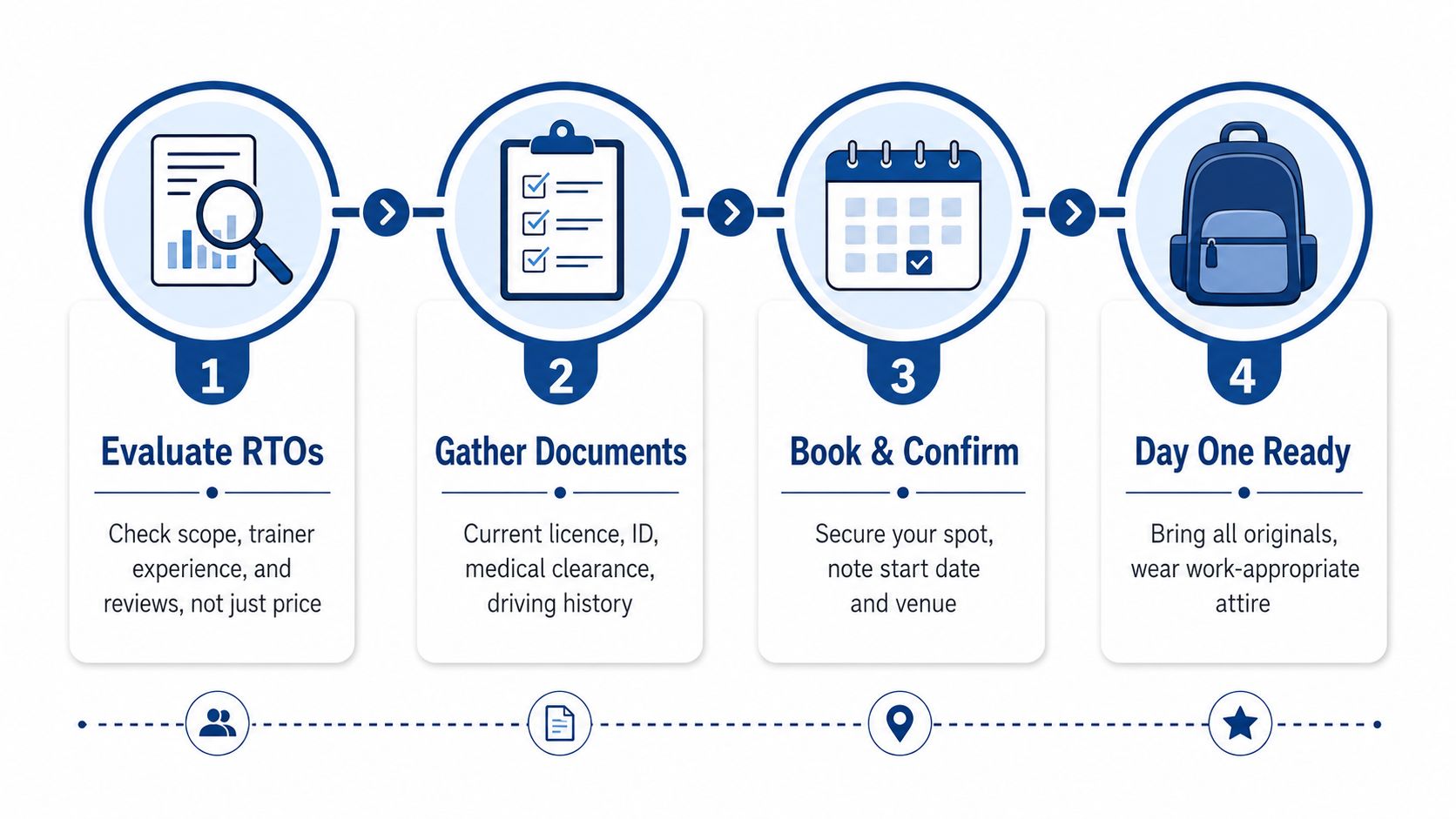
Arrive with your current driver licence, identity documents, available driving history evidence, completed medical documentation and Unique Student Identifier. Wear practical work clothing and suitable footwear. Bring reading glasses if you use them. Technical information and active participation take concentration, so having your documents and equipment ready helps you focus on the trainer's instructions.
Use this booking sequence:
- Confirm the load and licence requirement with your employer or consignor.
- Check your driver licence, medical and driving history position.
- Shortlist two or three RTOs and compare their delivery details.
- Request a pre-enrolment conversation if LLN or assessment requirements are unclear.
- Book training only when you can organise the EPA application within the required window.
The Sydney traffic controller training centre detailed comparison gives a useful example of questions to ask when comparing providers, including location and delivery arrangements.
TP Training provides practical, nationally recognised Dangerous Goods Drivers License Course training with experienced trainers and hands-on learning across NSW. If your work crosses the NSW licensing threshold, visit TP Training to review the course option with your eligibility documents ready.

You may also like

Trade Courses Sydney: 3 Career Pathways Worth Exploring

Mock Interview Online Preparation Guide