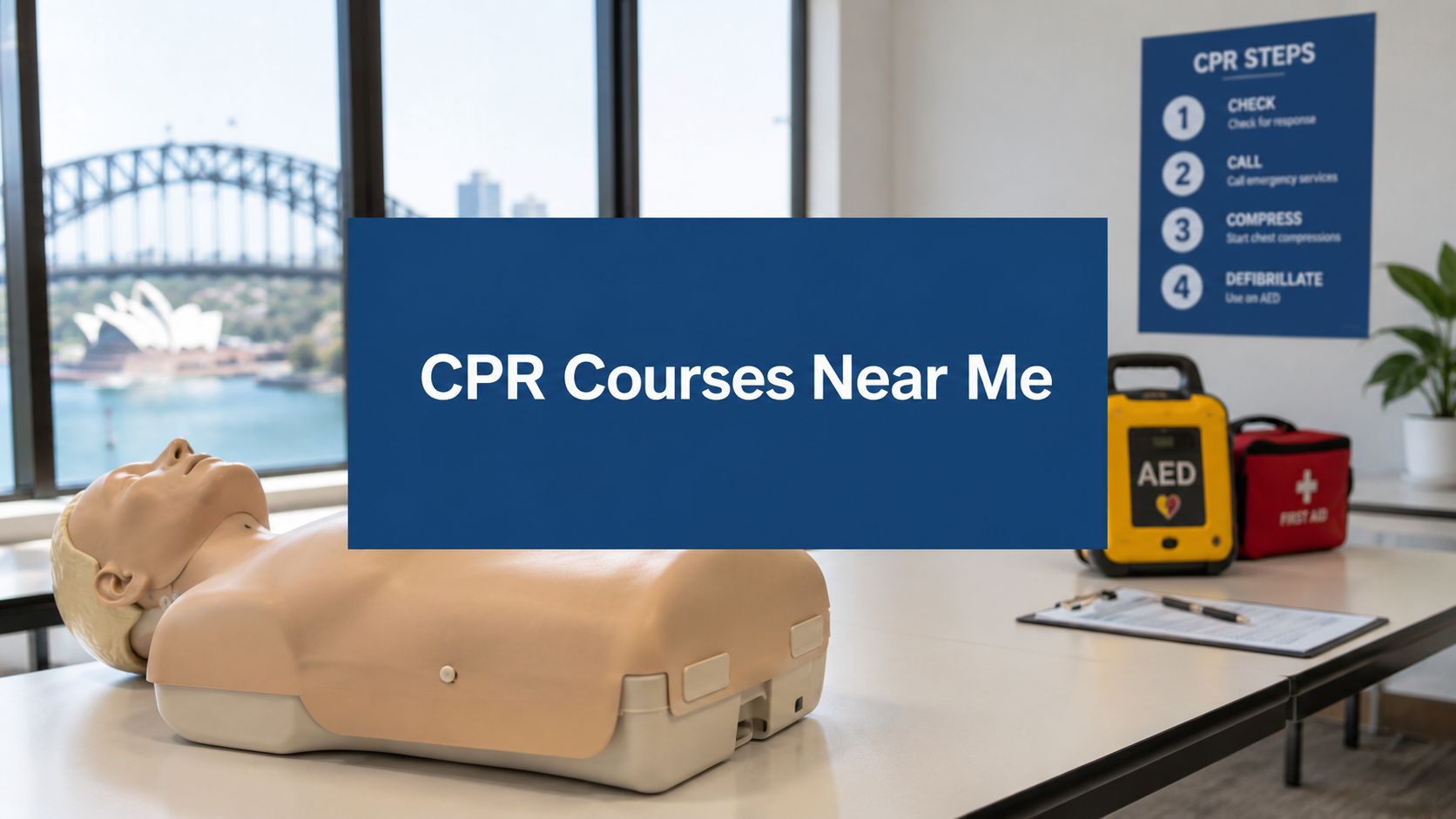
CPR Courses Near Me: How to Find the Right One in Sydney
You've got the tab open, your boss or site manager wants a current certificate, and you're trying to work out which local class is worth booking before the week disappears. In Sydney, that search for CPR courses near me shouldn't end at the closest date on a booking page. The course has to be recognised, assessed properly, and useful when someone drops in front of you.
If you choose badly, you get a certificate and very little else. If you choose well, you leave with a current HLTAID009 Provide cardiopulmonary resuscitation outcome, hands-on practice, and a clear idea of what to do under pressure. That difference matters, because CPR in Australia is built around nationally recognised competency standards and recurring workplace renewal, not a one-off class you forget about.
Table of Contents
- Why CPR Training Matters and What You're Really Booking
- Who Actually Needs a CPR Course and Which Type to Choose
- How to Compare CPR Course Providers Near You
- Why Assessment Quality Matters More Than the Cheapest Price
- What to Expect on the Day of Your CPR Course
- Booking a CPR Course Near You and Keeping It Current
Why CPR Training Matters and What You're Really Booking
A lot of Sydney people ring around for a certificate only after work has already put them on a deadline. A childcare centre asks for a current CPR renewal. A tradie gets told they can't step back on site without it. A hospitality worker needs to stay current because the venue treats emergency readiness as part of the job.
What you're booking is not a casual short course. In Australia, CPR training is built around the nationally endorsed unit HLTAID009 Provide cardiopulmonary resuscitation, and that sits inside a structured competency system so employers can align the result with workplace requirements. That's the bit many comparison pages skip. They sell convenience, but they don't tell you whether the course is the right recognised outcome.

Why the certificate keeps coming back every year
CPR is treated as a recurring compliance skill in many Australian workplaces, not something you do once and forget. A lot of employer training programs and provider guidance set the refresher window at 12 months for CPR competency maintenance, which is sensible when the skill is time-critical and easy to lose. The point isn't bureaucracy for its own sake, it's keeping people ready.
Practical rule: if your workplace says “current CPR”, assume they care about recent practice, not just any old paper in a folder.
Australia's need for CPR capability is real, not theoretical. The Australian Bureau of Statistics reported 42,471 deaths from ischemic heart diseases in 2023 in Australia, and that alone explains why CPR education is treated seriously across workplaces and community settings. The Australian Resuscitation Council also states that for every minute defibrillation is delayed, survival decreases by around 7–10%. That's why speed, confidence, and AED use matter as much as the certificate itself.
For NSW learners, I'd treat the course as a compliance plus capability decision. If the provider can't explain the recognition of HLTAID009, the renewal cycle, and the practical assessment standard, keep looking. If you want a broader employer context, TP Training's overview of CPR, first aid, white card, and workplace safety certifications shows how CPR sits alongside other workplace requirements, not in isolation.
Who Actually Needs a CPR Course and Which Type to Choose
The biggest mistake I see is people booking the wrong format because the search result looked simple. A stand-alone CPR renewal is not the same as a full first aid day, and it's definitely not the same as a childcare package that also needs anaphylaxis and asthma content. Choose the lane that matches your actual role, not the cheapest listing.
Match the course to the job
If you only need to keep CPR current, book the focused CPR module. That's the right choice for people whose employer wants a renewal rather than a full first aid qualification. Construction and trades workers often land here as well, especially when site rules want a current CPR result alongside other compliance documents.
Childcare and education staff usually need more than CPR alone. They commonly need HLTAID009 together with anaphylaxis and asthma training, because the workplace risk profile is broader and kids need faster recognition of respiratory and allergic emergencies. Hospitality and fitness staff often sit in the same recurring renewal rhythm, especially when their employer expects annual refreshers. If you work as a workplace first aid officer, the better move is often a combined CPR + first aid package, because you're expected to handle more than a collapse on the floor.
What each option usually covers
A focused CPR class should spend its time on the DRSABCD sequence, adult and infant manikin practice, and AED familiarisation. A full first aid day stretches further into broader incident management, which is useful but unnecessary if your only requirement is CPR renewal. Don't pay for a full day when a shorter targeted session fits the job.
A good provider explains the difference before you pay. A sloppy one sells the same class name to everyone and leaves the admin team to sort it out later.
For NSW workers who also move between care, community, and support settings, it can help to compare CPR with other role-based training. If you're also exploring support work pathways, the resource to browse NDIS nursing options is useful context because it shows how emergency response capability sits alongside broader care responsibilities.
One more practical note. TP Training's Basic Life Saving Course is the kind of local information page worth checking when you're deciding between CPR alone and a fuller emergency-response option.
If your role includes alcohol service as well as emergency response, the Provide Responsible Service Of Alcohol Course Rsa is another recognised NSW option, delivered with experienced trainers and hands-on learning across NSW. It's a different compliance box, but it often comes up in the same roster-heavy workplaces.
How to Compare CPR Course Providers Near You
Location is the easy part. Quality is what saves you from wasting a morning on a course that barely tests anything. I'd use four checks every time, no matter whether the listing is in Parramatta, Burwood, Auburn, Penrith, or the Sydney CBD.
The four checks that matter
First, confirm the provider is a registered Australian training organisation that issues HLTAID009. If they can't clearly show that, move on. Second, ask how much of the class is hands-on manikin practice versus theory. A CPR certificate without meaningful practice is weak value, even if the booking page looks polished.
Third, check the assessment method. Good courses observe compression rate, compression depth, and hand placement, because that's how real CPR performance gets measured. Fourth, ask about certificate turnaround if work depends on it. Same-day or fast issue matters when your manager wants proof before your next shift.
Use this checklist before you book
| Check | What to look for | Red flag |
|---|---|---|
| Accreditation | Issues HLTAID009 through a recognised Australian training organisation | Vague wording, no clear qualification name |
| Assessment method | Observed skills, not just a quiz | “Complete at your own pace” with no practical check |
| Practice time | Real adult and infant manikin time, AED use, repeated cycles | Mostly slides or video with little supervised practice |
| Location and turnaround | Convenient NSW venue and fast certificate issue | Slow admin, unclear dates, messy booking process |
Cheap online-only options often skip the bits that matter most. They may avoid real manikin time, skip AED practice, and never observe whether you can perform under pressure. That's fine if someone only wants a screen-based course. It's not fine if your employer expects real competence.
For a practical local comparison mindset, I also like resources that force you to think about verification rather than just booking convenience. The financial planning page PEO Metrics for finance teams is a good reminder that “near me” searches still need a quality filter, not just a postcode filter.
If you want a provider page that speaks to local accessibility as well as training delivery, TP Training's multilingual support information is worth a look, especially if language support affects how confidently someone learns and gets assessed.
Why Assessment Quality Matters More Than the Cheapest Price
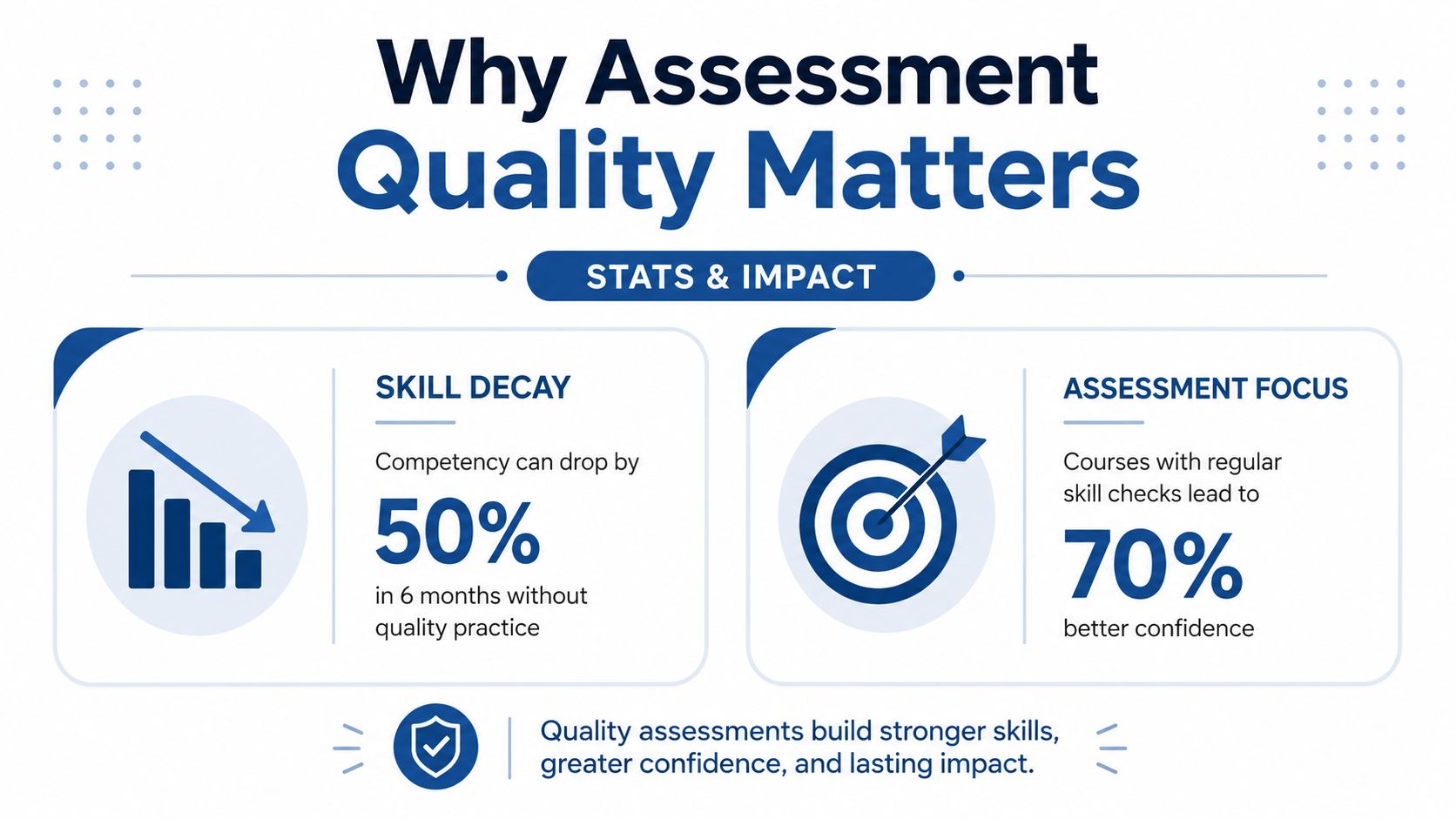
A cheap CPR course can look efficient and still leave you underprepared. That's the trap. The problem is skill decay, because CPR performance doesn't stay sharp just because you once sat through a class.
Skills fade, so assessment has to be real
Australian CPR education research and the Australian Resuscitation Council recommend checking chest-compression rate, depth, and hand placement immediately after training and again later, because retention drops. Broader randomized evidence shows the same pattern. One review found immediate post-training success around 63.1% in randomized trials and 59.7% at 2–4 months, while non-randomized studies fell from 88.17% to 72.9% over the same window. That is exactly why a quick attendance certificate is not enough. Source data on skill decay and retention
What better courses drill properly
The stronger courses keep the learner moving through the same sequence repeatedly, scene safety, responsiveness, breathing check, compressions, AED. They also use feedback manikins and timed cycles, so you can see whether your compression quality holds up instead of assuming it does.
My view: if a provider doesn't observe your compressions, it's too soft for workplace CPR.
That matters because early action saves lives. Australian guidance cites evidence that bystander CPR can roughly double or triple survival odds, and the Australian Resuscitation Council says every minute of delayed defibrillation drops survival by around 7–10%. When those are the stakes, a few dollars saved at booking time can be a false economy.
TP Training's how to get a White Card page sits in the same practical compliance mindset. Different ticket, same principle, get the right recognised outcome and make sure the training is properly assessed.
If your choice comes down to “cheapest online” versus “slightly more expensive with real practice time”, I'd take the second option without hesitation.
What to Expect on the Day of Your CPR Course
A good CPR day in Sydney should feel organised, not intimidating. You turn up in comfortable clothes, not heavy PPE, because the class is designed around movement, kneeling, compressions, and repeated practice. Bring photo ID, any required USI details if the provider asks for them, and any pre-course reading they've sent through.
The flow is usually simple
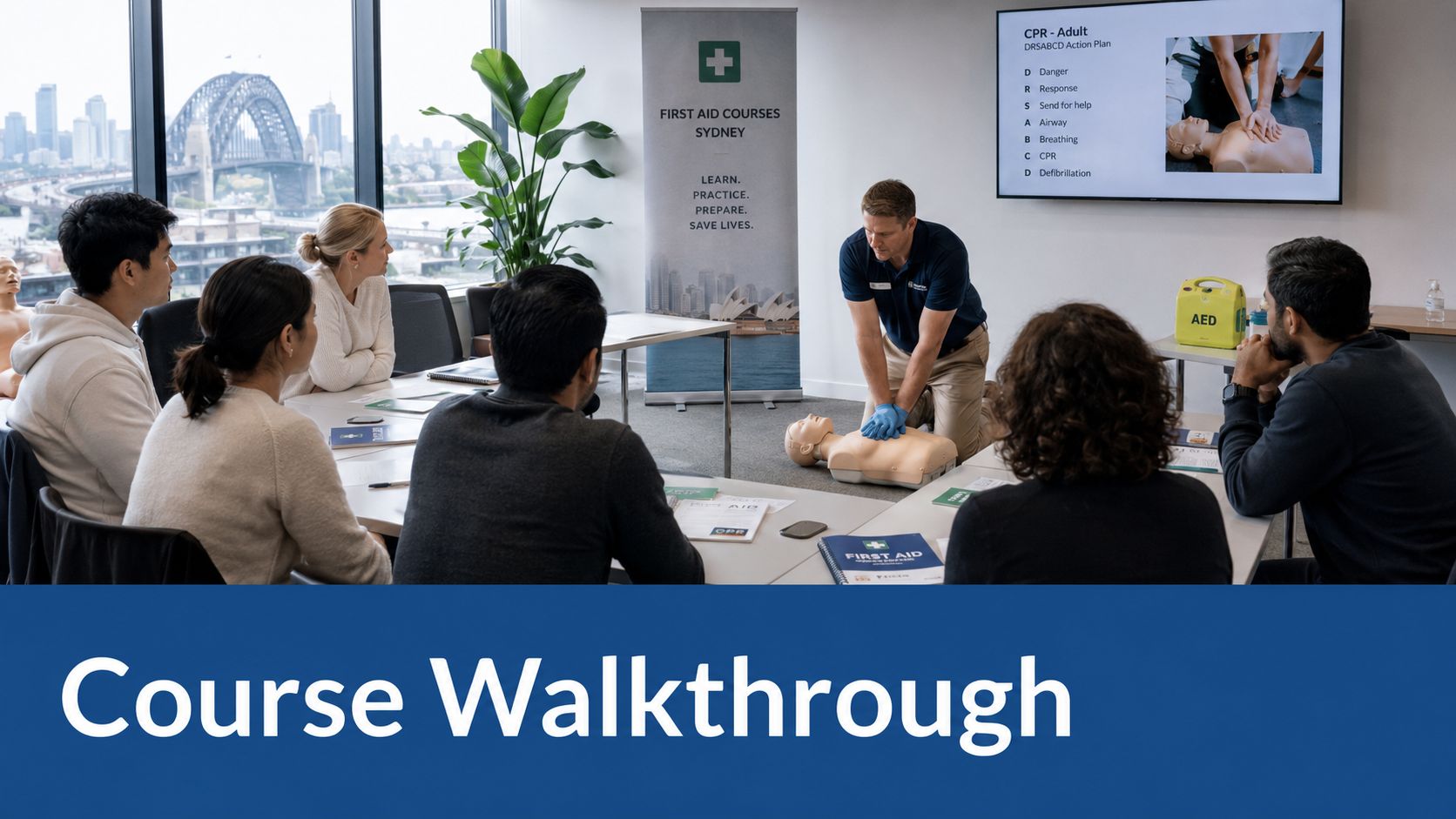
Most classes start with a short theory block, then move into a video or instructor demonstration of the DRSABCD sequence. After that comes the practical work on adult and infant manikins. That's the part people usually overthink, but it's just repetition with correction.
The assessment should be visible and direct. Expect observed scenarios, compression rate and depth checks, AED use, and a short incident response write-up or equivalent workplace-style documentation. If the trainer never watches you perform the steps, the class is too loose.
Most learners pass first time when they stay engaged and don't try to coast. Nervousness is normal, but the task is straightforward. The trainer wants to see that you can check the scene, respond to the person, start compressions, and use the AED sequence without freezing.
If English isn't your strongest language, ask about support before you book. Some NSW providers offer multilingual trainers, which helps a lot when the learner needs to understand instruction speed as well as the technique itself. If you do need to rebook, ask the provider's policy before the class starts, not after you've missed the session.
Booking a CPR Course Near You and Keeping It Current
Search smart, not broad. Add your suburb to CPR courses near me, then filter for HLTAID009 and a recognised NSW training organisation. If you're in Penrith, Burwood, Auburn, Parramatta, or the Sydney CBD, compare two or three providers using the four checks above before you tap the booking button.
What I'd do in practice
Book online if you want the fastest confirmation, then check weekday and weekend sessions before you pay. A lot of people assume the closest venue is the best fit, but the better choice is the one that matches shift patterns and gets you in the room without drama. Read the refund and rebook policy too, because life happens and a rigid admin process is a waste of everyone's time.
TP Training's NSW training centres are a convenient local option for people who want in-person delivery in Sydney and surrounding suburbs, and the organisation's broader course range makes it easy to line up CPR with other workplace training if needed. If you also need to sort out your student record details, the guide on creating and managing your USI is the kind of practical admin help that keeps enrolment moving.
Keep the renewal in view
Set a reminder for the 12-month CPR cycle as soon as you finish the class. Don't wait for your employer to chase you. If you're doing more than one workplace ticket, stack CPR with a related short course when it makes sense, because keeping the skill fresh is easier than rebuilding it from scratch each year.
The local habit I recommend is simple. Book the right course, confirm the recognition, complete the practical assessment properly, and lock the renewal date into your calendar before you leave the building.
If you want a practical NSW CPR booking path with recognised training, hands-on assessment, and convenient Sydney locations, start with TP Training and choose the course that matches your job, not just the nearest postcode. If you're ready to keep your certificate current, check the session times, compare the practical assessment quality, and book the class that will make you confident on the day it counts.

You may also like
High Risk Work Solutions in Australia: A Practical Guide
Basic Fatigue Management Course Guide for NSW Workers