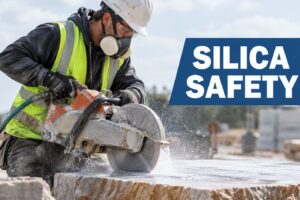

What Is a White Card and How Do You Get One in Australia
A White Card is the nationally recognised construction induction credential tied to CPCWHS1001, Prepare to Work Safely in the Construction Industry. You need it because it is a legal prerequisite for entering or working on many construction sites in Australia.
If you've heard the term but aren't sure what it really means, you're not alone. Plenty of people first hear “White Card” from a boss, a mate, or a job ad, then realise the card is more than a box to tick, it's the thing that lets you step onto site in the first place.
Table of Contents
- What a White Card Actually Is and Why It Exists
- Who Actually Needs a White Card on Site
- What the White Card Course Actually Teaches You
- How the Course Is Delivered and How to Enrol
- What a Real White Card Looks Like and How to Verify One
- Cross-State Recognition and Common Confusions
- Practical Next Steps and Common Questions
What a White Card Actually Is and Why It Exists
Most first-time workers want one simple answer, what is a White Card and why does everyone keep asking for it? In plain English, the White Card is Australia's nationally recognised construction induction credential, and it sits under CPCWHS1001, Prepare to Work Safely in the Construction Industry. It exists so workers get the same basic safety foundation before they enter a live worksite, whether they're in a city tower build, a housing job, or a civil project.
The legal point matters. A White Card is not just a certificate of attendance, it is a site-entry requirement for people who carry out construction work or regularly enter a construction site, including supervisors, site managers, apprentices, and other non-trade personnel. It is issued only after mandatory induction training through a Registered Training Organisation (RTO), and it applies across Australia rather than being limited to one state or territory. That national structure is what makes it so familiar to employers, because it gives them a common baseline before anyone starts work.
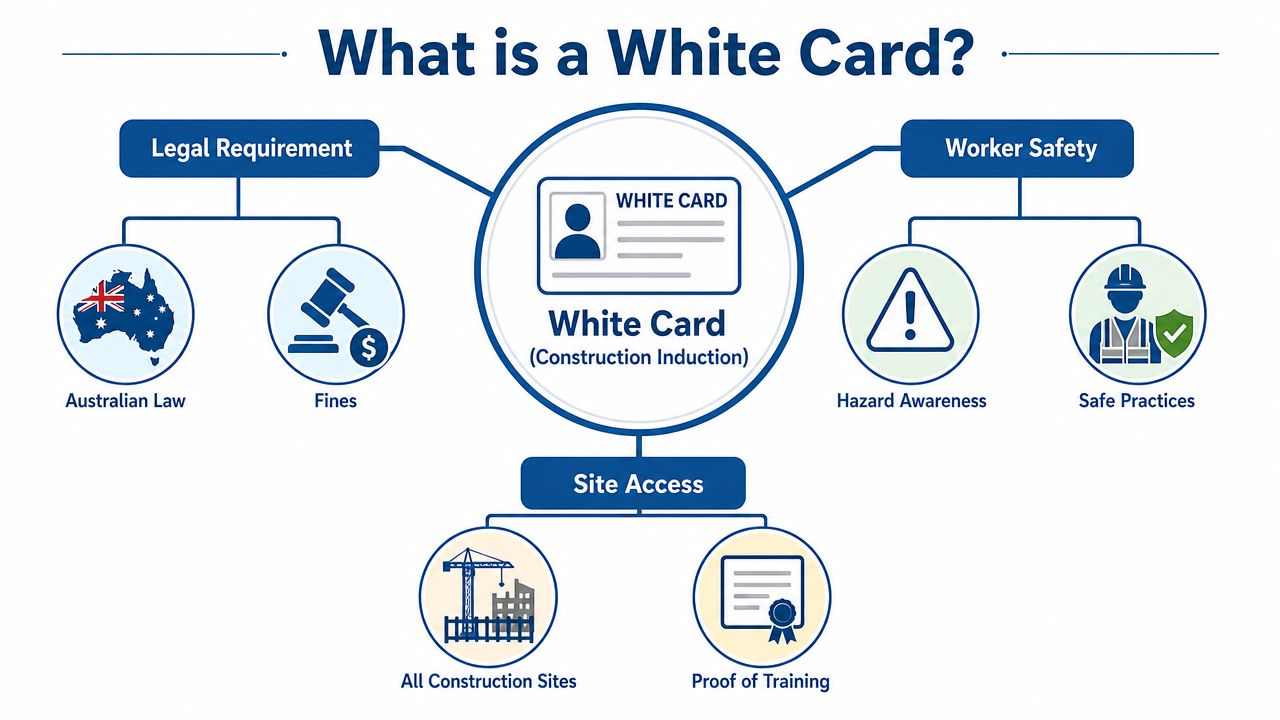
Why the card exists before the first day on site
Construction sites move fast, and new starters can miss hazards if nobody gives them a proper induction. The White Card is there to slow that first step down just enough to make sure a worker understands the basics of site safety, hazard awareness, and the chain of responsibility before they pick up tools or walk into active work areas.
Practical rule: if a role involves construction work, or regular access to a construction site, employers usually expect the White Card before the first shift.
That is why the credential matters beyond the classroom. It is the common starting point for people who want to work safely and be taken seriously by supervisors. If you're already thinking ahead, the rest of the article covers who needs one, what you learn, how enrolment works, and how to check that a card is legitimate once it's in someone's hand.
Who Actually Needs a White Card on Site
If you're asking whether you personally need one, the safest answer is to look at your actual job, not just the industry label. The White Card is required for construction labourers, tradespeople, apprentices, supervisors, site managers, and non-trade personnel who regularly enter active sites. In NSW, that usually includes anyone who is there to do work, manage work, or support work in a live construction environment.
The requirement doesn't stop at mainstream building work. It's also used in mining and quarrying, scaffolding, demolition, telecommunications, transportable premises, and some high-risk work involving asbestos. That wider use is a useful signal for job seekers, because a White Card can support entry into more than one type of high-risk workplace. If you're shifting between construction and related industries, the same basic induction often comes with you.
A simple way to think about it is this, if you're walking into an active worksite where hazards change from day to day, a White Card is usually part of the entry check. If you're sitting in an office away from the workface, or you're making a one-off casual visit with no site access needs, you usually don't need to book one just for that. The practical line is access and task, not job title alone.
For people heading into higher-risk site environments, related safety training often gets bundled into a longer career path, and some workers later add courses such as working at heights. Working at Heights course can sit naturally alongside White Card planning for workers whose roles expand beyond basic site access.
Good test: if the employer expects you to pass through site induction gates, wear PPE, or work near active trades, the White Card is probably part of your start-up checklist.
What the White Card Course Actually Teaches You
A White Card course gives you the working basics you need before you step onto a construction site. It is short, practical, and aimed at helping a new worker recognise common hazards, follow directions, and react properly when something on site does not look right.
The core skills you use on day one
The unit behind the credential, CPCWHS1001, turns into a few practical skills that matter from your first shift. You learn to spot hazards such as unguarded edges, moving plant, falling objects, poor housekeeping, and restricted access areas, then act on them instead of brushing them off. You also learn how WHS communication works, which means listening to site instructions, reporting problems, and following the induction rules that apply to that job.
A worker in western Sydney might arrive at a small commercial fit-out and be told to stay clear of a demolition zone. Another might be on a civil site where vehicle movement and exclusion areas are the main concern. The White Card course gives both workers a shared way to read those risks and respond the right way.
The course also covers safe work procedures, basic PPE use, incident reporting, and emergency response. If a chemical spill happens, or a barricade is moved, you need to know who to tell and what not to touch. That is the kind of practical judgement the induction is trying to build.
For learners who want a local option, the White Card Training Course outlines practical, nationally recognised training with experienced trainers and hands-on learning across NSW, which suits many first-time learners who want clear instruction rather than a theory-heavy class. If you are based near the city and want to compare delivery options, the White Card course Sydney CBD page is a useful place to check what the training looks like in a central location.
What the assessment feels like
Many learners expect a long exam, then relax when they see the assessment is usually built around group discussion, scenario-based activities, and a short knowledge check. You are not being asked to write an essay on safety law. You are being asked to show that you can recognise a hazard, follow a process, and make sensible decisions on site.
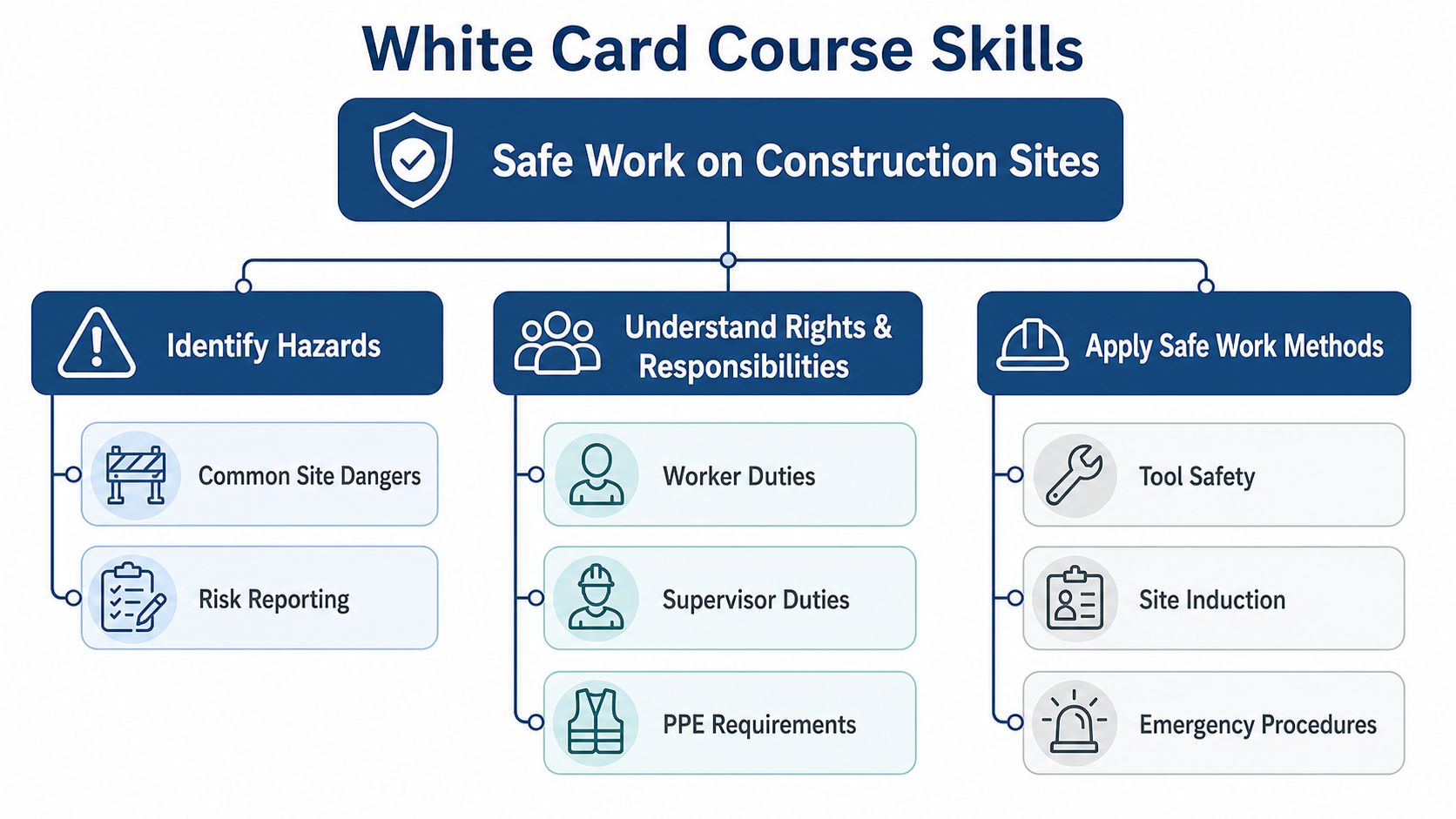
That is why the course is such a common starting point. It gives new workers enough practical awareness to walk onto site with less confusion and fewer avoidable mistakes. If you have never done construction before, that first layer of confidence matters almost as much as the card itself.
How the Course Is Delivered and How to Enrol
Booking a White Card course is usually simpler than people expect. In NSW, the common model is face-to-face classroom delivery, and that suits first-time learners who want a trainer in the room to explain site rules, answer questions, and correct misunderstandings quickly. Some states allow online components under approved rules, but the key is still that the training pathway has to be recognised and assessed properly.
Face-to-face or blended delivery
Face-to-face training works well for people who want a straightforward day and don't want to guess whether they've completed the right steps. It also helps if you're new to construction language, because a trainer can explain terms like exclusion zone, induction, or PPE without making you feel behind. Blended or online components can suit workers who are already familiar with the site environment, but only where the state rules and training provider arrangements allow it.
The enrolment flow is usually simple. You choose a date, book online or by phone, receive confirmation, attend the training centre, and complete the assessment. In most cases, you'll leave with a Statement of Attainment on the same day, while the physical card is processed afterwards.
What to bring and where people usually book
First-time learners often worry they need to buy gear before they arrive. In many cases, PPE is provided, so you don't need to turn up with a hard hat and boots just to sit the induction. That lowers the barrier for job seekers who are starting from scratch and don't yet know what their employer will require.
TP Training lists practical NSW locations including Penrith, Burwood, Auburn, Parramatta, and Sydney CBD, which is handy for Sydney-based learners trying to fit training around public transport or a first job interview. The provider's own USI guidance is also useful if you need to check your student details before enrolment, and the process is explained in this USI resource.
Booking tip: pick the location that's easiest to reach on time, not just the one that looks closest on a map. For a short induction course, punctuality matters more than anything else.
What a Real White Card Looks Like and How to Verify One
A real White Card is usually easy to recognise once you know the basics. It is a credit-card-sized plastic card with a white or light background, the title “General Construction Induction Card,” the worker's full name, a unique card number, the date of issue, and the issuing RTO details. Those printed fields matter because they let a supervisor trace the card back to the organisation that issued it.
That visual check is the first step, not the last one. Site supervisors and employers often want to know whether the training organisation is legitimate and whether the worker has completed the right induction. A current Statement of Attainment can be enough in the short term while the physical card is being produced, which is why new starters should keep their paperwork handy on day one.
How supervisors usually check it
The practical workflow is simple. They look at the card details, match the worker to the document, and confirm the training organisation where needed. If the printed information doesn't line up, or the card looks altered, that's when the conversation gets serious. The point is to prevent a person from entering site on false credentials.
If you need a quick visual reference for card details, How to Find Your White Card Number is useful because it focuses on the card number itself, which is one of the easiest identifiers to check against paperwork.
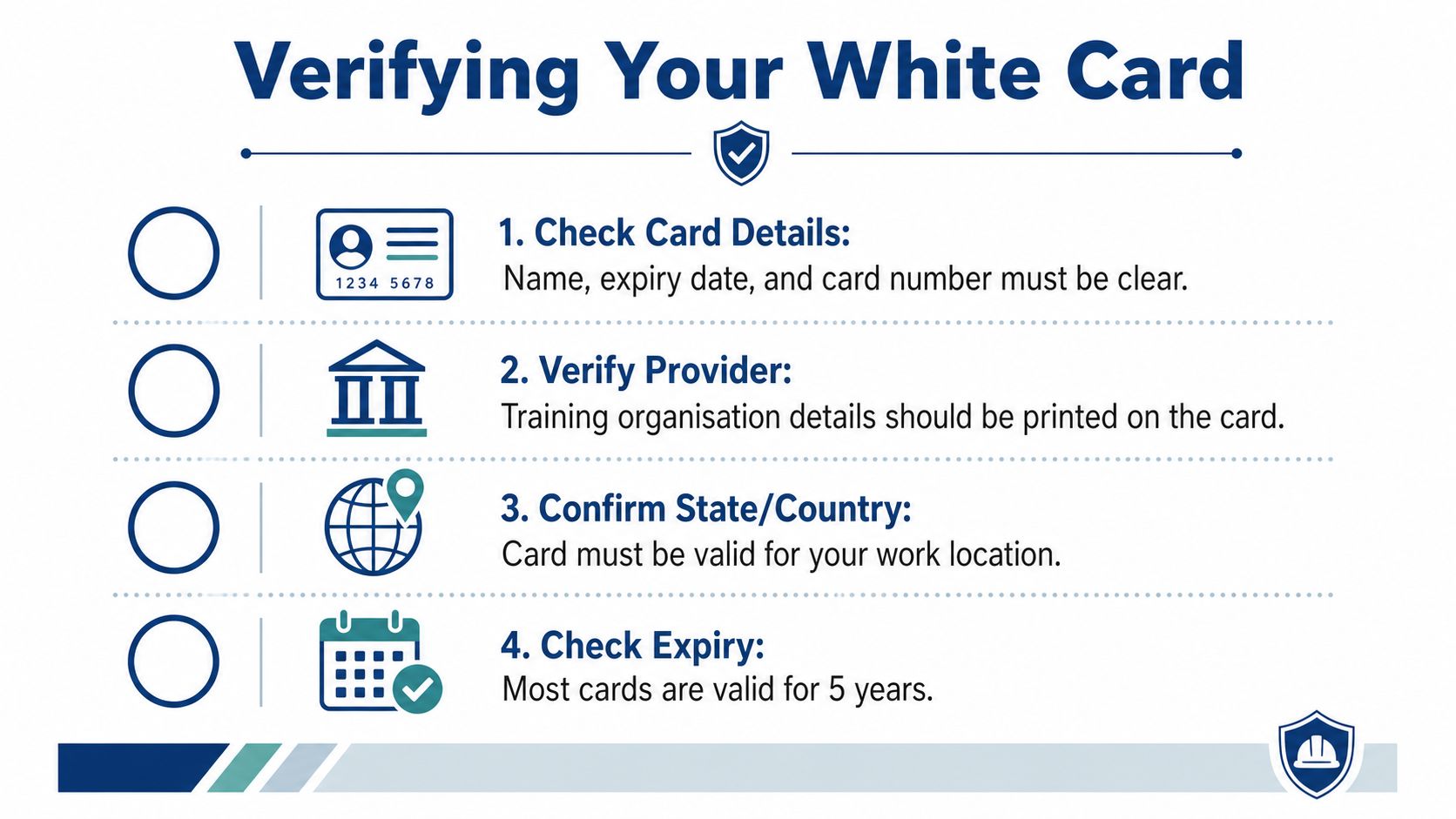
A supervisor doesn't need a long story. They need a card, a name, and proof the induction came from a proper training provider.
That's why verification is part of real site control, not just admin. It protects the team, reduces confusion at the gate, and makes sure the card in someone's wallet means something on the job.
Cross-State Recognition and Common Confusions
The first question many workers ask is simple. If a White Card is completed in one state, can it be used in another, and what happens when the first day on a NSW site arrives?
What travels with you and what doesn't
The White Card itself travels with you. A worker who completed the course in Queensland, for example, can still present that card on a NSW worksite if it is valid and issued through proper training channels. The site induction does not travel with you, because each project has its own hazards, access rules, and safety procedures. That is where confusion often starts. People see a nationally recognised card and assume it replaces every other safety step.
The national training register is what lets employers check that a card came from a real training organisation. That matters because course delivery can vary, and workers may complete training in different ways depending on the approved provider. Recognition depends on legitimate completion, not just on carrying a plastic card in your wallet.
Day-one evidence can also cause uncertainty. Some employers will accept a current Statement of Attainment while the physical card is still being issued, while others want the card as soon as it is available. That is a site process issue, not a different rule. The requirement stays the same, but the supervisor still decides what paperwork is enough for a safe start on site.
Where people still trip up
A lot of confusion comes from guides that say the card is “valid across Australia” and stop there. That statement is true, but it leaves out the part workers meet at the gate. Recognition is national, yet site-specific induction, employer paperwork, and evidence of completion can still differ from one job to another.
A practical comparison helps here. The White Card is only one part of the entry process, and it often sits beside other checks such as CPR or first aid. If you want to compare those training pathways, CPR, First Aid, White Card and Workplace Safety Certifications shows how the requirements relate to one another without turning every ticket into the same thing.
If you want a broader view of licensing and state-based entry rules, the overview at state contractor rules helps explain why portable credentials still sit alongside local compliance checks. The same pattern shows up with the White Card, national recognition at the core, with local site steps on top.
Once a worker understands that split, the card becomes less mysterious. It is a national baseline for construction safety, and it still sits inside a local site system that can ask for its own proof, its own induction, and its own sign-in checks.
Practical Next Steps and Common Questions
What happens after you hear the words “White Card” for the first time? For many new starters in NSW, the next steps are simple, but they still feel unfamiliar until someone explains the path from booking to holding the card on site. A White Card course usually takes a single day, and one Australian training provider example lists a course fee of $208 (TAFE Gippsland). That gives you a realistic sense of the time and cost commitment before you book. The course is a paid compliance step, not a casual workplace introduction.
| Detail | Typical Answer |
|---|---|
| Course length | A single day |
| Course fee | One example provider lists $208 |
| Delivery | Usually face-to-face in NSW |
| Evidence on completion | Statement of Attainment, then the physical card |
| What to bring | Booking confirmation and identification as advised by the provider |
| What if the card is lost | Ask the issuing RTO or the provider about replacement steps |
Once people understand that the White Card is only one piece of site entry, the rest makes more sense. It works alongside other checks, such as employer paperwork and site induction, so workers can arrive with the right evidence instead of guessing at the gate. If you want to compare how the White Card sits beside other entry requirements and licence checks, the broader discussion around state contractor rules helps explain why portable credentials still sit next to local compliance checks.
A few last practical answers
You usually do not need months of study for this one. You need to turn up, follow the trainer's instructions, and show you understand the basics of working safely. On a NSW site, that might mean knowing where to sign in, what protective gear is expected, and why the supervisor wants your proof of completion before you start work.
If your card is lost, contact the issuing training organisation and ask what replacement proof they can issue. Keep your enrolment records and Statement of Attainment details somewhere safe, because those details make replacement easier when you need it.
For a new starter, the smartest next step is simple. Choose a nearby NSW location, book a date that suits your schedule, and arrive ready to learn. If you want a straightforward path into construction safety training, TP Training can help with White Card enrolment, practical delivery, and the kind of first-day guidance that makes the process less intimidating.

You may also like

Barista Course NSW: A Practical Guide to Getting Started