CPR Course Parramatta: What to Expect and How to Book
You've been asked to show a current CPR qualification before starting a new job, renewing a workplace requirement, or joining a role where you may need to respond to an emergency. You want a course near work or home, but you also want to know what happens in the classroom, what the assessment involves, and when you'll need to refresh the skill again.
A CPR course in Parramatta is usually a practical, focused session rather than a difficult academic exercise. The training centres on HLTAID009 Provide Cardiopulmonary Resuscitation, hands-on practice with manikins, AED operation, and a clear NSW refresher rhythm that helps workers keep their skills current.
Table of Contents
- A Typical Morning in a Parramatta CPR Class
- What HLTAID009 Means for CPR Training in Parramatta
- Inside the Classroom – Skills and Assessment
- Prerequisites and What to Bring on the Day
- Course Length, Schedule and NSW Refresher Cycle
- Who a Parramatta CPR Course Is For
- Booking Your TP Training Parramatta CPR Session
- Key Takeaways Before You Book
A Typical Morning in a Parramatta CPR Class
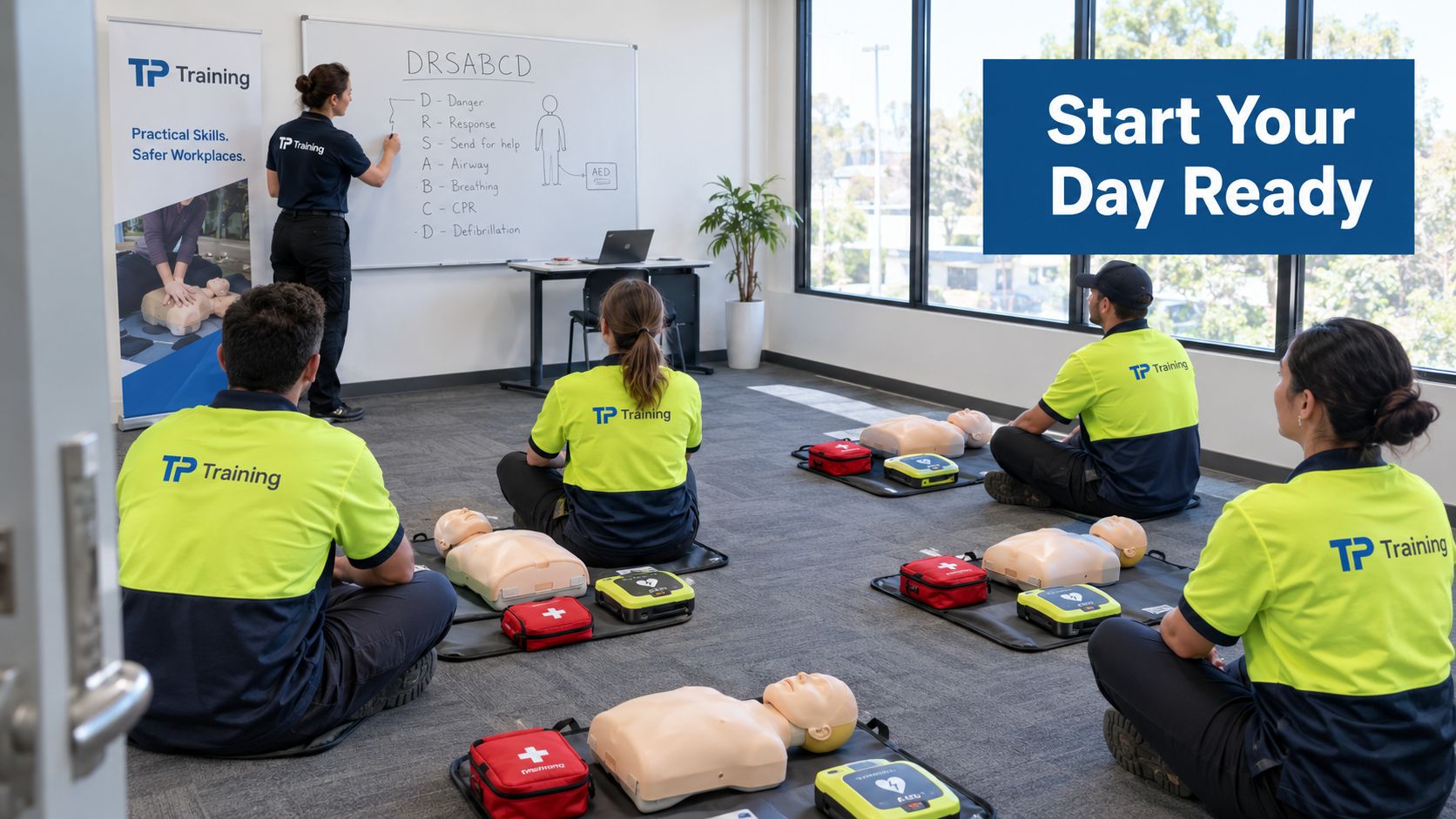
Just after 8am, a learner arrives at a TP Training Parramatta classroom with a coffee in one hand and a booking confirmation on their phone. They may be a construction worker between projects, a parent fitting training around school drop-off, or a jobseeker adding a current qualification to their résumé. The group is mixed, and that's normal for a Parramatta CPR class.
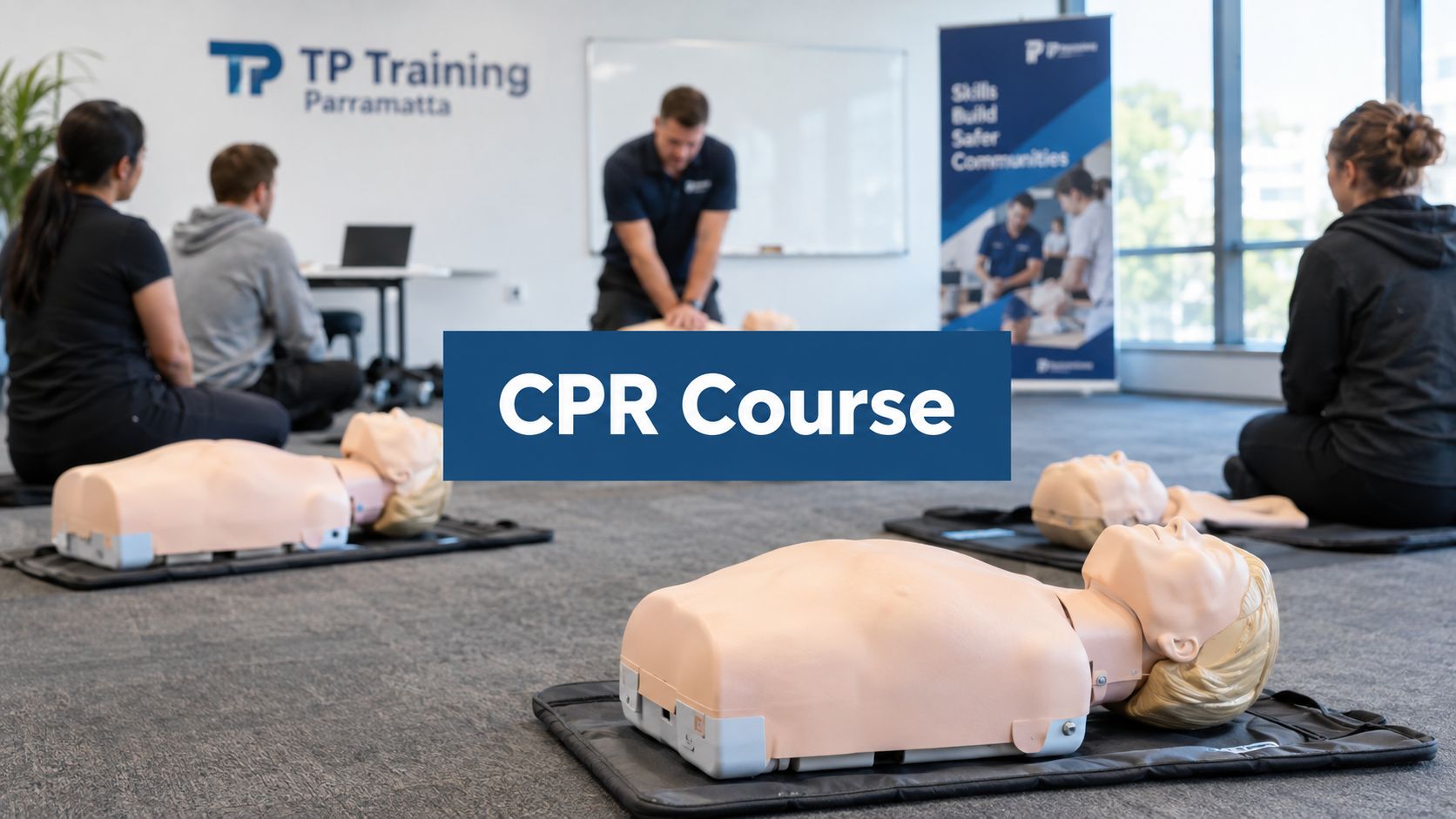
Inside, the room is organised for movement. Manikins are spaced across the floor, training equipment is ready for use, and the whiteboard carries the DRSABCD emergency action plan. The trainer starts by making the room feel manageable. Nobody is expected to perform perfectly on the first attempt, and nobody needs previous first aid experience to participate.
Arrival and the first discussion
After sign-in, the trainer checks learner details and explains how the session will run. The opening conversation is practical rather than intimidating. One person may need CPR for a hospitality role, another may work around machinery, and someone else may just want confidence after seeing an emergency in the community.
That conversation matters because CPR isn't learned by memorising a certificate title. Learners need to understand what they'll do when an unresponsive person is on the floor and other people are looking to them for direction.
Practical rule: Start with safety, check the person's response, and send for help early. A calm sequence is more useful than rushing into compressions without assessing the scene.
From demonstration to practice
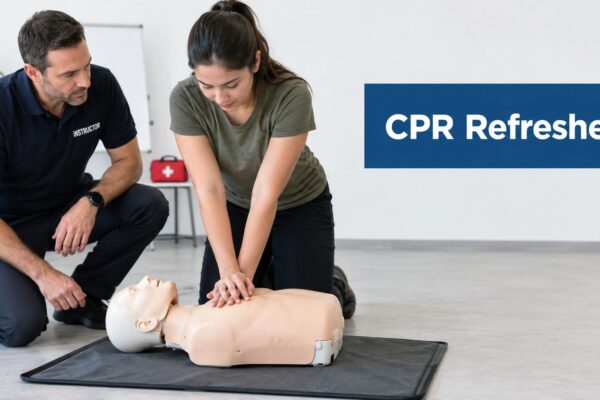
The trainer demonstrates the first compression cycle, including hand position, body alignment, depth, and the need to allow the chest to recoil fully. Learners then move to their own manikins and practise. The trainer walks around the room, correcting posture and helping participants find a sustainable rhythm.
The first few compressions can feel awkward. That's expected. The purpose of the class is to turn verbal instructions into physical actions, so learners can practise the sequence before they ever need it at work, at home, or in a public place.
What HLTAID009 Means for CPR Training in Parramatta
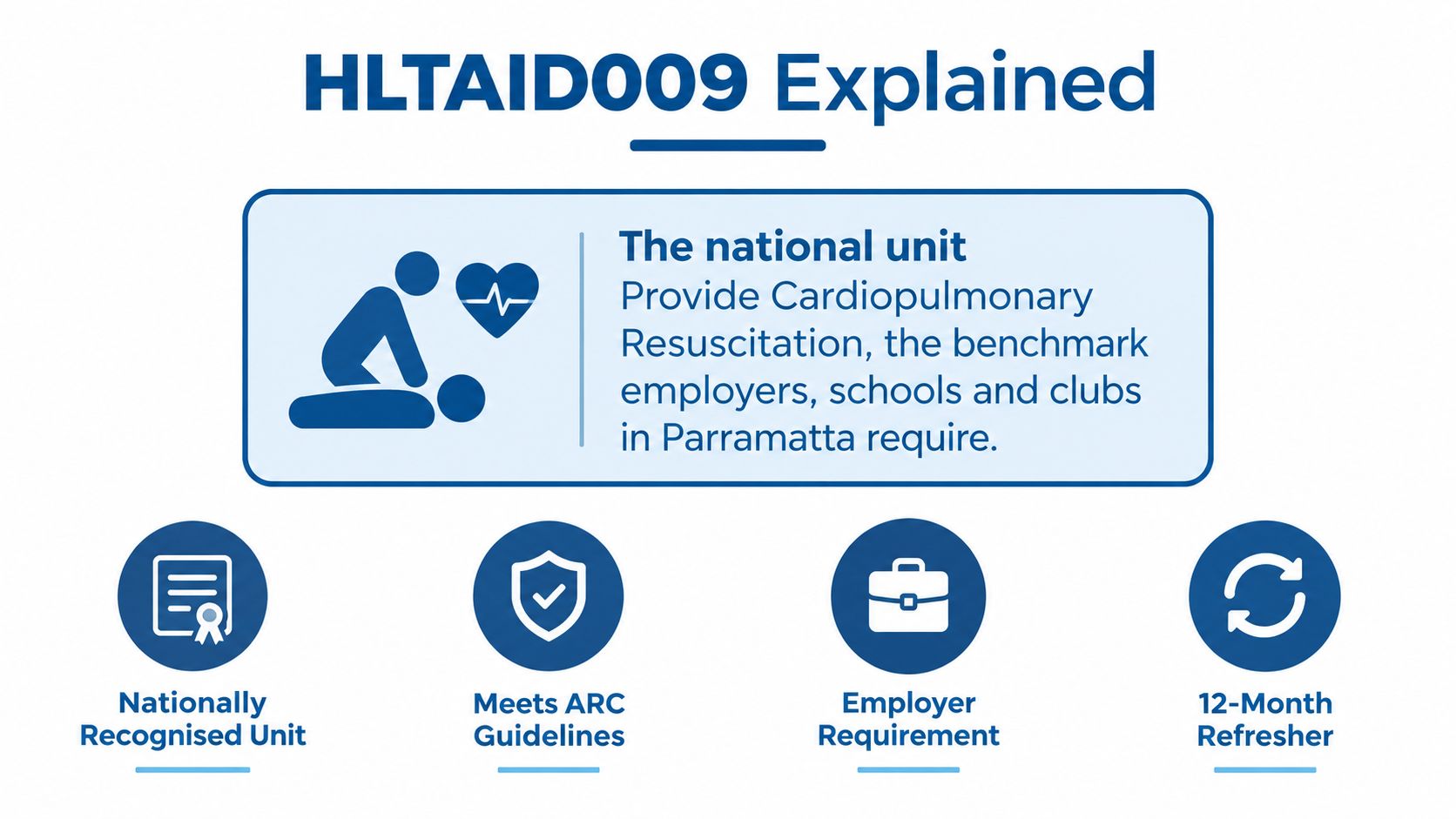
HLTAID009 Provide Cardiopulmonary Resuscitation is the nationally recognised unit used by CPR training providers across Australia. Parramatta providers commonly advertise CPR sessions under this code, while the broader first aid unit is HLTAID011 Provide First Aid. The shared codes give employers and learners a consistent way to identify the training outcome, regardless of which approved venue delivers it. See the Parramatta course information for examples of how local providers present these units.
In plain language, HLTAID009 means you're being assessed on whether you can respond to a simulated emergency, perform CPR, and use an AED in line with Australian Resuscitation Council guidance. The official HLTAID009 unit requirements include CPR procedures and AED operation according to manufacturer instructions.
Competency is demonstrated, not ranked
This is competency-based assessment. You aren't competing against the other people in the room, and you aren't placed on a bell curve. You demonstrate the required skills, receive feedback, and have the opportunity to correct and repeat a task if the trainer identifies something that needs attention.
The trainer is looking for safe, consistent performance. That includes recognising an emergency, following the response sequence, providing compressions and breaths appropriately, and operating the AED safely. A written task may check knowledge, but practical demonstration is central to the qualification.
The code also helps prevent a common misunderstanding. Completing a CPR course isn't the same as holding a full first aid qualification. HLTAID009 focuses on cardiopulmonary resuscitation, while HLTAID011 covers a wider range of first aid responses. If your employer asks for the broader unit, check the requirement before booking. TP Training also provides information about the HLTAID011 first aid course for learners comparing the two pathways.
Inside the Classroom – Skills and Assessment
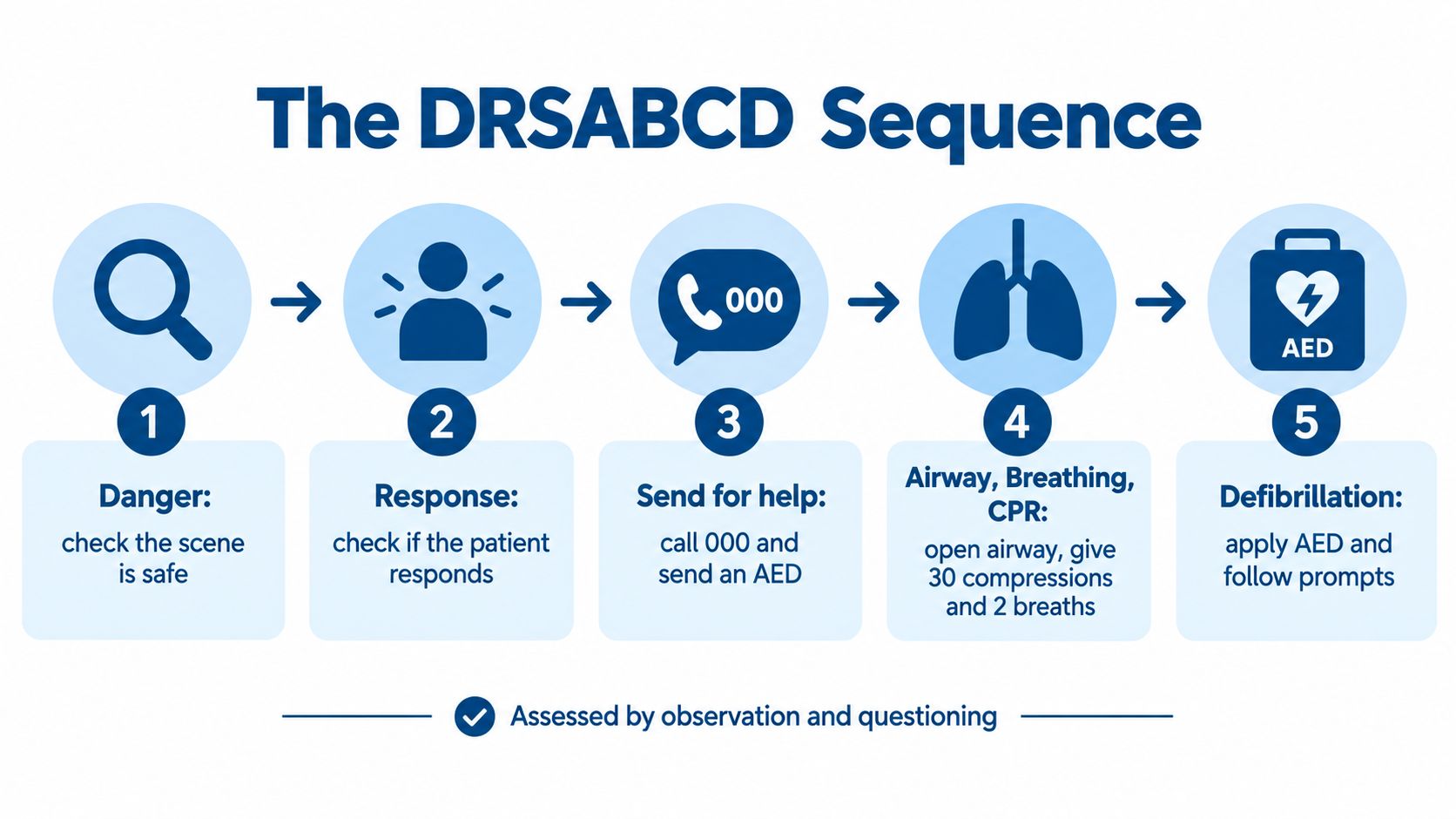
The practical lesson follows the DRSABCD sequence so learners have a repeatable structure under pressure. The letters guide the first response, from checking the scene to using a defibrillator, rather than asking a learner to remember disconnected techniques.
The sequence learners practise
- Danger: Check that the scene is safe for you, the casualty, and other people.
- Response: Check whether the person responds to your voice or touch.
- Send for help: Call 000, ask someone to fetch an AED, and make the emergency clear.
- Airway: Open the airway using the taught technique.
- Breathing: Look, listen, and feel for normal breathing.
- CPR: Begin compressions and rescue breaths when indicated.
- Defibrillation: Attach the AED and follow its spoken and visual prompts.
For adult CPR, Healthdirect's Australian guidance describes 5 sets of 30 compressions and 2 breaths in about 2 minutes. If compressions-only CPR is used, the target is about 100 to 120 compressions per minute. Better Health Channel guidance states that adult compressions should reach at least one-third of the chest depth, around 5 cm in adults.
What the trainer observes
Assessment takes place on manikins, not through a theory exam alone. The official HLTAID009 assessment requirements require evidence that CPR tasks are completed under relevant state or territory regulations and workplace procedures. A Parramatta provider also specifies 2 minutes of uninterrupted CPR on an adult manikin on the floor, which reflects the physical nature of the benchmark.
The trainer watches hand placement, compression rhythm, depth, recoil, airway management, rescue breaths, and AED safety. You may also answer questions about why you took a particular action. The aim is to show that you can combine knowledge and movement in a realistic scenario.
During practice, quality matters more than speed. Keep your shoulders over your hands, listen to the AED, and follow the sequence rather than trying to guess the next step.
Learners who want a plain-language explanation of foundational emergency response can also review TP Training's basic life-saving course guidance.
Prerequisites and What to Bring on the Day
A Parramatta CPR course doesn't require formal academic qualifications, but participants need to meet practical and communication requirements. Learners must be at least 14 years old and physically able to complete 2 minutes of uninterrupted chest compressions on a manikin placed on the floor, as reflected in provider entry information and the practical assessment expectations.
You'll need enough English literacy to follow spoken instructions, read short scenarios, communicate during an emergency simulation, and understand the assessment questions. You don't need previous first aid knowledge. Complete beginners are common, and the trainer takes the group through each action before asking anyone to perform it independently.
Prepare your body and documents
Tell the training provider before booking if you have an injury, are pregnant, or have a mobility concern. The trainer may be able to adjust manikin positioning or discuss a safer way to participate, but you should not wait until the assessment begins to disclose a limitation.
Wear clothing that allows kneeling, bending, and leaning over a manikin. Restrictive workwear and high heels can make the practical session uncomfortable. Bring valid photo identification, such as a driver licence or passport, for identity and USI checks. A notepad can help, although handouts are provided digitally.
TP Training's USI management guide can help if you need to locate or manage your Unique Student Identifier before enrolment. Learners moving into traffic-related work may also compare the Prepare Work Zone Traffic Management Plan Course Pwz Red Card, which TP Training delivers as practical, nationally recognised training with experienced trainers and hands-on learning across NSW.
Course Length, Schedule and NSW Refresher Cycle
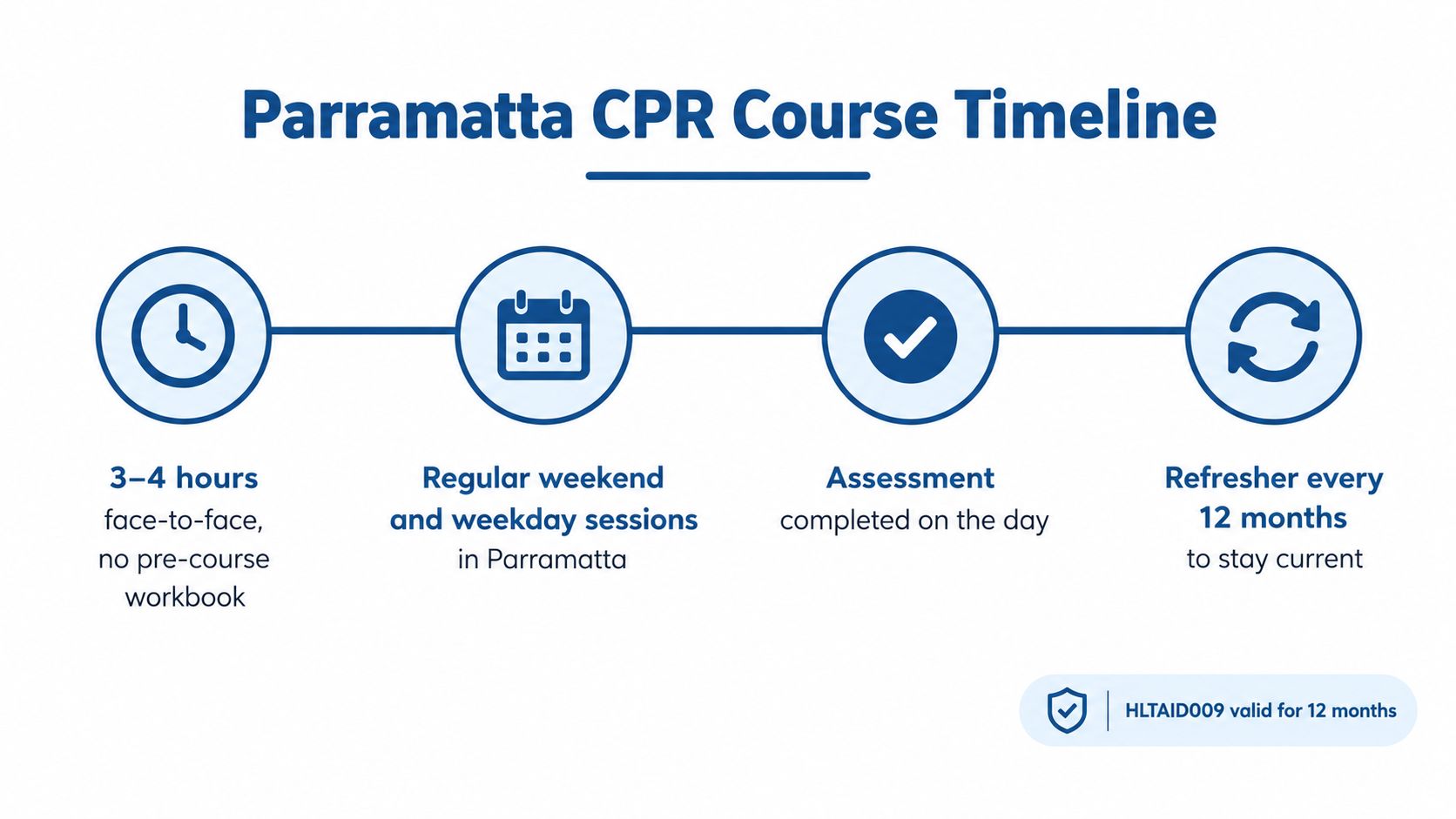
Local course listings show that Parramatta CPR sessions commonly run in compact blocks of about 2.5 to 4 hours, with advertised prices ranging from $45 to $59. Venues listed in or near Parramatta include 96 Phillip St, 18-40 Anderson St, 125 Church Street, 35 Smith Street, and 12-14 Wentworth St, giving workers and jobseekers several accessible options. Some listings also advertise same-day certification and multiple weekly dates in September 2026, so check the provider's current calendar before relying on a particular time or price. Parramatta CPR course listings provide examples of this local availability.
A standalone HLTAID009 session is designed to fit around ordinary work and family commitments. Providers may offer weekday mornings, weekday afternoons, and rotating Saturdays, while the exact timetable depends on the venue. For organisations planning several staff members, a group booking can make attendance easier to coordinate than asking each worker to enrol separately.
The compliance cycle has two clocks
The most useful planning distinction is between CPR currency and broader first aid renewal. SafeWork NSW's workplace first aid guidance says CPR refresher training should be completed annually, while first aid qualifications should be renewed every three years.
| Training need | Practical planning point |
|---|---|
| HLTAID009 CPR | Plan an annual refresher to keep CPR skills current. |
| HLTAID011 first aid | Plan renewal every three years, subject to workplace and regulator requirements. |
| Employer policy | Check whether your organisation sets an earlier date or additional requirement. |
Keep the annual CPR refresher as a recurring calendar appointment. Then track the wider three-year first aid renewal separately, so an employee doesn't assume that completing one course keeps every first aid obligation current.
Website teams building training enrolment pages may also find flexible course CMS themes useful when presenting schedules and course information clearly. For learners, TP Training's guidance on how often CPR should be refreshed offers another way to plan the recurring date.
Who a Parramatta CPR Course Is For
A CPR qualification suits people who could become the first capable responder at work, in a community setting, or at home. In Parramatta, that includes hospitality staff in cafés and restaurants, construction workers moving between western Sydney sites, and early childhood educators meeting role-specific safety expectations.
Consider three ordinary booking decisions. A hospitality worker wants a current qualification before applying for a café position, so they choose a local session that fits around shifts. A construction tradie books after a supervisor reminds the team that emergency skills need regular practice. A childcare educator checks whether the employer needs HLTAID009 alone or the broader HLTAID011 first aid unit before selecting a course.
Different roles, the same core actions
Fitness instructors, aged care workers, teachers, retail supervisors, and corporate WHS representatives all benefit from the same practical sequence. The workplace changes, but the first response still begins with scene safety, a response check, a call for help, CPR, and AED use.
School-leavers and jobseekers often choose CPR training because it supports applications in hospitality, community services, care, and other people-facing roles. Parents and grandparents may book for a different reason, such as refreshing skills after a worrying personal experience. The motivation varies, but the class gives each learner the same opportunity to practise.
Confidence comes from repetition. You don't need to arrive feeling like an emergency responder. You need to be willing to practise the sequence, accept corrections, and demonstrate the skill safely.
The course is also relevant to anyone who wants transferable emergency capability rather than a certificate kept in a drawer. Ask your employer which unit and currency date they require, then choose training that matches that requirement.
Booking Your TP Training Parramatta CPR Session
Booking should begin with the exact unit your employer or organisation has requested. Select HLTAID009 Provide Cardiopulmonary Resuscitation, review the Parramatta date and location, and check the session length before confirming. Local listings show different venues and compact delivery blocks, so don't assume every course has the same timetable or assessment arrangement.
Complete the enrolment carefully
Enter your legal details as they need to appear on training records, confirm your contact email, and have your USI information available. Payment arrangements depend on the provider's booking terms. TP Training may outline options such as paying upfront or arranging payment on the day, while employers booking several staff can ask about group billing and coordinated attendance.
If you can't attend, contact the provider as early as possible. Rescheduling depends on the applicable booking window and available sessions, so waiting until the start time can limit your options. Your confirmation email should become the practical reference point for the address, arrival time, identification requirements, and any pre-course information.
TP Training's overview of CPR courses near you can help you compare location and course details before choosing a session.
Know what happens at the campus
Arrive with enough time to find the sign-in desk and prepare for the learner briefing. Staff check photo identification, confirm enrolment details, and explain the classroom rules for using manikins, cleaning equipment, and moving safely around the training floor. The trainer then introduces the DRSABCD sequence and establishes how questions and repeat attempts will work.
During the session, you'll demonstrate practical skills on adult and infant manikins, use an AED trainer, and complete the required knowledge task. The practical evidence is collected through observation, while the written component checks that you understand the decisions behind the actions.
A learner who needs feedback can ask for it during practice, not only at the end. Trainers can correct hand position, body alignment, compression rhythm, airway technique, and AED handling before the final demonstration. That feedback loop is why the classroom experience feels more like coached skill development than a traditional exam.
Receive and store your result
After you demonstrate competency and complete the required assessment activities, the Statement of Attainment for HLTAID009 is issued digitally according to the provider's processing arrangements. TP Training describes digital records as being stored in the student account for later employer verification, with delivery commonly expected on the same day or within 24 hours. Confirm the exact timing with the campus when booking.
Save the digital statement in a place you can access from your phone and forward it to your employer if requested. Add the next annual CPR refresher to your calendar immediately, then keep the broader first aid renewal date separate if you also hold HLTAID011.
Key Takeaways Before You Book
A Parramatta CPR course is a short, practical investment in being ready to act when someone becomes unresponsive. The central qualification is HLTAID009 Provide Cardiopulmonary Resuscitation, a nationally recognised unit that focuses on DRSABCD, CPR technique, rescue breaths where appropriate, and safe AED use.
You don't need to arrive with a first aid background. You do need to be prepared to kneel, practise compressions on a manikin, follow spoken instructions, and demonstrate the required actions. The assessment is based on observed performance and supporting knowledge, so a certificate is not awarded just for sitting in the room.
Check these points before you enrol
- Confirm the unit: Make sure the booking is for HLTAID009 if that's what your employer or organisation has requested.
- Check the venue: Parramatta has multiple local and nearby training locations, so verify the address and arrival instructions.
- Prepare physically: Wear clothing that allows kneeling and tell the provider about injuries, pregnancy, or mobility concerns.
- Bring identification: Have valid photo ID and your USI details ready for enrolment and certification.
- Plan the next date: NSW guidance sets an annual CPR refresher expectation and a three-year first aid renewal cycle, so record both dates separately.
Course timing and prices vary between providers, and advertised local sessions can change. Compare the current details, ask whether the assessment is face-to-face, and check how digital certification is delivered before you pay.
The most useful next step is concrete. Choose a scheduled Parramatta session, arrive ready to practise, and leave with a clearer understanding of what you'll do in a real emergency and when your next refresher belongs on the calendar.
TP Training offers practical HLTAID009 CPR training in Parramatta, with trainer-led practice, manikin assessment, and guidance on keeping your NSW CPR currency organised. Visit TP Training to check the current Parramatta course details and book a session that fits your work or study commitments.

You may also like
Operate Truck or Trailer Mounted EWPs Safely
Dogging Rigging Ticket: Your Complete NSW Guide