
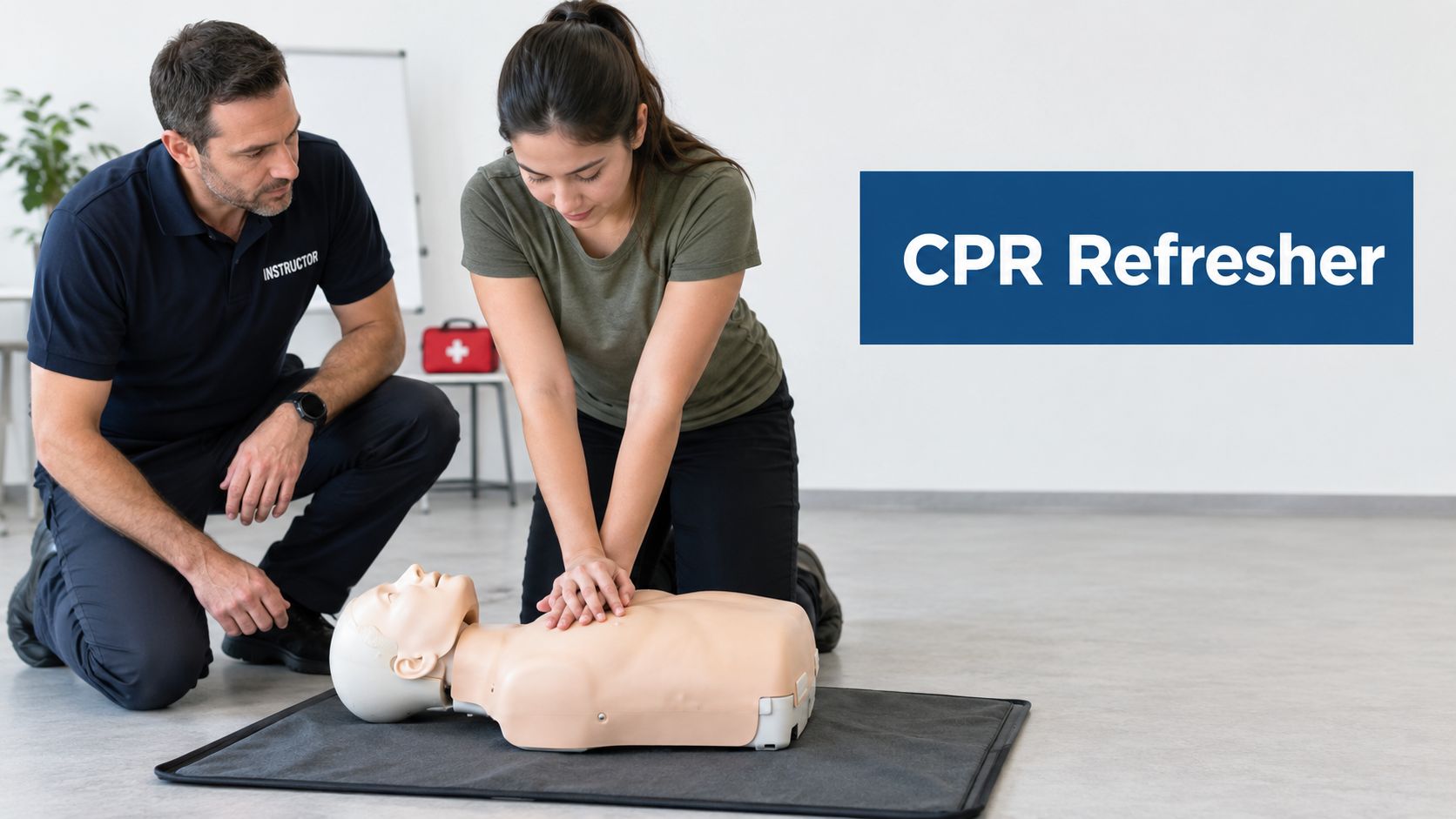
How Often Should CPR Be Refreshed in Australia
In Australia, CPR is typically refreshed every 12 months, while full first aid qualifications are renewed every three years. The annual CPR cycle applies even when your broader first aid certificate is still current.
You may be checking the date on a workplace first aid register, preparing for a site audit, or looking at a certificate that expires soon. The common confusion is understandable: one document can show that your first aid qualification remains valid, while the CPR component requires an earlier update. For a workplace safety officer, the practical question isn't only “Is the certificate still in date?” It's also “Can this person perform CPR confidently and in line with current Australian guidance?”
The answer starts with two separate clocks. HLTAID009 Provide Cardiopulmonary Resuscitation is generally current for 12 months, while HLTAID011 Provide First Aid is generally current for three years. Queensland Government guidance states that CPR refresher training should be completed annually, while first aid should be renewed every three years (Queensland Government CPR course information). St John Ambulance Victoria also explains the separate CPR and first aid renewal periods in its training FAQ (St John Ambulance Victoria first aid FAQ).
Table of Contents
- Why CPR Has Its Own Refresh Cycle
- The 12-Month and 3-Year Renewal Structure
- National Guidelines Versus Workplace Requirements
- What If You Have Not Practised CPR Since Your Last Course
- What a CPR Refresher Course Actually Covers
- Signs It Is Time to Book a Refresher
- Where to Book an Accredited CPR Refresher
- Putting the 12-Month Rule Into Practice
Why CPR Has Its Own Refresh Cycle
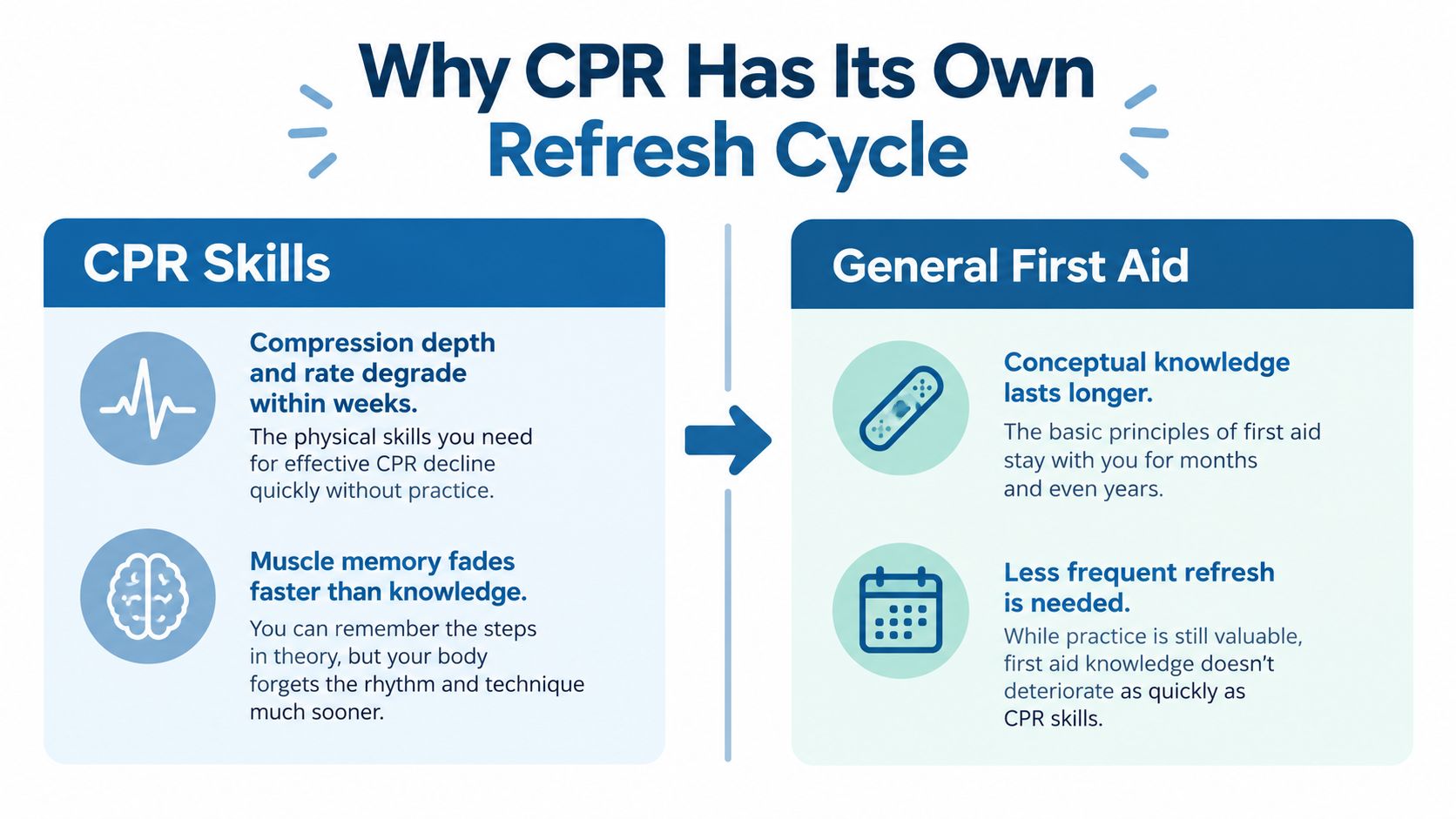
Your certificate may still look valid, but CPR is a physical skill that needs regular rehearsal. A person can remember the general sequence yet hesitate over hand placement, compression rhythm, rescue breaths or the AED. That gap matters because a real emergency demands movement, judgement and communication at the same time.
CPR is more than remembering information
General first aid includes topics such as wound care, burns, illness recognition and anaphylaxis management. These areas still require training, but much of the learning involves recognising signs, selecting an appropriate response and following a clear procedure. CPR adds a psychomotor element. Your hands must compress the chest correctly, maintain an effective rhythm and coordinate with another rescuer or an AED.
Australian training guidance links the shorter cycle to this difference. The Australian Resuscitation Council and Safe Work Australia are commonly cited in Australian training practice as supporting annual CPR renewal, while full first aid qualifications are commonly renewed every three years (National First Aid College guidance on CPR renewal). The annual interval is therefore not just an administrative preference. It reflects the need to keep a hands-on emergency skill current.
Why the shorter interval protects performance
During a refresher, the trainer can observe technique rather than relying on a learner's confidence. They can correct posture, hand position, compression quality, AED sequence and communication. The learner also gets the chance to practise the decision-making steps that are easy to overlook when reading theory alone.
Guidance can change over time, and a current course helps participants work from the training approach being taught in Australia. A workplace safety officer who wants to connect CPR currency with broader compliance planning can also review TP Training's overview of CPR, first aid, White Card and workplace safety certifications.
Practical rule: Treat the annual CPR date as a skills date, not merely as the date printed on a document.
The 12-Month and 3-Year Renewal Structure
A January course date can create two separate renewal dates. CPR needs a yearly refresh, while the broader first aid qualification usually remains current for three years. Treat them as two clocks rather than one certificate period.
Australian training guidance describes HLTAID009 Provide Cardiopulmonary Resuscitation as current for 12 months and HLTAID011 Provide First Aid as current for three years (IRFA first aid and CPR FAQ). Completing both on the same day creates a three-year cycle with CPR updates due during the first and second years.
| Qualification | Validity Period | CPR Refresh Included? | Renewal Action |
|---|---|---|---|
| HLTAID009 Provide Cardiopulmonary Resuscitation | 12 months | Yes, for the course period | Refresh CPR at month 12 and month 24, then renew again at month 36 |
| HLTAID011 Provide First Aid | 3 years | Includes CPR training, but CPR still requires annual updating | Renew the full first aid qualification at month 36 and maintain annual CPR currency |
| HLTAID010 Childcare First Aid (Childcare First Aid Course) | 3 years | The CPR component still requires the annual update | Follow the same yearly CPR cycle while the broader qualification remains current |
Seeing the cycle in practice
Suppose you complete first aid and CPR together in January. Your first CPR refresher is due the following January, with another due in January the year after. At the third January point, the CPR update and three-year first aid renewal generally fall together.
The calendar can look confusing because HLTAID011 Provide First Aid includes CPR training. Completing that full course again before the three-year point can satisfy the CPR refresh requirement, provided the course is accepted for your workplace and the timing meets its requirements. The longer first aid period does not automatically keep CPR current between courses.
Keep both dates recorded in your workplace register. A guide to how long a first aid certificate lasts can help explain the difference between qualification currency and the annual CPR cycle. A Provide First Aid Course covers broader nationally recognised first aid training, with practical learning delivered by experienced trainers across NSW.
National Guidelines Versus Workplace Requirements
A Sydney construction worker may hold a current CPR statement but still be unable to join the site's first aid roster until the employer checks the training record. The same principle applies in childcare, schools and healthcare. Each workplace can set its own process for confirming who is ready to respond.
Australian workplaces share a practical annual CPR baseline, yet their administrative requirements can differ. A construction site may request current evidence before assigning a designated first aider. A childcare service may require educators to keep CPR current under its operating procedures. Schools and healthcare employers may use separate registers, audits and renewal reminders.
The baseline is not always the final requirement
The Safe Work Australia model Code of Practice: First Aid in the Workplace guides employer decisions without overriding state or industry rules (Safe Work Australia). A safety officer should therefore review the organisation's risk assessment, applicable state requirements, contract conditions and site procedures.
The annual CPR cycle remains a widely used Australian workplace baseline. An employer may require an earlier refresher if the role involves higher risk, regular emergency exposure, frequent staff changes or a client-specific contract. The three-year first aid qualification does not remove those workplace checks.
Match the training record to the role
Use four questions when reviewing a training register:
- Role: Is the person formally rostered as a first aider, or trained only as a general precaution?
- Environment: Do they work near children, machinery, mobile plant, traffic, heights or isolated areas?
- Evidence: Can the organisation quickly locate the statement of attainment and next renewal date?
- Policy: Does the employer set a shorter interval than the usual annual CPR cycle?
Record the answer in the workplace first aid register rather than leaving it in an employee's personal inbox. For an Australian overview of certification considerations, see first aid certification in Australia. TP Training provides information about first aid certification and course options, but the employer and relevant regulator or industry authority remain responsible for confirming the applicable obligation.
What If You Have Not Practised CPR Since Your Last Course
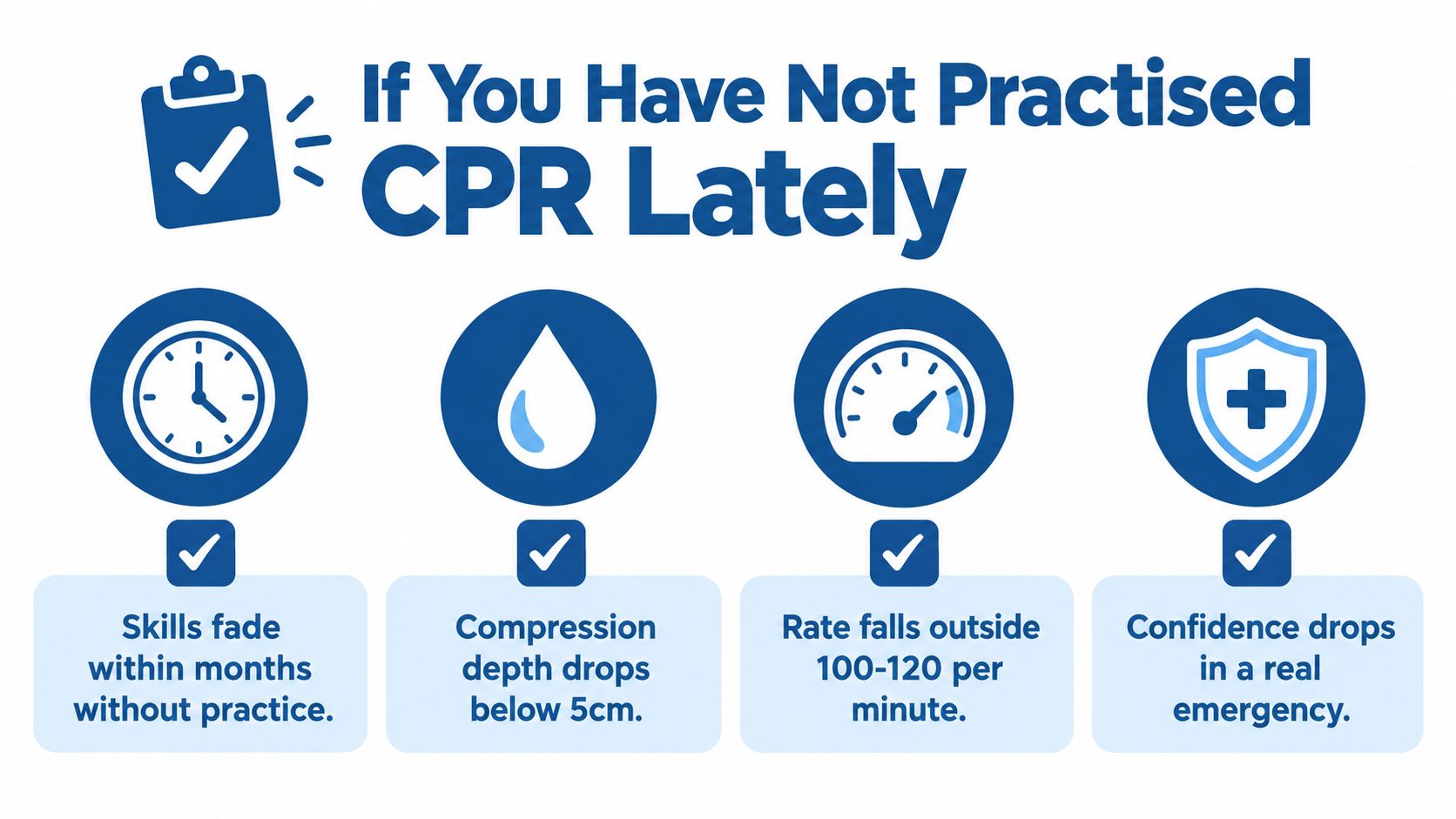
Holding a current certificate doesn't guarantee that you feel ready to act. If you haven't touched a manikin since your last course, you may remember the broad idea of CPR but struggle with the physical details when someone asks you to demonstrate it.
Common warning signs include uncertainty about the compression-to-ventilation sequence, hesitation over the DRSABCD order, or anxiety about switching on an AED. You might also find yourself asking where the pads go, who should call an ambulance, or how to coordinate with another rescuer.
Take uncertainty seriously
Australian guidance recognises that people who don't perform resuscitation regularly need retraining to maintain skills and confidence. The International Paramedic College discusses the annual CPR renewal expectation separately from the three-year first aid cycle and highlights the importance of retraining for people who aren't regularly practising resuscitation (International Paramedic College discussion of CPR renewal).
That doesn't mean every moment of doubt requires a complete first aid course. It does mean you shouldn't wait for a certificate to become administratively expired before addressing a clear loss of confidence. A supervised refresher gives you feedback that an online quiz or memory check can't provide.
What you can do before the booking
Check your certificate date, tell your employer that you feel rusty, and ask whether an earlier supervised session is available. Review the course material, practise the response sequence during an approved workplace drill, and make sure you know where the site's AED and emergency contact process are located.
Confidence is useful, but observed performance is the better test. If you haven't practised, book training that lets an instructor watch you perform CPR.
What a CPR Refresher Course Actually Covers
A CPR refresher in Australia focuses on the practical requirements of HLTAID009 Provide Cardiopulmonary Resuscitation. The session is usually shorter than a full first aid course, but it still requires learners to demonstrate the skill rather than watch a presentation.
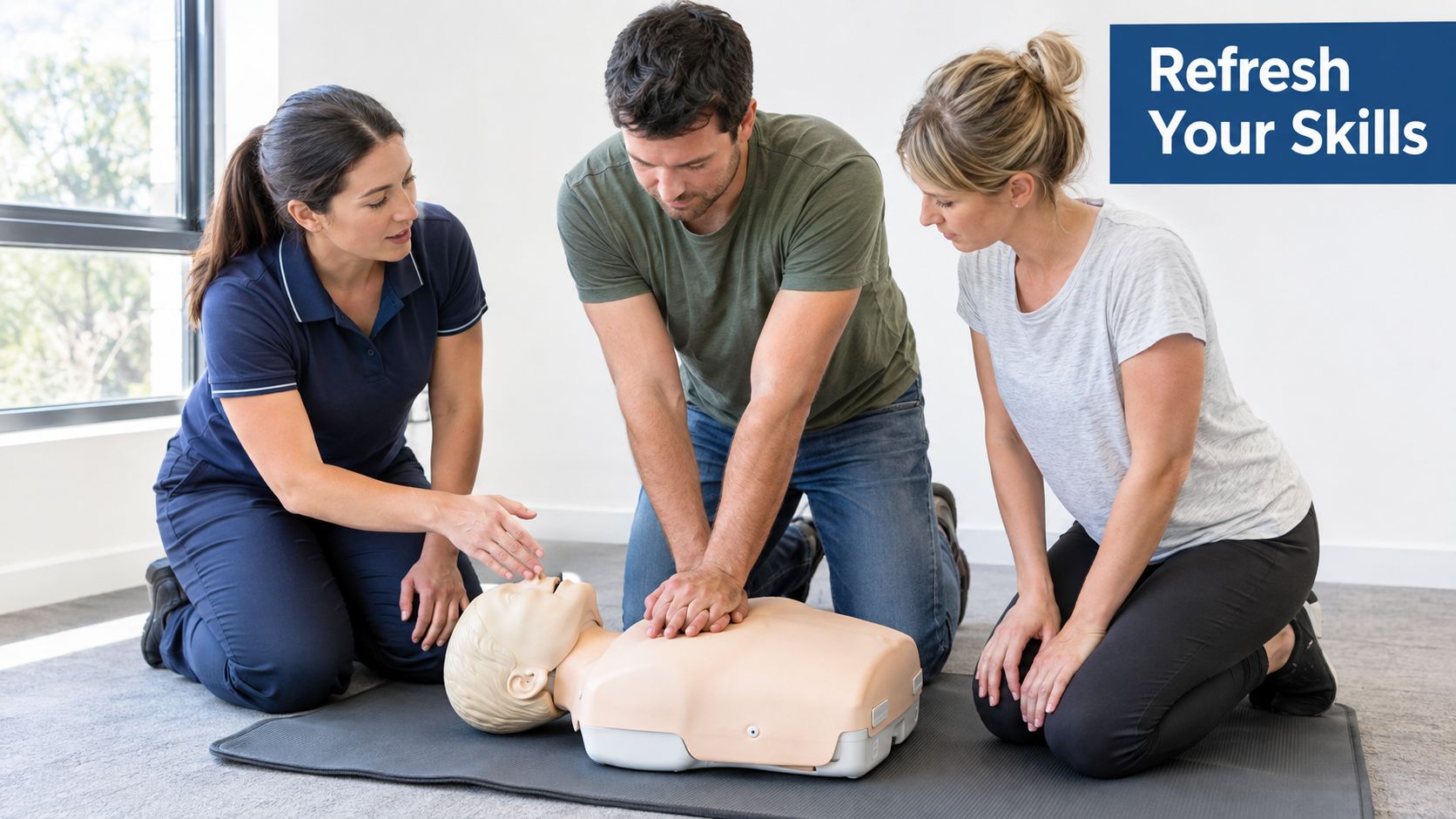
The day generally begins with scene assessment and the DRSABCD response. You work through adult and infant CPR on training manikins, practise compression technique, and receive feedback from the trainer. The instructor may also test how you respond when another person is present, because real workplace emergencies often involve delegation and communication.
Expect practical assessment
A typical refresher revisits:
- Scene assessment: Identify danger, check responsiveness and arrange emergency assistance.
- CPR technique: Perform compressions and ventilations on adult and infant manikins.
- AED use: Follow prompts, apply pads correctly and maintain safety around shock delivery.
- Team response: Communicate clearly with a second rescuer and manage role changes.
- Related responses: Revisit choking management and the recovery position.
- Escalation: Contact ambulance services and provide a structured handover.
Assessment generally combines observed practical scenarios with a short theory questionnaire. The exact timetable varies between providers and delivery formats, so confirm the course outline before booking. TP Training's explanation of HLTAID011 first aid course content can help you distinguish the broader first aid course from a CPR-only refresher.
The same training organisation also provides practical, nationally recognised Cpccldg3001 Perform Dogging Licence Course And Training In Sydney training with experienced trainers and hands-on learning across NSW. That course is separate from CPR, but the comparison is useful for safety officers managing several workplace competency records.
Signs It Is Time to Book a Refresher
The first check is your calendar. Find the date of your last HLTAID009 assessment and count forward 12 months. If that anniversary has passed, don't rely on the fact that your full first aid certificate still has time left on it.
Administrative signals can be just as important as personal confidence. An upcoming workplace audit, a new contract, a change in the first aid roster or a return from extended leave can all expose a gap that wasn't visible in day-to-day operations.
Use a two-part self-audit
Check the paperwork first:
- Certificate date: Confirm when your last CPR assessment was completed.
- Workplace register: Compare your personal record with the employer's first aid register.
- Role change: Recheck currency if you're moving into a designated first aider position.
- Employer request: Act promptly if a site manager asks for current evidence.
- Leave period: Treat a long absence as a reason to rebuild confidence before returning to duty.
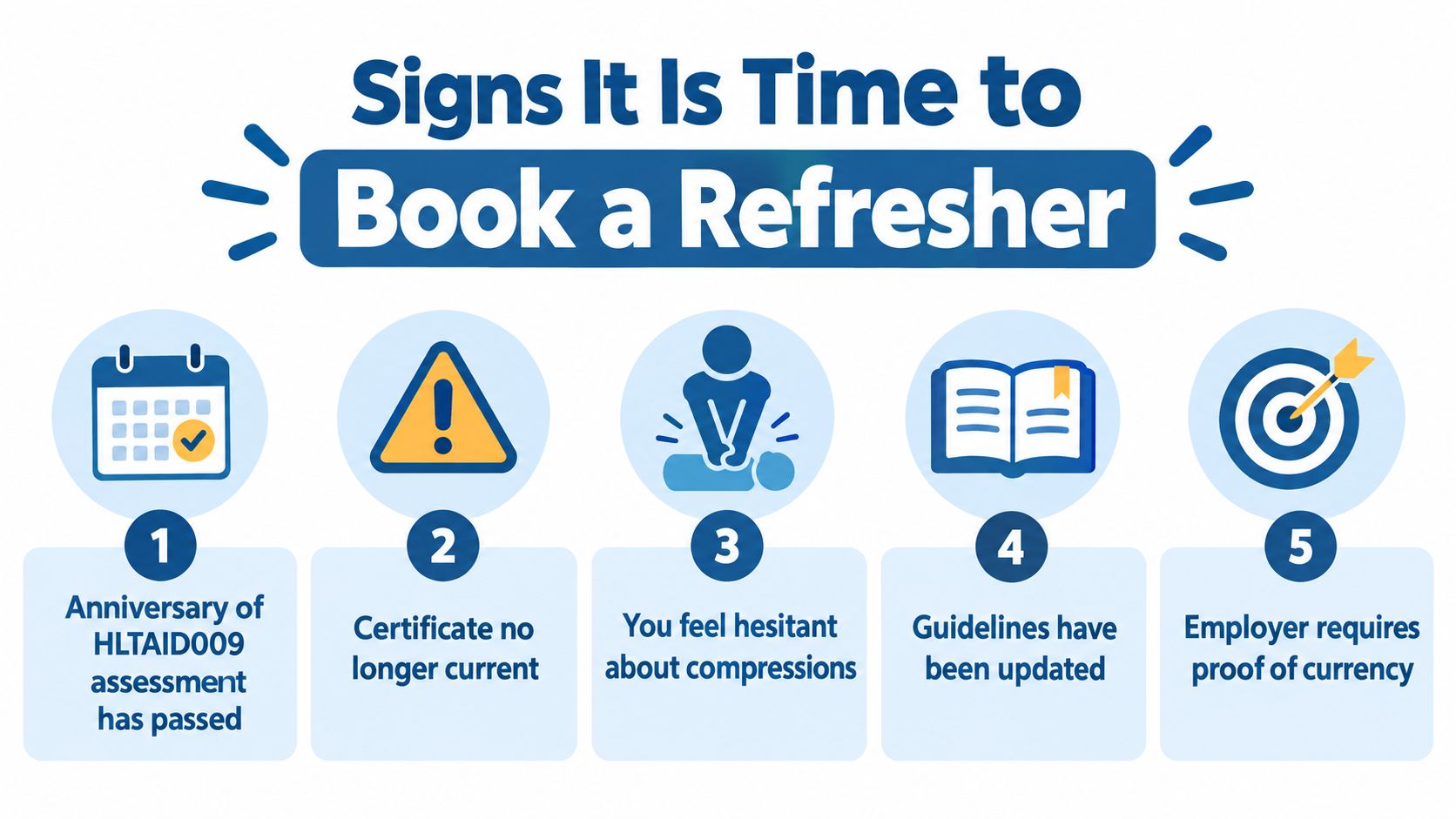
Then assess your readiness candidly. Can you explain the response sequence without prompting? Would you know where to find the AED? Could you start compressions while another person calls for help? If the answer is uncertain, a refresher is sensible even if the certificate date hasn't yet become a compliance problem.
Don't wait for a failed audit
A safety officer's job isn't only to file certificates after they expire. It also involves making sure the person rostered for the role can respond. Record renewal dates early, notify staff before the anniversary and give people enough time to complete training without creating a gap in coverage.
Where to Book an Accredited CPR Refresher
Choose a provider that can deliver the nationally recognised HLTAID009 unit through a Registered Training Organisation. The provider should explain how the course aligns with the current training package and should issue a statement of attainment that identifies the RTO.
Before you book, ask how the practical assessment works. A credible refresher should include observed CPR on adult and infant manikins, AED practice and the theory component required by the unit. Check how and when the statement of attainment will be issued, and confirm that your learner details, including your USI, are recorded correctly.
Compare providers before enrolling
| Criterion | What to look for | Why it matters |
|---|---|---|
| RTO status | A verifiable RTO and clear training organisation details | Confirms that the course sits within the nationally recognised training system |
| Course mapping | Current HLTAID009 information and relevant CPR guidance | Helps ensure the assessment matches the unit being undertaken |
| Practical work | Adult and infant manikin assessment plus AED use | Tests the physical skill, not only theory recall |
| Assessment records | Clear explanation of theory and practical requirements | Lets you arrive prepared and avoid misunderstandings |
| Certificate process | Defined timing and correct learner information | Makes workplace record keeping easier |
| Delivery fit | Face-to-face or blended arrangements that suit the role | Helps shift workers and teams complete training without unnecessary disruption |
Cost, duration and delivery mode vary between providers, so compare the actual course inclusions rather than choosing on timetable alone. TP Training delivers accredited HLTAID009 refreshers at NSW locations including Sydney CBD, Parramatta, Penrith, Liverpool, Blacktown, Campbelltown, Newcastle, Wollongong and selected regional hubs. Weekday, evening and Saturday sessions may suit different work patterns, but confirm current options directly with the provider.
For people comparing locations and course formats, CPR courses near me offers a practical starting point. Employers arranging group training should also ask about workplace delivery and whether the provider can supply the records needed for the site's first aid register.
Putting the 12-Month Rule Into Practice
Make CPR a recurring workplace task, not a one-off event that disappears after the certificate is filed. Set a calendar reminder for 11 months after the certificate date, then use the remaining month to contact the provider, confirm the course and complete the refresher before the current period ends.
A simple register can show each worker's name, role, last CPR assessment, next due date, broader first aid expiry and evidence location. HR and WHS teams can then identify gaps without searching through individual email accounts. Keep the certificate PDF in a labelled folder, store a photograph or scanned copy where your organisation permits it, and retain the paper version with other compliance documents.
Build readiness into normal operations
Schools, childcare centres and construction sites can make current CPR evidence a condition of being rostered as a workplace first aider. A short internal practice drill can also help staff rehearse the emergency sequence between formal courses, provided it complements rather than replaces accredited assessment.
The most useful routine is straightforward:
- Record the assessment date as soon as the certificate is issued.
- Set the 11-month reminder for the individual and the workplace register.
- Book before the annual date so an unavailable session doesn't create a gap.
- Check practical confidence during workplace exercises and after staff changes.
- File the evidence where a supervisor can retrieve it during an audit or incident review.
The core answer to “how often should CPR be refreshed” is every 12 months in Australia, while full first aid is generally renewed every three years. The annual date is the minimum planning point. Your real objective is a first aider who can recognise the emergency, begin CPR, use the AED and communicate clearly without avoidable hesitation.
TP Training provides practical, nationally recognised CPR and first aid training with experienced trainers and hands-on learning across NSW. Review the available options and visit TP Training to plan your next CPR refresher before your annual renewal date.

You may also like

Owner Builder Online Course: Your Complete NSW Guide

High Risk Work Solutions in Australia: A Practical Guide