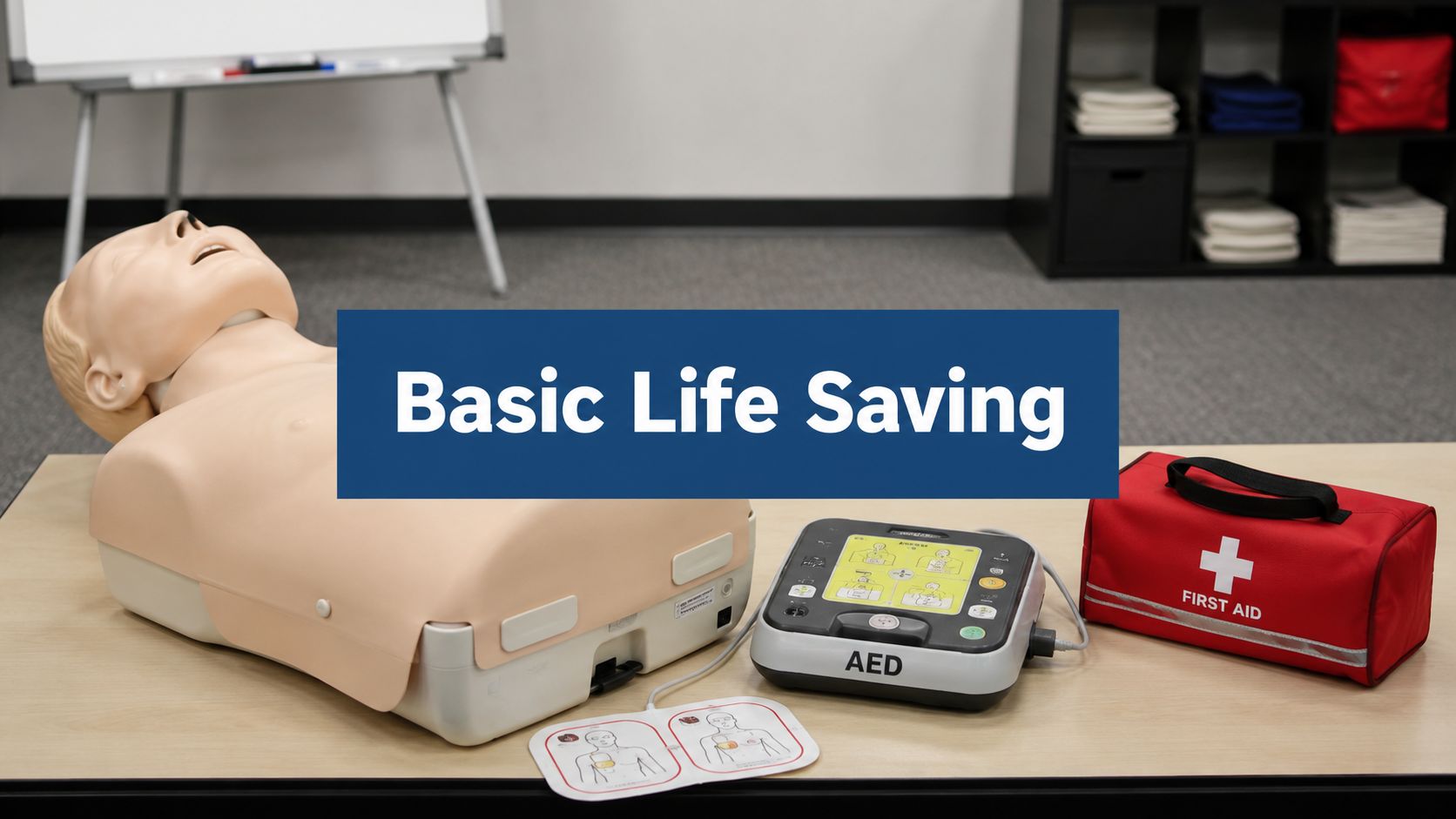
Basic Life Saving Course Your Complete 2026 Guide
You might be looking at job ads, onboarding paperwork, or a site requirement and seeing the same question come up again and again. Do I need a basic life saving course, and what does it involve?
That's a fair question. A lot of people assume it's just “doing CPR”, or they worry it will be too medical, too hard, or only relevant for nurses and ambos. In practice, a Basic Life Saving course is designed for ordinary workers and community members who need to respond clearly in the first critical minutes of an emergency.
If you work in construction, traffic control, warehousing, hospitality, childcare, disability support, schools, sport, or public-facing roles in NSW, this training can make a real difference. It gives you a simple action plan, hands-on practice, and a recognised certificate that employers understand.
Table of Contents
- Why Basic Life Saving Skills Are Essential in 2026
- What You Will Learn in a Basic Life Saving Course
- Who Needs a Basic Life Saving Certificate in NSW
- Course Formats Duration and Assessment
- Understanding Your Australian Certification
- Basic Life Saving vs CPR vs Full First Aid
- How to Book Your Course in Sydney and NSW
Why Basic Life Saving Skills Are Essential in 2026
A worker collapses at a job site. A customer drops to the floor in a venue. A family member stops breathing normally at home. In moments like that, those on scene don't need medical jargon. They need a clear process and the confidence to start.
That's why this training matters. Less than 5% of Australians currently hold formal first aid or basic life saving training, despite approximately 470,000 hospital admissions annually due to preventable injuries, and immediate CPR by a bystander can double or triple survival chances in cardiac arrests, which most often occur at home, according to Fire and Rescue's reporting on Australia's first aid training gap.
That gap affects more than health settings. It affects workplaces, families, sports clubs, schools, warehouses, road crews, and anyone who may be first on scene before paramedics arrive.
Why this matters for work and daily life
A Basic Life Saving course isn't just about ticking a compliance box. It helps you:
- Act faster: You won't waste time wondering what to do first.
- Stay safer: You learn to check danger before rushing in.
- Communicate clearly: You practise calling 000 and giving useful information.
- Use equipment properly: If there's an AED nearby, you'll know how to approach it calmly.
- Feel employable: Many employers value workers who bring practical safety skills to site.
Practical rule: In an emergency, simple actions done early are often more useful than perfect actions done late.
For many NSW students, the benefit is peace of mind. You stop seeing first response as something “for someone else” and start seeing it as a skill you can learn, practise, and carry into work and community life.
What You Will Learn in a Basic Life Saving Course
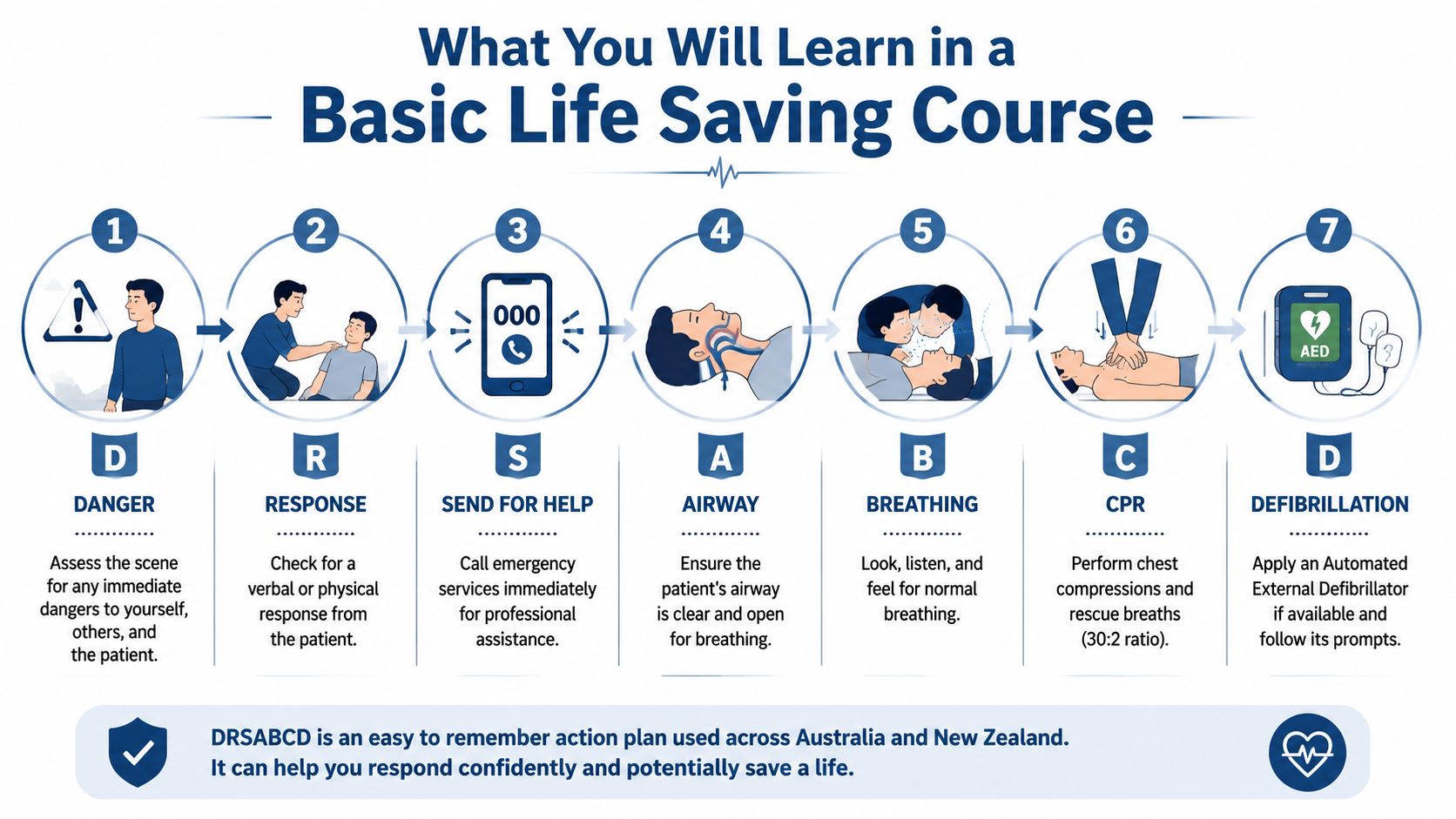
The heart of a basic life saving course is a sequence called DRSABCD. It sounds technical at first, but it's really just a memory tool that helps you respond in the right order under pressure.
The Australian Basic Life Saving curriculum requires chest compressions at a rate of 100 to 120 per minute, with a 30:2 ratio of compressions to rescue breaths, and training must assess learners on the full DRSABCD sequence, including danger assessment, sending for help by calling 000, and identifying the need for CPR, as outlined in this Sydney Morning Herald report discussing Australian BLS requirements.
The DRSABCD sequence in plain English
Here's what each step means in real life.
Danger
Before you touch anyone, you check the area. On a worksite, that could mean moving machinery, traffic, live power, broken glass, or unstable materials. You can't help safely if you become the next casualty.Response
You check whether the person responds to voice or touch. In class, you learn how to do this clearly and firmly without causing harm.Send for help
You call 000 or direct someone specific to do it. In training, students often realise this is one of the most important parts because vague instructions like “someone call for help” can slow everything down.Airway
You learn how to open the airway and look for anything obvious that's stopping normal breathing.Breathing
This isn't a long examination. You're checking whether the person is breathing normally. If they're not, that tells you what comes next.CPR
You practise chest compressions and rescue breaths on a manikin. That hands-on repetition matters because the rhythm and body position feel different from just reading about them.Defibrillation
If an AED is available, you learn how to apply it and follow its prompts safely.
One of the biggest breakthroughs students have is realising the sequence gives them a script. Under stress, that structure helps.
What the practical skills feel like in class
The training is surprisingly physical and practical. You won't just sit and listen. You'll usually work through realistic scenarios, speak the steps out loud, and practise until the sequence starts to feel natural.
A good trainer also explains how these skills connect to different jobs. For example, someone doing high-risk work may already value procedural thinking. That's one reason workers in practical trades often do well in this training. If your role also involves licences such as the Cpcclrg3001 Rigging Course Level 1 Licence To Perform Rigging Basic Level, you'll recognise the same hands-on approach to safety, observation, and controlled response.
Common things students worry about include:
- “What if I forget the order?” Repetition fixes that quickly.
- “What if I'm not strong enough?” Trainers show you body position and technique, not just force.
- “What if I panic?” Practice helps replace panic with a routine.
- “What if there's an AED?” You learn to follow the prompts rather than guess.
By the end, the jargon usually feels much less intimidating. It becomes a practical workflow you can remember when it counts.
Who Needs a Basic Life Saving Certificate in NSW
Some people book this course because an employer asked for it. Others book because they're changing careers, returning to work, or want to be useful in a crisis. Both reasons are valid.
Workers who may face emergencies on site
In NSW, this certificate is especially relevant for people working in environments where incidents can happen fast and help may not be immediately beside them.
That includes:
- Construction and civil workers: Sites involve physical risk, multiple contractors, moving plant, and changing conditions.
- Traffic control and road crews: Work happens around vehicles, weather, noise, and public movement.
- Warehouse and industrial staff: Manual handling, machinery, and shift work can all create emergency situations.
- Support, care, and education workers: You may be responsible for children, older adults, or people who need prompt assistance.
If you're an employer or team leader, clear documentation matters too. Many supervisors use templates to standardise inductions, toolbox talks, and safety procedures. If you need to create training manuals easily, a structured template can help turn course knowledge into workplace instructions people use.
A lot of NSW students first come across compliance training through other required tickets. Hospitality staff, for example, may already be familiar with mandatory learning through topics such as responsible service of alcohol. Basic life saving sits in a different category, but the same principle applies. Training supports safer decisions when pressure is high.
Job seekers and community members who want practical confidence
You don't need to be in a high-risk trade to benefit.
This course also suits:
- Job seekers: It shows initiative and a safety mindset.
- Parents and carers: Emergencies often happen in everyday settings, not clinical ones.
- Sports coaches and community volunteers: You may be the first adult nearby when something goes wrong.
- Anyone who freezes under pressure: A taught sequence gives you something to follow.
A certificate can help you get through recruitment. The real value is knowing what to do before the ambulance arrives.
For many students, that's the turning point. They stop seeing first response as specialised knowledge and start seeing it as part of being a capable worker and community member.
Course Formats Duration and Assessment
If you've never done this kind of training before, you're probably wondering what the day looks like. Most students want to know three things. How long does it take, how practical is it, and how hard is the assessment?
How the training is usually delivered
A Basic Life Saving course is usually a mix of short theory segments and supervised practical training. The theory gives you the reasons behind the steps. The practical side is where you repeat the sequence until it starts to feel automatic.
You can expect a learning environment that is more workshop than lecture. Trainers typically demonstrate first, then students practise in pairs or small groups, ask questions, and repeat key actions on manikins and training equipment.
If you're comparing options, it helps to understand different delivery styles before you enrol. This guide on choosing the right training gives a useful overview of how training methods affect learner confidence and retention.
What assessment looks like
Assessment usually feels far less formal than people expect. You're not being asked to perform like a paramedic. You're being assessed on whether you can follow the required sequence safely and competently.
Typical assessment tasks include:
- Practical demonstration: You show the DRSABCD process on a manikin.
- CPR performance: You demonstrate compressions, breaths, and transitions between steps.
- Communication: You show that you can send for help and respond clearly.
- Knowledge check: Some courses include short written or digital questions.
If you can follow instructions, ask for feedback, and practise the steps, you can usually approach assessment with confidence.
Students who already work in structured environments often find this reassuring. The process is similar to other vocational training where competence matters more than academic writing. If you've looked into short compliance pathways such as the PWZ Red Card ticket in just 1 day for work zone traffic management certification in Sydney, you'll recognise the same practical focus. You learn the task, perform it correctly, and show that you can apply it in realistic conditions.
The main thing to bring is a willingness to practise. Most learners don't struggle with “the test”. They just need a bit of repetition before the steps click into place.
Understanding Your Australian Certification
People often focus on getting the certificate and forget the bigger point. A first response qualification only helps if the skills are still usable when a real emergency happens.
What the certificate means
In Australia, a basic emergency life support certificate such as HLTAID010 is a recognised way to show that you've completed training and assessment in the required emergency response skills. For employers, it's evidence that you've been taught a standard process rather than picking things up informally online.
It's also part of your broader training record. If you're new to vocational study, make sure your enrolment details and records are set up correctly, including your Unique Student Identifier guidance. That small admin step can save a lot of hassle later when you need proof of completed training.
For learners who like preparing methodically, there's a useful lesson in Cramberry's PMP preparation advice. It isn't about first aid, but the mindset applies. Break the material into small chunks, rehearse key sequences, and don't rely on last-minute cramming for practical performance.
Why refreshers matter more than people think
A common oversight for many workers is that while a basic emergency life support certificate like HLTAID010 is often valid for 3 years, critical psychomotor skills like chest compression depth and rate degrade significantly within 6–12 months. Without annual refreshers, compliance with the mandated 5–6 cm depth can drop by over 40% in the first year, according to Emergency's overview of HLTAID010 and skill retention.
That matters because emergency response is physical. It's not just about remembering words on a page. You need to maintain rhythm, body position, compression depth, and decision-making under stress.
A refresher isn't bureaucracy. It's maintenance.
- Memory fades: The acronym may stay familiar, but the sequence can become slower.
- Technique slips: Hand placement, pace, and compression quality can drift.
- Confidence drops: People hesitate when they haven't practised recently.
- Standards matter: Employers want current evidence, but real-world readiness matters even more.
Skills that save lives are perishable. Treat them the way you'd treat any safety-critical task. Review them before you need them.
Basic Life Saving vs CPR vs Full First Aid
These course names get mixed up all the time. If you choose the wrong one, you can end up with training that's either too narrow for your job or broader than you currently need.
The simplest way to think about it is scope. CPR only focuses on resuscitation skills. Basic life saving includes CPR but places it inside a full immediate response sequence. Provide First Aid is broader again and usually covers a wider range of incidents.
Course Comparison At a Glance
| Feature | Basic Life Saving (e.g. HLTAID010) | CPR Only (e.g. HLTAID009) | Provide First Aid (e.g. HLTAID011) |
|---|---|---|---|
| Main focus | Immediate emergency response using the DRSABCD process | CPR response for a person who isn't breathing normally | Broader first aid response across multiple incident types |
| Includes DRSABCD | Yes | Usually centres on the CPR part of the response | Yes, within a wider first aid context |
| CPR practice | Yes | Yes | Yes |
| AED use | Yes, as part of the response sequence | Commonly included in CPR-related training | Yes |
| Scope beyond resuscitation | Limited to core emergency life support actions | Narrowest scope | Broadest scope |
| Who it suits | Workers needing a practical emergency response certificate | People who only need CPR currency or a narrow skill set | Workplace first aid officers and roles needing wider coverage |
| Assessment style | Practical demonstration plus knowledge checks | Practical CPR-focused assessment | Practical scenarios and broader knowledge checks |
How to choose the right option
Ask yourself three questions.
What does my employer or industry ask for?
If a job ad, site induction, or contract names a unit, follow that requirement first.What situations am I likely to face?
If your role involves general workplace incidents, not just cardiac arrest response, a broader first aid course may make more sense.Do I need a stepping stone or a wider qualification?
Some people start with basic life saving because it's targeted and practical, then add more training later.
If you're still unsure, it helps to compare common workplace safety tickets side by side. This overview of CPR, first aid, white card and workplace safety certifications can help you place a Basic Life Saving course in the bigger NSW training picture.
The right choice isn't the course with the longest name. It's the one that matches your role, risk level, and required competency.
How to Book Your Course in Sydney and NSW
Booking a basic life saving course shouldn't feel complicated. Individuals typically seek a nearby location, a date that fits around work, and clear enrolment steps.
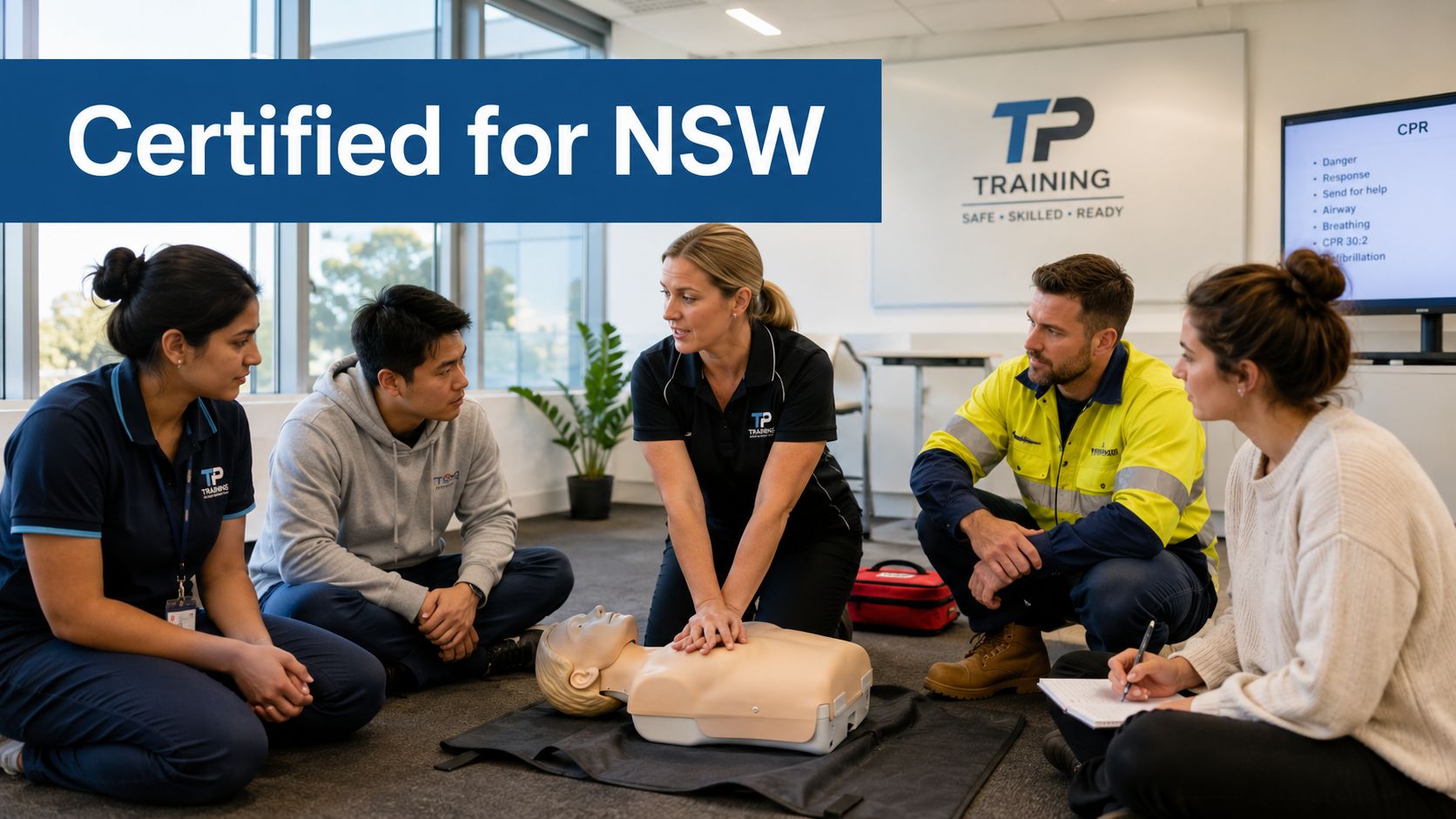
TP Training delivers nationally recognised, practical training across Penrith, Burwood, Auburn, Parramatta, and Sydney CBD. That gives students across Sydney and wider NSW a straightforward way to train close to home or work.
A simple booking process usually looks like this:
- Choose your location: Pick the centre that's easiest for travel and parking or public transport.
- Select the right course: Make sure the unit matches your job or employer requirement.
- Complete enrolment details: Use the same personal details you use for formal training records.
- Attend ready to practise: Wear comfortable clothes and expect hands-on participation.
If language support helps you feel more confident during enrolment or training, it's worth checking available assistance. TP Training outlines multilingual support in English, Mandarin, Korean and Vietnamese, which can make the process more accessible for many NSW students.
The important part is not waiting until a job starts tomorrow or a site supervisor asks for paperwork at the gate. Book early, train properly, and give yourself time to learn the skills well.
If you want a practical Basic Life Saving course in NSW, TP Training is one option to consider for nationally recognised, hands-on vocational training across Penrith, Burwood, Auburn, Parramatta, and Sydney CBD. Choose a location that suits you, confirm the right course for your job, and take the next step toward workplace confidence and real emergency readiness.

You may also like
First Aid Training in the Workplace: A Complete Guide
CPR Course Penrith: Book Your Training Today