
Traffic Control Combo Course – Blue & Yellow Card for 2026
You're probably weighing a practical question, not an academic one. You want work that's steady, pays properly, and doesn't require years out of the workforce. Then you start looking into traffic control and hit the usual confusion. Do you need the Blue Card first, the Yellow Card later, or both together?
If your goal is to get job-ready without doubling back for more training, the Traffic Control Combo Course – Blue & Yellow Card is usually the smarter move. It gives you the entry-level traffic control authority commonly acquired, plus the implementation skills that make you more useful on site from the beginning. That matters when employers need workers who can do more than hold a bat and wait for instructions.
People often come into this field because they want a clear pathway. Traffic control offers that. You train, you assess, you get on site under the right conditions, and you build from there. If you want a realistic look at what day-to-day work feels like before you enrol, TP Training's guide on whether traffic controllers enjoy the job is worth reading.
Table of Contents
- Your Guide to a Traffic Management Career in NSW
- Understanding the Blue Card and Yellow Card Roles
- What to Expect in the Traffic Control Combo Course
- Why Choose the Combo Course Over Separate Training
- How to Enrol Your Step by Step Guide
- Your Career Path After Certification
- Frequently Asked Questions About Traffic Control Training
Your Guide to a Traffic Management Career in NSW
Traffic management suits people who prefer practical work, clear site rules, and a qualification path that leads directly into live projects. In NSW, that matters because traffic control isn't treated as informal site support anymore. It sits inside a regulated framework, and workers need the right training before stepping into the role.

Since 1 July 2020, Traffic Control Work Training became a legislated obligation in NSW for workers conducting traffic control on or adjacent to public roads, and workers must hold the relevant SafeWork NSW training outcome to perform supervised duties until final assessment is completed, as outlined by Upskill Institute's 2024 road traffic controller overview. That's the first reason the combo course matters. It doesn't just help you enter the industry. It lines you up with the legal structure the industry now operates under.
Why this pathway appeals to career changers
A lot of students aren't coming from traffic management at all. They're coming from warehousing, retail, labouring, hospitality, or periods out of work. They want a role where they can start with a recognised qualification and build practical credibility quickly.
The two foundational roles are:
- Traffic Controller. The person who controls vehicle movement using a stop/slow bat or approved portable traffic device.
- Traffic Management Implementer. The worker who sets up and applies a pre-approved traffic guidance scheme on site.
Those roles connect. One manages flow in real time. The other helps put the traffic setup into operation properly.
Practical rule: If you already know you want more than an entry-level position, doing both cards together usually saves you from coming back later to repeat the process in pieces.
Why the combo course is the efficient starting point
The fastest route isn't always the cheapest on paper. It's the route that avoids rebooking, relearning, and delaying job opportunities. The combo course makes sense for people who want immediate flexibility. Instead of qualifying for only one narrow task, you come out prepared for both core functions that many employers need on active sites.
That's why experienced coordinators often steer serious job seekers toward combined training. It gives you more room to say yes when work comes up.
Understanding the Blue Card and Yellow Card Roles
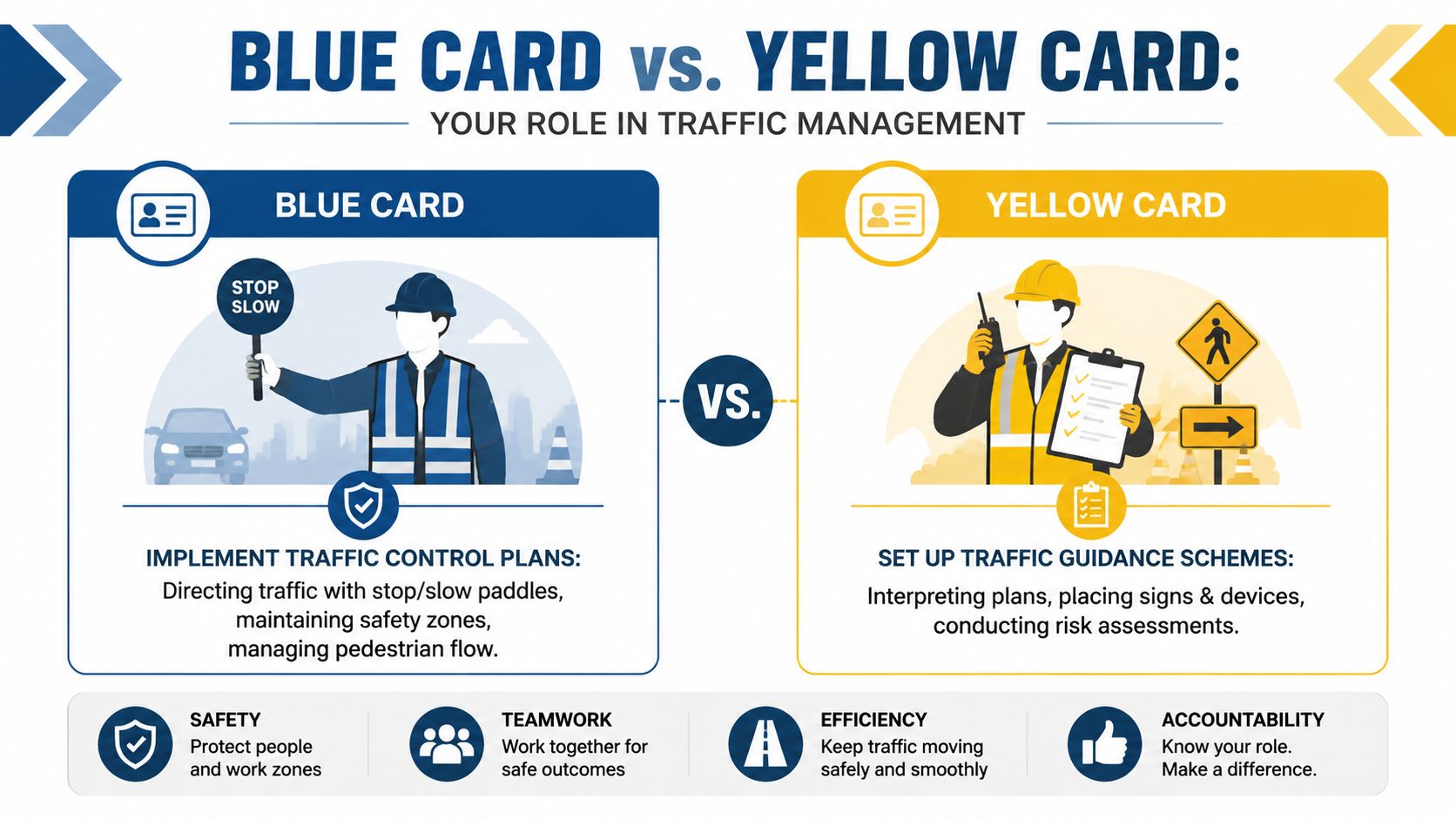
People mix these two cards up all the time. The easiest way to understand them is this. The Blue Card puts you in the traffic stream. The Yellow Card puts you in the site setup and implementation side of the job.
Why the two cards do different jobs
Think of the Blue Card holder as the player on the road and the Yellow Card holder as the on-field coach. The player acts in the live environment, gives directions, and keeps movement safe. The coach reads the plan, positions the setup, and makes sure the work zone operates the way it was approved.
SafeWork NSW states that the combo course integrates RIIWHS205E (Control Traffic with Stop/Slow Bat) for the Blue Card and RIIWHS206E (Implement Traffic Management Plan) for the Yellow Card. It also distinguishes the legal authority attached to each card. The Blue Card holder may use the stop/slow bat, while the Yellow Card holder is qualified to deploy site traffic management plans on a worksite, according to SafeWork NSW.
In practical terms:
- Blue Card work includes directing traffic, maintaining separation between workers and vehicles, and communicating clearly with drivers and crews.
- Yellow Card work includes interpreting the approved setup, placing signs and devices correctly, and managing the on-site application of the traffic plan.
A student who only holds one card can still work. A worker with both can usually fit into more site situations.
For people who only need the entry point, the Traffic Controller Course Blue Card covers practical, nationally recognised Blue Card training with experienced trainers and hands-on learning across NSW. The issue is that many students who start there later realise they also need the implementation side to widen their options.
Why employers value both
Sites don't run well when responsibilities are blurred. They run well when workers understand exactly what they're authorised to do and what the approved plan requires. That's why holding both cards isn't just about collecting tickets. It makes you more versatile on real jobs.
A worker with both cards can usually help with:
| Site need | Blue Card only | Blue and Yellow together |
|---|---|---|
| Directing live traffic | Yes | Yes |
| Operating under a pre-approved setup | Limited | Yes |
| Implementing traffic management arrangements | No | Yes |
| Taking on broader site responsibility | Limited | Stronger fit |
If you want a broader sense of how traffic tickets connect to better-paying work, TP Training's article on TC tickets for higher-paying traffic control jobs adds useful context.
The workers who move ahead fastest usually aren't the ones with the most tickets. They're the ones with the right tickets for the work actually being offered.
What to Expect in the Traffic Control Combo Course
A common scenario is a student who wants to start earning in traffic control, but also wants to avoid coming back a few weeks later for the second ticket. The combo course is built for that decision. It puts both licence pathways into one training block, so you can build entry-level capability and broader site usefulness in the same program.
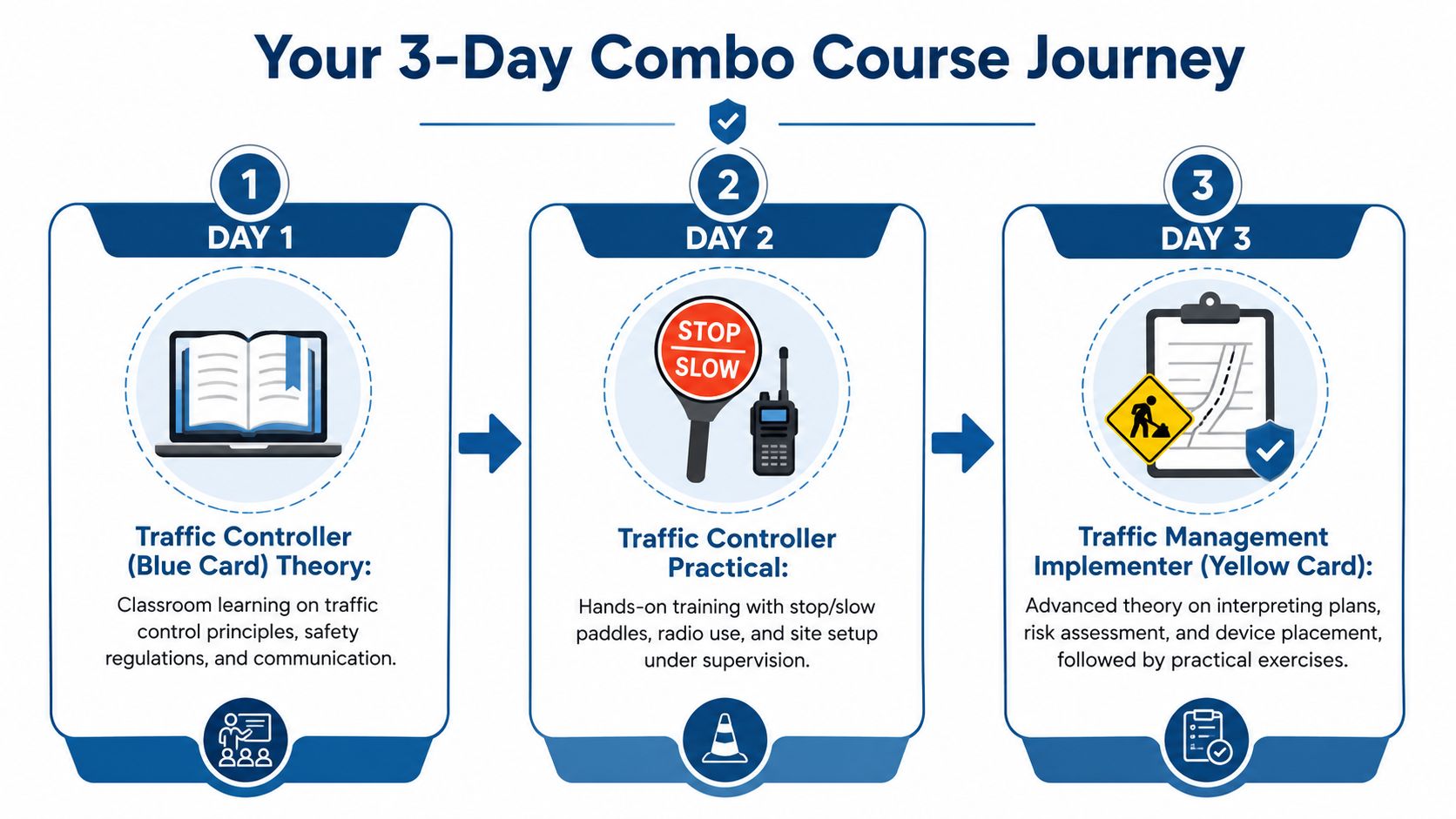
The course runs over 3 days. Expect two full classroom days, followed by a shorter practical assessment day. On completion, students receive a SafeWork NSW Statement of Completion that allows supervised work for a limited period while the final traffic control work card is processed.
The training starts with the rules that keep live roadwork safe. That means traffic control principles, communication, risk awareness, work health and safety duties, and the approved procedures that govern what you can and cannot do on site. The early part matters because traffic control is procedural work. Good intentions do not protect a site if the setup, wording, or sequence is wrong.
From there, the course shifts into applying those rules to real site conditions. Students work through traffic guidance material, site layouts, and implementation tasks that reflect what happens on roadwork, civil, and utility jobs. The Yellow Card content raises the standard. You are no longer only reacting to traffic. You are working with the approved arrangement and understanding how to put it in place properly.
A typical flow looks like this:
- Core theory. Safety duties, communication methods, traffic control devices, and the legal framework for roadside work.
- Plan interpretation and site application. Reading layouts, identifying hazards, and understanding how an approved setup translates to the work zone.
- Practical assessment. Demonstrating the required tasks under observation using the correct process and site communication.
Students often expect the hard part to be standing outside or handling equipment. It usually is not. The harder part is accuracy under pressure. A sign placed incorrectly, a missed instruction, or a rushed response can affect the whole work area.
These are the issues that catch people out most often:
- Reading the setup carefully. Small mistakes in placement or sequence can change how the site operates.
- Communicating clearly. Radio calls and verbal directions need to be controlled and specific.
- Following the process in order. Assessors are looking for safe, repeatable actions, not guesswork or shortcuts.
Good training leaves you able to apply the plan calmly on site, not just repeat terms in a classroom.
The practical day gives students a clear picture of that standard. It also helps you judge whether this is just a short-term entry ticket or a smarter career move. In my experience, workers who complete both cards together are usually in a stronger position to take on a wider mix of shifts earlier, which can lead to better earning potential over time.
That is one reason in-person delivery still matters for this type of training. Live assessment shows whether a student can perform safely under instruction, not just pass theory. ProMed Certifications on online learning makes a similar point in another training field.
Students who want a broader view of the pathway into traffic work can also read TP Training's guide on how to become a traffic controller in NSW before booking.
Why Choose the Combo Course Over Separate Training
The strongest reason to choose the combo course is simple. It reduces rework. Separate training can still get you there, but it often means more admin, more scheduling, and a slower move from basic entry to broader site responsibility.
The practical trade-off
Doing the Blue Card first can make sense if you only need the most basic legal authority to begin. The problem comes later when you realise the Yellow Card is what expands your usefulness on site. Then you're back in training, back in assessment, and back in booking around work or family commitments.
The combo format solves that by bundling the core learning path into one organised process.
| Benefit | Separate Courses | Combo Course |
|---|---|---|
| Training flow | Broken into separate enrolments and assessments | One structured pathway |
| Time to broader capability | Slower because the second course comes later | Faster because both roles are covered together |
| Admin load | More booking, more planning, more repetition | Simpler to organise |
| Employer appeal | Entry-level fit first, broader fit later | Wider job fit from the start |
| Career progression | Often delayed until the second card is completed | Better positioned for added responsibility earlier |
There's also a training-quality issue worth being honest about. Skills like traffic control don't translate well when people try to shortcut the practical side. That's one reason discussions around online versus in-person learning matter across safety training generally. ProMed Certifications' piece on online learning and in-person training covers that debate in another compliance-focused field, and the same principle applies here. For live-risk work, hands-on assessment matters.
The combo course is the better investment when your goal is employability, not just initial compliance. It gives you a faster path to being the worker who can both operate and assist with implementation, rather than the worker who needs another ticket before stepping up.
How to Enrol Your Step by Step Guide
Enrolment is usually straightforward once you know the prerequisites. The delays happen when people book first and check documents later. That's avoidable.
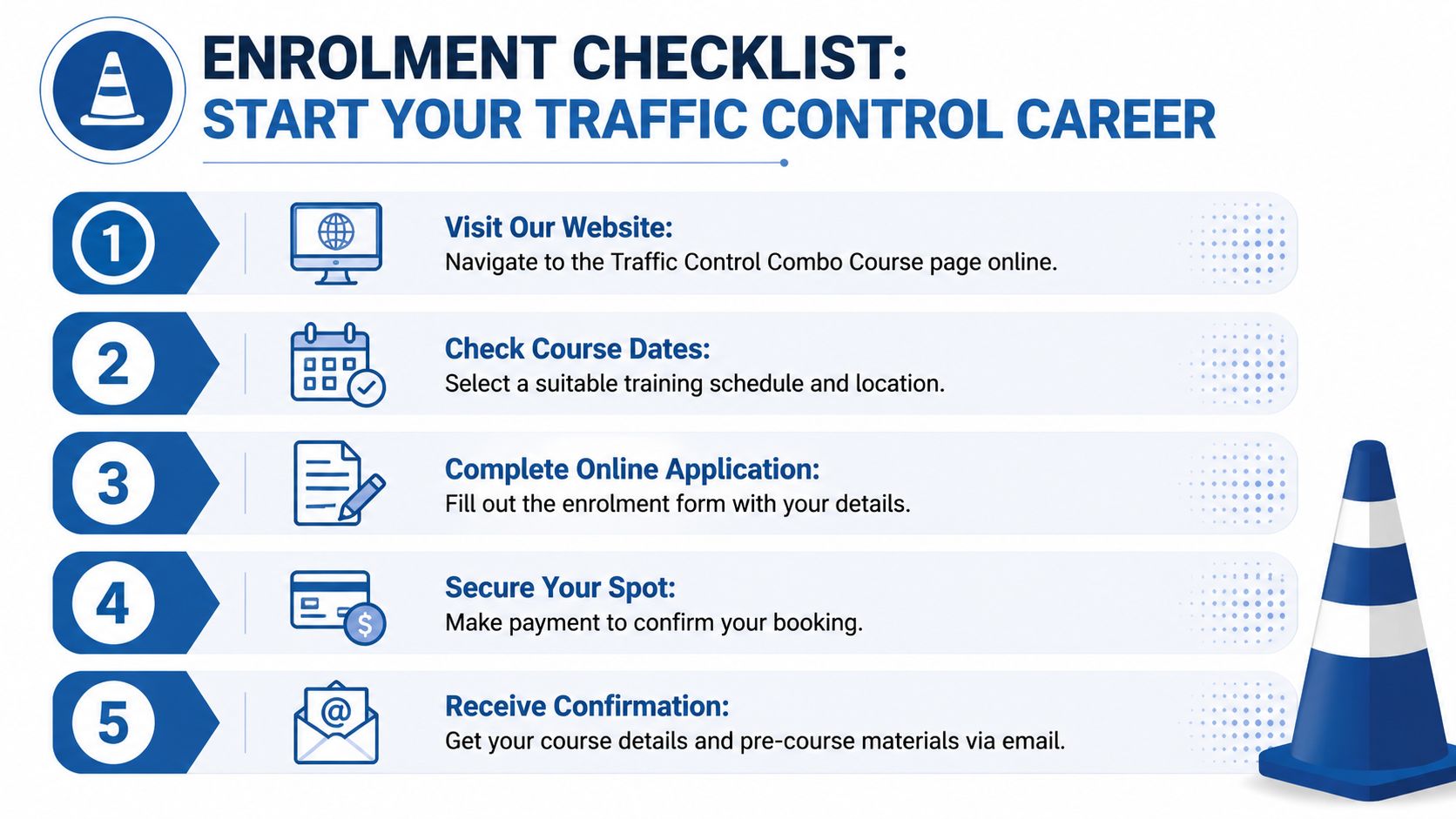
To enrol, candidates must be at least 17 years old, hold a current SafeWork NSW White Card, and provide 100 points of verified identification. That can include an Australian driver's licence worth 40 points combined with a birth certificate or passport worth 70 points each, according to Service NSW guidance on applying for a White Card.
What you need before you book
Use this checklist before you choose a date:
- Check your age requirement. You need to be at least 17.
- Confirm your White Card is current. Traffic control sites are treated as construction sites, so this isn't optional.
- Prepare your ID correctly. Don't assume one document will be enough. You need the full 100 points and the documents must support your identity details properly.
- Have your student details ready. Your name and records need to match your identification and training documents.
If you haven't sorted your student number details yet, TP Training's guide to creating and managing your USI helps prevent a common enrolment delay.
How to make enrolment smoother
Most booking issues come down to paperwork, not eligibility. A practical approach is to gather everything first, then choose the course date and location that suits your routine. That matters if you're working casually, travelling in from outer suburbs, or coordinating around family commitments.
A simple order works best:
- Verify your White Card
- Check your ID points
- Match your legal name across documents
- Choose the most practical location
- Book once your documents are ready
TP Training delivers training across NSW locations including Penrith, Burwood, and Sydney CBD, which gives students a few workable options depending on travel and schedule. If you're ready to compare dates and delivery details directly, the Traffic Control Combo Course Blue Yellow Card page is the practical place to start.
Turn up organised. Students who arrive with complete ID, correct names, and their White Card sorted usually have a much smoother training experience.
Your Career Path After Certification
A lot of students reach this point with the same question. How quickly can this training turn into regular paid work, and does doing both cards together alter what jobs you can take?
In practice, yes. The combo course gives you a faster start because employers and labour hire companies often prefer workers who can step into more than one approved traffic management function. Instead of qualifying for a narrow entry point, you come out with broader site usefulness from day one. That matters when rosters are being filled and supervisors need people who can do more than one part of the job safely.
How the work usually develops
The first jobs are usually straightforward. You start in traffic controller duties, work under site direction, and build confidence in live road conditions. From there, the workers who keep getting called back are usually the ones who are reliable, switched on, and already hold the training needed for implementation-related tasks.
A common progression looks like this:
- Entry into traffic control work with supervised duties on active sites
- More roster flexibility because you can assist across a wider range of approved traffic tasks
- Stronger prospects for higher-responsibility work such as site setup support, crew coordination, or supervisory assistance
That second step is where the combo course earns its keep. Completing Blue Card and Yellow Card training together is not just about finishing two units at once. It is a strategic career investment. You spend less time repeating admin, less money booking separate training, and you put yourself in a better position for work that carries more responsibility and better pay.
The trade-off is simple. The combo pathway asks more of you upfront, but it can save months of piecemeal progress later. For many students, that is the smarter move.
If you want a practical look at what that can mean for wages and job options, TP Training's guide to traffic controller earnings and career opportunities in Sydney is worth reading.
It also helps to see where traffic control sits alongside other safety-based qualifications. The Safety Space H&S course guide gives a useful broader view of how different training pathways connect to different site roles across Australia.
The short version is this. After certification, your next opportunities depend on three things: whether you can get to work reliably, whether you perform well on site, and whether your training already covers the tasks employers need filled. The combo course puts you in a stronger position on that third point from the start.
Frequently Asked Questions About Traffic Control Training
Common practical questions
How long is the TCWT card valid for?
Since 1 July 2020, the Traffic Control Work Training card has been a legislated requirement in NSW. The card is valid for three years, and workers need to complete an accredited refresher course to renew it and continue working legally on NSW roads, as noted in TP Training's published traffic control guidance.
What if I don't pass the practical assessment the first time?
Assessment outcomes depend on the training provider's process and the specific gaps identified. In practice, students should ask before booking how reassessment is handled, what support is available, and whether further practice is recommended before another attempt. That's a normal question, not a red flag.
Do I need my own PPE for training?
Providers handle this differently. Always check before the course date so you know what you must bring and what will be supplied. Don't assume. Turning up underprepared creates avoidable stress on assessment day.
For readers comparing broader workplace safety training pathways across Australia, the Safety Space H&S course guide gives a useful general overview of how different safety courses fit different job roles.
The main point is simple. Traffic control training is regulated, practical, and tied to legal responsibilities on live roads. If you treat it like a serious trade entry point, you'll make better training choices from the start.
If you're ready to move into traffic management or step up beyond a single entry-level ticket, TP Training offers practical, nationally recognised training across NSW with hands-on delivery in traffic control and related site safety courses.

You may also like
CPR Course Penrith: Book Your Training Today
Safety & Health Policy: A Guide for Australian Employers