
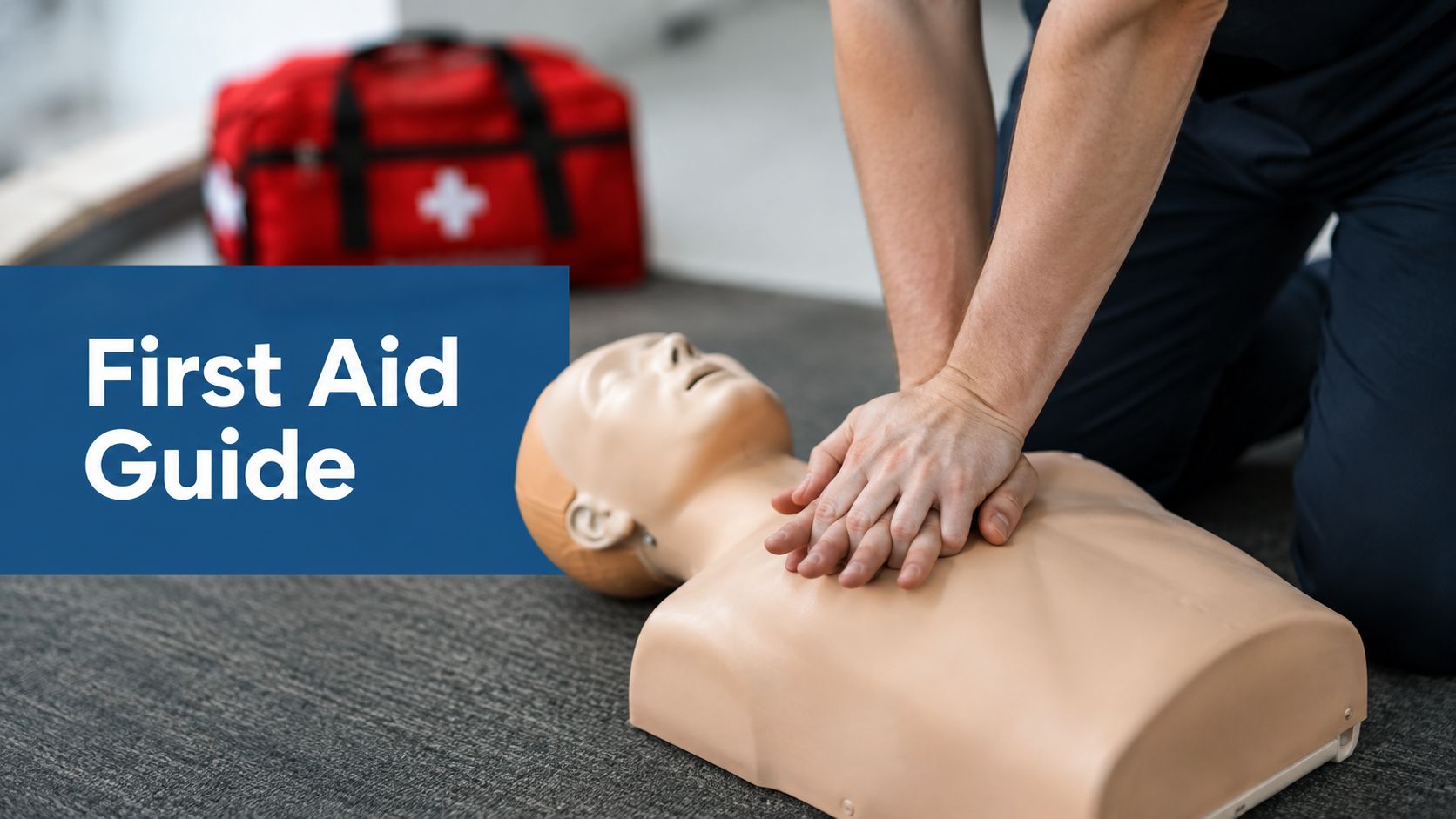
First Aid Course HLTAID011 Complete Guide for NSW
You're on a construction site in western Sydney when a worker cuts their hand on exposed metal. A colleague reaches for the first aid kit, someone calls for help, and you're suddenly expected to know what to do next. In a traffic-control crew, a warehouse, or a busy café, the first few minutes can feel confusing unless people have practised a clear response.
The first aid course HLTAID011 gives workers a nationally recognised foundation for responding to injuries and medical emergencies. It isn't just a certificate to attach to a job application. It's practical training in assessment, CPR, AED use and first aid procedures, with skills that need to be performed under pressure.
Table of Contents
- Introduction to the First Aid Course HLTAID011
- What HLTAID011 Provide First Aid Means in Australia
- Core Skills and Competencies You Will Learn
- Course Duration Delivery and How Assessment Works
- Certification Validity Renewal and Workplace Compliance
- Who Should Enrol Cost and What Is Included
- Booking Your HLTAID011 Course with TP Training in NSW
Introduction to the First Aid Course HLTAID011
A first aid response usually starts before anyone feels ready. A person may collapse near a loading bay, suffer a burn in a commercial kitchen, or become unwell beside a live roadwork zone. Your first responsibility isn't to become a doctor. It's to identify danger, seek help and follow a trained process while emergency services are on their way.
That's where HLTAID011 Provide First Aid fits. The unit supports everyday workers, supervisors, job seekers, employers and community members who may need to respond to an emergency. It combines knowledge with physical practice, so learners don't only read about CPR or bleeding control. They practise the actions and receive feedback from a trainer.
Workplace readiness remains uneven across Australia. St John's workplace readiness report found that 48% of workplaces offered accredited first aid training, while 43% had appropriate first aid resources such as kits and signage, and 24% of employees had participated in first aid procedures training or drills. These figures point to a practical problem, particularly in higher-risk industries, where having a certificate matters less if the person holding it hasn't built confidence through practice. St John's Australian workplace readiness report provides the benchmark.
What this guide helps you understand
You'll learn:
- What HLTAID011 is: How the unit sits within Australia's nationally recognised training system.
- What you'll practise: DRSABCD, CPR, AED use and responses to common workplace injuries and illnesses.
- How delivery works: Why many providers combine self-paced theory with face-to-face assessment.
- How competency is judged: What practical performance looks like on an adult manikin and during scenarios.
- How to stay ready: Why renewal planning and workplace equipment should be treated as risk controls.
For NSW workers, the course can support more than compliance. It can help a construction worker respond around plant and tools, a traffic controller think clearly near moving vehicles, or a hospitality worker manage a serious incident until professional help arrives. TP Training's practical workplace safety resources also explain how first aid sits alongside other common credentials in CPR, first aid, White Card and workplace safety certification pathways.
What HLTAID011 Provide First Aid Means in Australia
HLTAID011 is the current nationally recognised “Provide First Aid” unit in Australia. The National Training Register lists it as current from 16 October 2020 and records that it supersedes earlier first aid units. That status makes it the foundational first aid qualification for workplace and community settings across Australia. The National Training Register entry for HLTAID011 is the authoritative place to check the unit.
A useful comparison is a driver's licence. A licence doesn't make someone a professional driver, but it confirms that they've met a defined competency standard. HLTAID011 works in a similar way. It shows that a learner has completed the required training and assessment for a broad first aid unit, rather than only attending an informal information session.
HLTAID011 compared with CPR-only training
HLTAID011 includes CPR skills, but it covers more than resuscitation. A separate CPR unit is narrower, while Provide First Aid addresses a wider range of emergencies and injuries. Employers may specify which unit a role requires, so read the position description or workplace training policy before enrolling.
Childcare workers should also check whether their role requires a course designed for education and care settings. Children may need age-specific first aid responses, and an employer or regulator may nominate a particular qualification. HLTAID011 remains broad workplace first aid training, but it shouldn't automatically be treated as a substitute for every specialised first aid course.
What you receive after successful completion
When you're found competent, the registered training organisation issues a Statement of Attainment for HLTAID011. The document records the unit you completed and can be provided to an employer as evidence of training.
The important distinction is between attendance and competence. Sitting in a classroom doesn't demonstrate that you can deliver CPR, use an AED or manage an emergency sequence. Assessment requires you to show the relevant skills, which is why face-to-face practical participation is central to the course.
Core Skills and Competencies You Will Learn
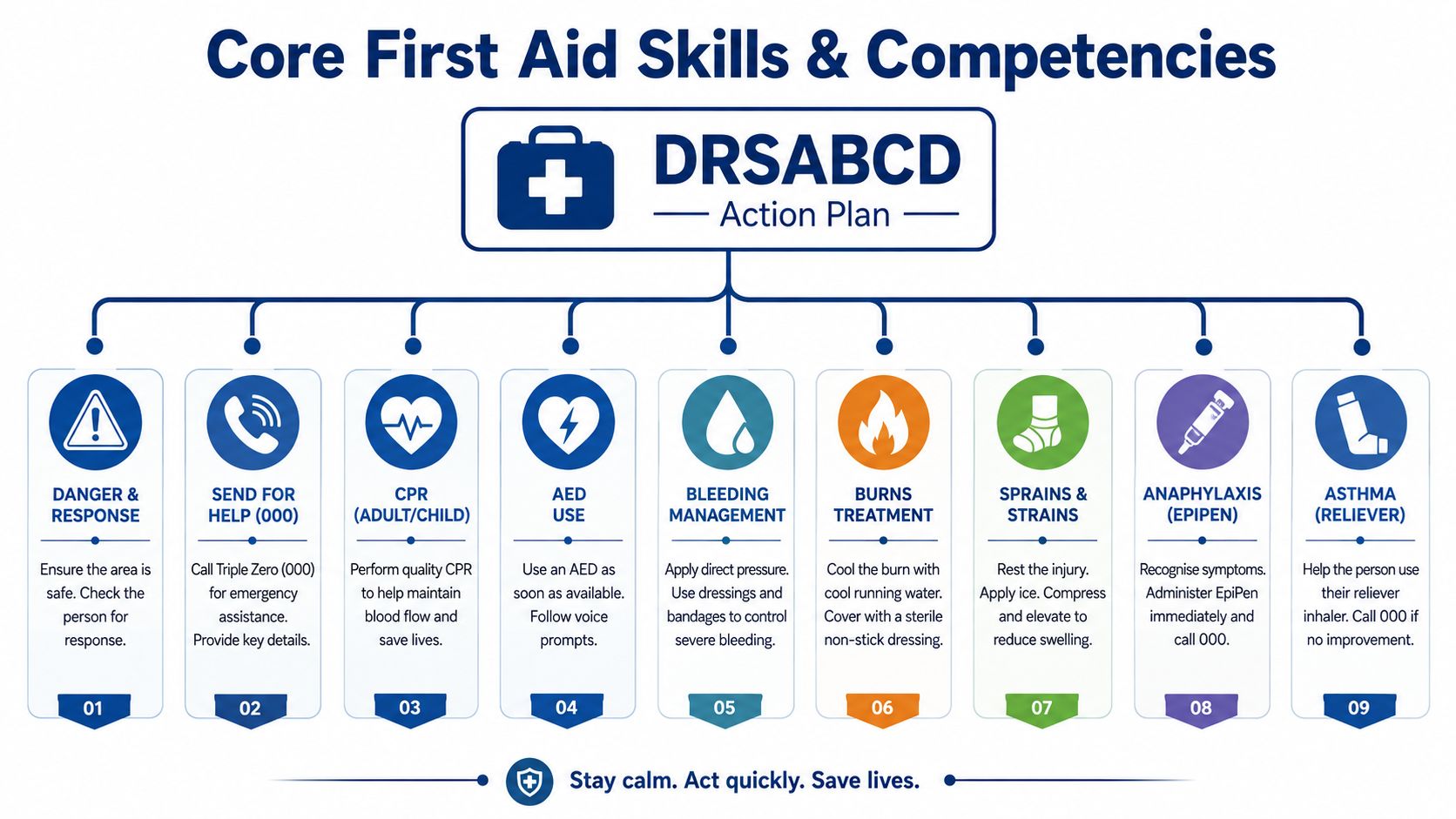
The course's central memory aid is DRSABCD. It gives you an order of action when an incident is chaotic:
- Danger: Check hazards before approaching. At a worksite, that could include traffic, electricity, unstable materials, machinery or chemical exposure.
- Response: Check whether the person responds to your voice or touch.
- Send for help: Call 000 or direct another person to call, then ask someone to locate the first aid kit and AED if one is available.
- Airway: Open and assess the airway.
- Breathing: Check for normal breathing.
- CPR: Start CPR when the person isn't breathing normally.
- Defibrillation: Apply an AED as soon as it's available and follow its prompts.
The sequence helps prevent a common mistake, rushing towards a casualty without checking whether the scene is safe. A traffic controller who runs into live traffic, or a construction worker who approaches an electrical hazard, may create another casualty instead of solving the first problem.
Why CPR and AED practice matter
Cardiac arrest is time-critical. The Australian College for Emergency Medicine states that delaying defibrillation by about one minute can reduce survival by roughly 10%, and survival may fall to around 2% to 5% after 12 minutes. CPR can slow that decline while an AED and emergency services are being accessed, but it doesn't reverse the effect of delay. ACEM's early access to defibrillation policy explains why rapid action matters.
On the course, learners practise compressions on manikins, use training AEDs and coordinate the response with other people. That practice makes the process more familiar. Familiarity matters when you need to kneel on a warehouse floor, work around bystanders or communicate with a 000 operator.
Applying first aid to ordinary workplace incidents
HLTAID011 also covers responses to common injuries and medical conditions. A warehouse worker may need to manage bleeding after contact with packaging equipment. A cook may need to respond to a serious burn. A civil worker may deal with a sprain, while a colleague with asthma or anaphylaxis may need urgent assistance.
The skill isn't memorising a long list of conditions in isolation. It's learning to assess the person, control immediate risks, provide appropriate first aid and monitor them until help arrives.
Practical rule: Treat the workplace around the casualty as part of the emergency. Your gloves, first aid kit, phone, AED and communication with co-workers all influence the outcome.
If you're building several construction competencies, first aid may sit alongside other practical training. For example, Cpccldg3001 Perform Dogging Licence Course And Training in Sydney is another nationally recognised, hands-on training option provided by TP Training across NSW. It's a separate qualification, but both courses reflect the value of practising job-relevant actions rather than relying only on written information. You can also use CPR course guidance to compare CPR-only training with broader first aid needs.
Course Duration Delivery and How Assessment Works
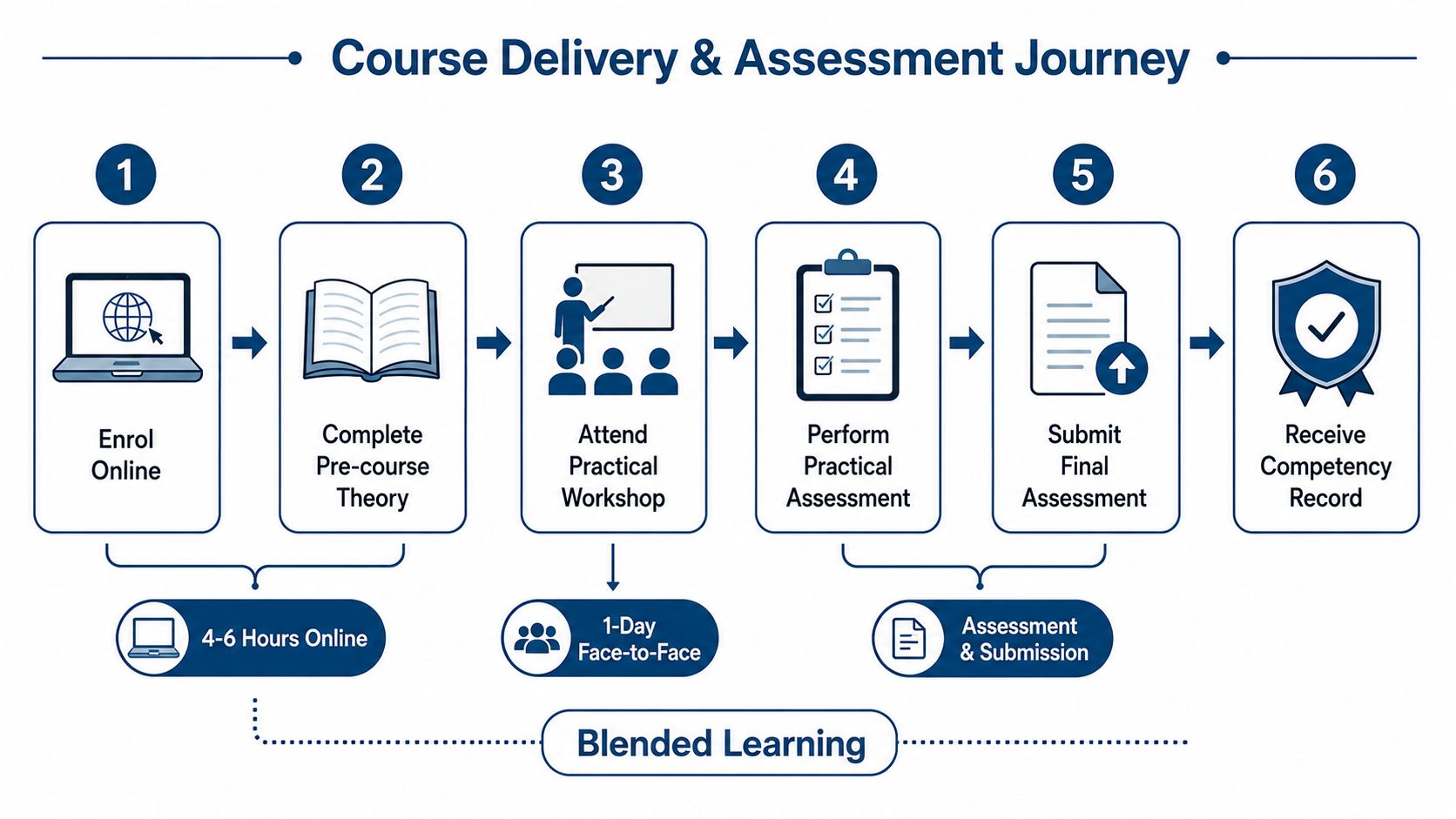
HLTAID011 is commonly delivered as a blended course, although the exact format depends on the provider. One common model can involve up to six hours of self-paced e-learning followed by four hours of face-to-face training. Some providers use a model of around eight hours total. These formats show why you should check the enrolment information carefully rather than assuming every course takes the same amount of time.
Online theory normally covers concepts you need before practical training. You may work through emergency procedures, workplace responsibilities, common injuries and response decisions. The face-to-face session then gives you time to practise physical skills with a trainer present.
What happens during the practical session
Expect to work with adult manikins, training AEDs, bandages and other first aid equipment. You may respond to scenarios that require you to identify hazards, communicate with others, perform CPR or manage an injury.
Assessment is performance-based. You aren't judged only on whether you can select a correct answer on a quiz. You need to demonstrate that you can carry out required actions in the correct sequence and at the required standard.
The CPR assessment includes a specific task. You must complete at least two minutes of uninterrupted single-rescuer CPR on an adult manikin placed on the floor, using five cycles of compressions and ventilations. The assessment guide specifies a 30:2 compression-to-breath ratio, so CPR shouldn't be described as an indefinite or vague activity. The HLTAID011 learner assessment guide sets out this measured requirement.
How to prepare for the day
Wear comfortable clothing that allows you to kneel and move safely. Bring any identification or enrolment information requested by the provider, complete the online component before the workshop if applicable, and allow enough time to arrive calm rather than rushed.
If you're nervous about the CPR component, tell the trainer early. Trainers expect learners to need correction and repetition. The purpose of assessment is to confirm competence, not to reward people who already know everything.
| Course stage | What you're doing | Why it matters |
|---|---|---|
| Self-paced theory | Completing knowledge activities before or around the workshop | Builds the decision-making foundation |
| Face-to-face practice | Working with manikins, AED trainers and first aid equipment | Turns instructions into physical skills |
| Scenario assessment | Responding to simulated emergencies | Tests communication and sequence under pressure |
| CPR demonstration | Performing the defined floor-based CPR task | Confirms practical resuscitation competence |
Training formats and vocational pathways can vary, so learners should review the provider's course information and broader vocational training guidance in Australia before booking.
Certification Validity Renewal and Workplace Compliance
Passing HLTAID011 is one step. Keeping the skill usable at work requires a separate plan for renewal, practice and equipment.
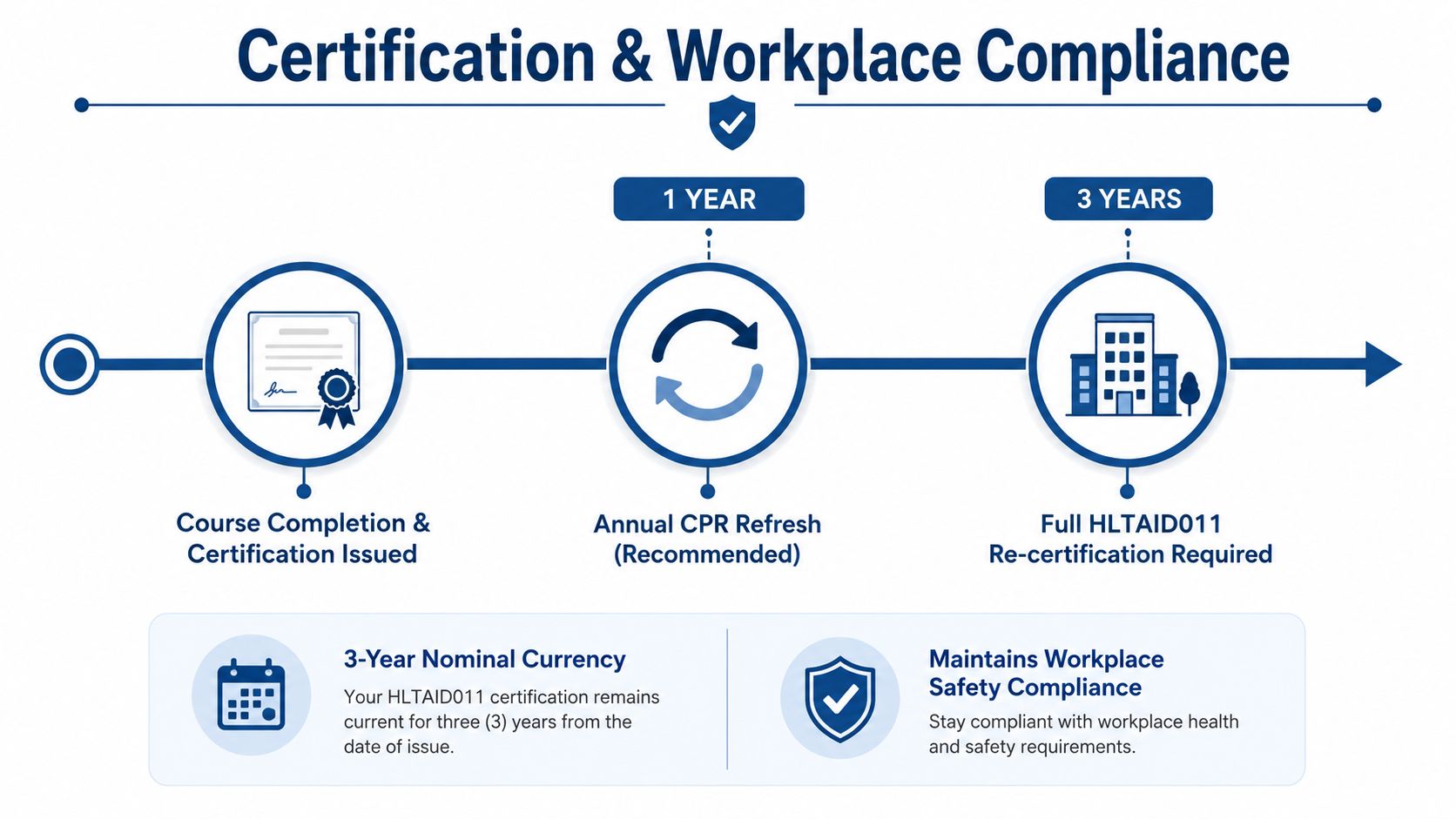
The nominal currency period for HLTAID011 is three years, while CPR should be refreshed annually as a workplace safety practice. The certificate and the practical skill therefore operate on different rhythms. A worker may still hold a current first aid Statement of Attainment but feel less confident with compressions if they haven't practised recently.
Currency versus workplace readiness
A workplace needs more than a list of names and expiry dates. Safe Work Australia's Model Code of Practice says all workers must be able to access a first aid kit, meaning at least one kit must be provided at the workplace. The kit should suit the workplace and be immediately identifiable with a white cross on a green background, with a contents list and protective packaging against dust, moisture and contamination. Safe Work Australia's first aid code also identifies common workplace injuries such as cuts, sprains, minor burns and major bleeding wounds.
A construction site might need arrangements that reflect machinery, heights and moving materials. A hospitality venue may need accessible supplies for burns and cuts. A traffic-control operation needs a response plan that accounts for vehicles and public exposure. The correct kit, trained people and clear access routes should work together.
A practical renewal comparison
| Situation | Sensible action |
|---|---|
| New enrolment | Complete HLTAID011 and record the competency date |
| Approaching annual CPR refresh | Book CPR practice or renewal through the employer's process |
| Approaching the three-year point | Plan full HLTAID011 retraining before the current period ends |
| Changing workplaces | Check whether the new employer has stricter site requirements |
| After a long period without practice | Ask a trainer about a refresher rather than relying on memory |
Workplace insight: Compliance records show whether training is current. Drills, accessible equipment and confident communication show whether the workplace is actually ready.
A strong employer process tracks individual currency, checks first aid kits and includes workers in emergency procedures. That approach reduces the risk of discovering an expired certificate or empty kit after an incident has already occurred.
Who Should Enrol Cost and What Is Included
HLTAID011 suits people who may be the first trained responder at work or in the community. That includes construction and civil workers, traffic controllers, warehouse and logistics staff, hospitality employees, supervisors, employers, job seekers and career changers.
The strongest reason to enrol is usually connected to the role:
- Construction and civil work: Respond around tools, plant, materials, falls, bleeding and other site hazards.
- Traffic control: Think about scene safety, road exposure and communication before approaching a casualty.
- Warehousing and logistics: Manage incidents around loading areas, forklifts, storage systems and manual handling.
- Hospitality: Respond to burns, cuts, allergic reactions and sudden illness in a fast-moving environment.
- Job seekers: Add a nationally recognised workplace skill that may appear in employer requirements.
- Employers: Build a more organised response capability by training workers and maintaining suitable equipment.
What course fees usually reflect
Prices vary between providers and locations, so ask for a clear inclusions list before comparing costs. Fee differences may reflect the delivery model, trainer support, practical facilities, learning materials, assessment administration and whether workplace delivery is available.
A typical HLTAID011 offering may include:
- Theory resources: Online or printed learning material covering the knowledge requirements.
- Practical equipment: Adult manikins, training AEDs, bandages and other first aid materials.
- Trainer guidance: Demonstrations, corrections and opportunities to repeat techniques.
- Assessment: Knowledge checks and practical scenarios, including the defined CPR demonstration.
- Outcome documentation: A Statement of Attainment when you're assessed as competent.
If you work with children, compare HLTAID011 with a relevant Childcare First Aid Course before booking. The right choice depends on your role and the qualification your employer or workplace requires.
Learners may also need support with enrolment information, literacy, language or digital access. TP Training outlines its multilingual support for English, Mandarin, Korean and Vietnamese learners, which can help you ask practical questions before committing to a course.
Booking Your HLTAID011 Course with TP Training in NSW
Choosing a course is easier when you check four things first: the unit code, delivery format, practical assessment requirements and renewal expectations. If those details are clear, you can compare providers without being distracted by vague promises about convenience or speed.
TP Training delivers practical, nationally recognised training through NSW centres in Penrith, Burwood, Auburn, Parramatta and Sydney CBD. For a first aid learner, the important questions are whether the booking suits your work schedule, whether the course includes hands-on assessment, and what evidence you'll receive after successful completion.
Before you book
Use this short checklist:
- Confirm the unit: Check that the course is HLTAID011 Provide First Aid if that's what your employer requires.
- Ask about delivery: Find out whether theory is completed online, face to face or through a blended format.
- Check assessment details: Confirm that practical CPR, AED use and scenario assessment are included.
- Plan your renewal: Record the completion date and ask how annual CPR refresh expectations apply.
- Prepare your USI: Make sure your Unique Student Identifier details are correct before enrolment. TP Training's simple USI management steps can help.
Common questions from first-time learners
Do I need previous first aid experience?
HLTAID011 is designed for learners who need the Provide First Aid competency. You don't need to arrive as an experienced first aider, but you do need to participate in the learning and demonstrate the required skills.
Do I need a USI?
Registered training enrolments generally require a correct USI. Confirm your details with the provider before training so your records can be processed properly.
Will I receive my certificate on the same day?
Timing depends on the provider's assessment and administration process. Ask before booking when your Statement of Attainment or competency record will be issued.
What if I'm worried about CPR?
Tell your trainer. CPR is physically demanding, and the assessment is specific, but practice and feedback are part of the training process.
For NSW workers, the most useful course is the one that matches the workplace requirement and gives you enough practical time to perform the skills confidently. Review the locations, complete the enrolment requirements, and choose a training date that lets you arrive prepared rather than trying to fit the course around an already exhausting shift.
TP Training offers practical HLTAID011 first aid training across NSW, with hands-on learning for job seekers, workers and employers who need workplace-ready skills. Visit TP Training to review course information, locations and booking options, then take the next step towards safer, more confident emergency response.

You may also like
First Aid Training Cost: A Complete Guide for Sydney Workers
How Long Licence Crystalline Silica Prevention Last