Asbestos Awareness Training in Australia
You're on an older site, the ceiling tile's already down, and the white-grey sheet in your hands looks harmless enough. A foreman is waiting, the job's behind schedule, and someone says, “It's probably just fibro.” That's the exact moment asbestos awareness training matters, because the right response isn't guesswork, it's knowing when to stop, step back, and check before anyone disturbs a material that could still contain asbestos.
In Australia, that's not a rare edge case. About 1 in 3 homes still contain asbestos, and the built environment has carried an estimated 13 million tonnes of asbestos-containing materials. The Asbestos Safety and Eradication Agency also estimated 6.2 million tonnes of asbestos legacy material remained in the built environment in 2021 (Asbestos Facts and Figures Guidance 2025). That's why this training is more than paperwork. It's a practical habit for people who work around older homes, plant rooms, roof spaces, wall cavities, service voids, and renovation debris.
Table of Contents
- Why Asbestos Awareness Training Still Matters on Australian Worksites
- What Asbestos Actually Is and Why It Cannot Be Identified by Sight
- Legal Duties, Codes of Practice, and Who the PCBU Is
- Who Must Complete Asbestos Awareness Training in NSW
- Online vs Face-to-Face Delivery, Duration, and Assessment
- What the 11084NAT Course Covers Module by Module
- What Asbestos Awareness Training Does Not Authorise You to Do
- Frequently Asked Questions and Your Next Step with TP Training
Why Asbestos Awareness Training Still Matters on Australian Worksites
A new apprentice pulls off a bit of old wall lining in a bathroom reno. The sheet breaks cleanly, but not in a way that gives them certainty. It's grey, fibrous, and older than the rest of the room. That pause, the one between “I'm not sure” and “should I keep going?”, is exactly where asbestos awareness training earns its keep.
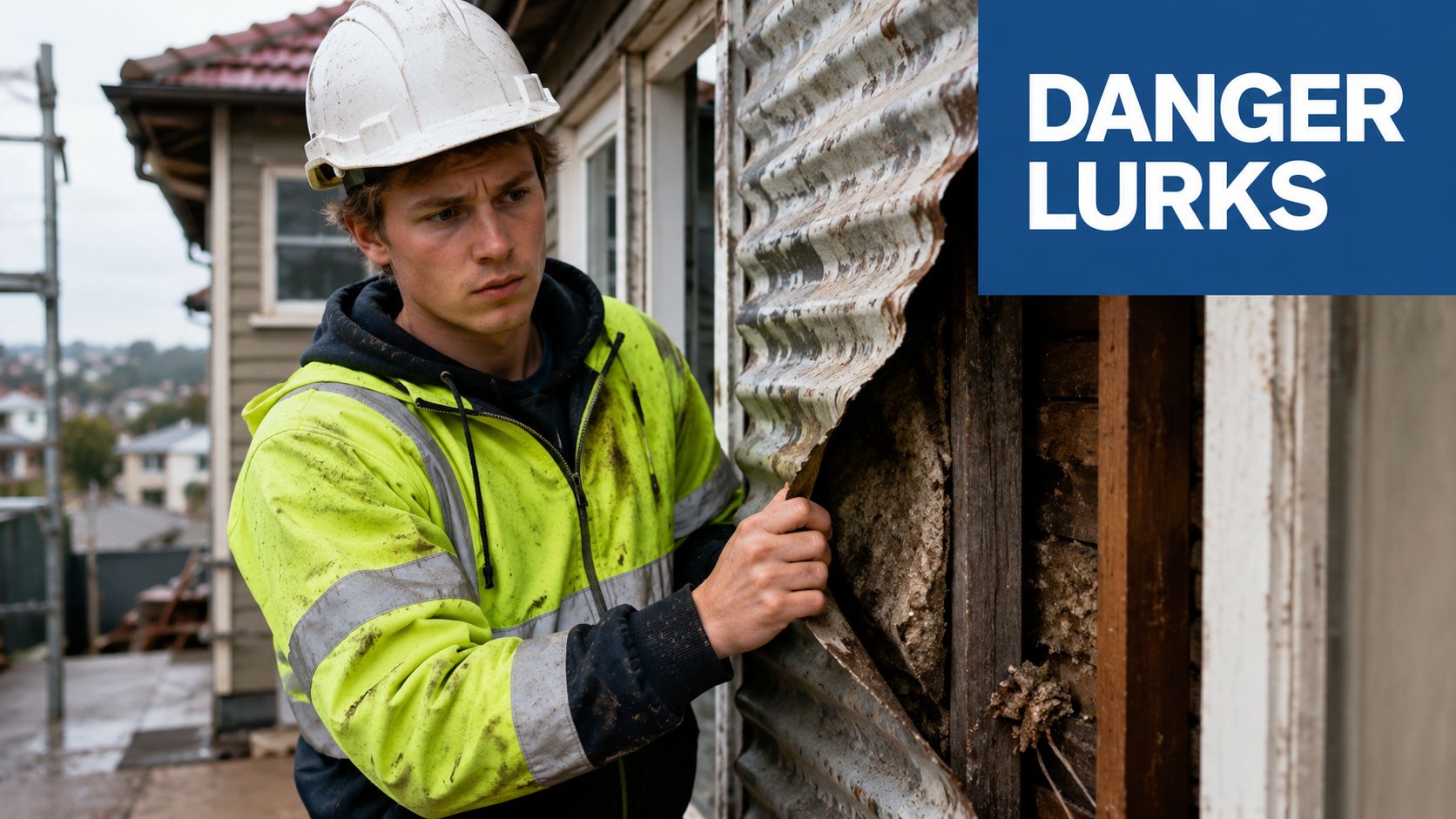
The hazard still sits inside ordinary workplaces, not just demolition zones. In housing, maintenance, and small commercial jobs, workers can encounter asbestos in sheeting, eaves, wet areas, fences, backing boards, insulation, and old plant rooms. Because asbestos remains embedded in everyday Australian work sites, the point of awareness training is simple, recognise suspect material early and avoid disturbing it until it's properly checked.
Practical rule: if the material is old, damaged, or uncertain, treat it as suspect and stop before you cut, drill, or rip it out.
That rule matters because guessing on site is expensive in the worst possible way. A worker who knows only “asbestos is dangerous” still has to decide what to do when the job is part-finished and the client is impatient. A worker who's had awareness training has a process, look, pause, report, and escalate.
For people in construction, renovation, maintenance, cleaning, and trades, the value of the training is not abstract compliance. It's the ability to recognise when a task crosses from routine work into a hazard that needs verification, controls, or a different person altogether. If you work near older buildings, roof cavities, ceiling voids, buried services, or dated fit-outs, this is foundational knowledge, not a box-ticking exercise.
What Asbestos Actually Is and Why It Cannot Be Identified by Sight
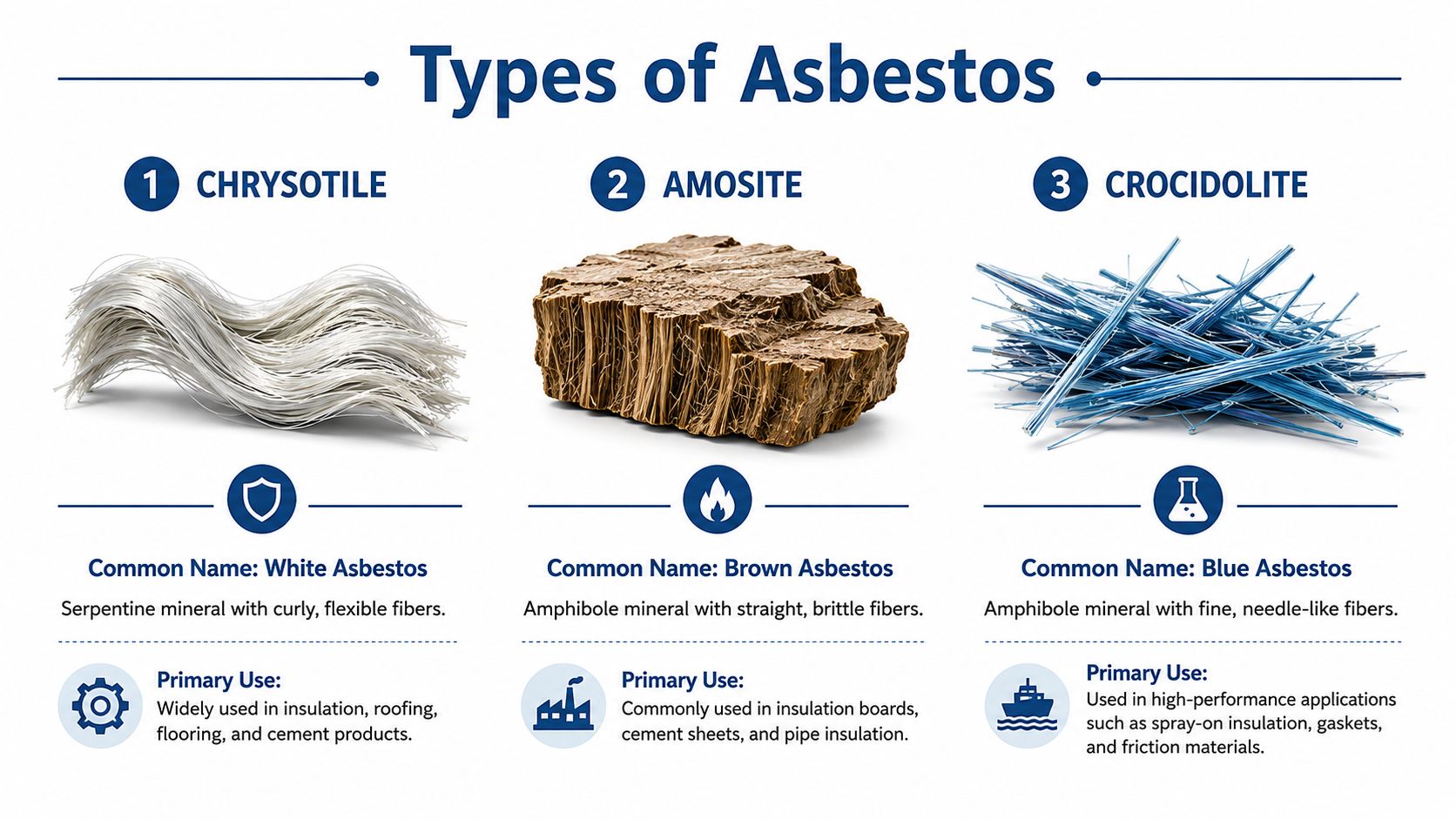
A worker opens a wall cavity in an older Sydney unit and finds a pale sheet behind the plaster. It looks ordinary enough, until the question turns from appearance to risk. Asbestos is not one material with one look. It is a group of fibres that were used in different products for the same reasons, heat resistance, strength, and durability. The three main commercial types are chrysotile, amosite, and crocidolite, and each can appear in different legacy building products across older Australian sites.
Why the eye is the wrong tool
You cannot identify asbestos by colour, texture, or age alone. A sheet can resemble fibre cement, a tile can resemble standard vinyl, and insulation can resemble ordinary old packing material. The only reliable way to know whether a material contains asbestos is laboratory testing of a representative sample.
That is why awareness training focuses on recognition, not heroics. Workers learn to spot likely asbestos-containing materials, then leave the material alone until someone with the right process confirms what it is. If the job is old enough to raise doubt, doubt is enough to stop work.
Why the fibres matter
The danger starts when fibres become airborne and are breathed in. Those respirable fibres can lodge in lung tissue and contribute to diseases such as asbestosis, lung cancer, and mesothelioma. The risk is tied to disturbance, so the site question is not whether the material looks bad, it is whether anyone should be disturbing it at all.
For workers trying to make quick sense of the issue, the practical rule is straightforward. Old material plus uncertainty means caution. Australian building stock carries a large legacy burden, so unidentified material should stay suspect until testing says otherwise. The 10830Nat 11084Nat Crystalline Silica Exposure Prevention Asbestos Awareness Combo Courses package is one option that combines that asbestos recognition lens with crystalline silica prevention training for workers who need both in one booking.
Where older materials fit in
Many workers already know the common signs of older materials, but the true skill is linking them to a decision. If a bathroom wall, eave sheet, or floor product comes from an older build period and cannot be positively identified, the correct move is to assume risk, not improvise. That is the line where awareness stops and more specific controls, verification, or a different person becomes the only safe option.
For a related practical overview of how silica awareness sits alongside asbestos awareness in worker training, see TP Training's note on the silica awareness course update.
Legal Duties, Codes of Practice, and Who the PCBU Is
The law does not leave asbestos decisions to the nearest tradie on site. In a workplace, the duty sits with the PCBU, the person conducting a business or undertaking. In plain English, that is the business or operator running the site, job, or workplace activity, and the duty is to keep workers safe so far as is reasonably practicable.
What the duty means in practice
That duty cannot be handed off to someone else. A worker cannot be told, “You're the one who has to decide whether the building is safe”, and then carry the legal burden alone. The PCBU must set up the conditions for safe work, which includes making sure asbestos risks are identified, controlled, and handled before work begins.
For older buildings, the planning stage matters as much as the job itself. If a building was constructed before 2004, the relevant codes of practice and asbestos management processes require the site to be checked before work disturbs anything that might contain asbestos. The job should not start on a guess, and unidentified suspect material should be treated as dangerous until verified safe.
Codes of practice are the playbook, not decoration
Codes of practice turn the legal duty into site behaviour. They tell the PCBU what should happen before disturbance, how risks are managed, and what controls sit around removal, waste, and emergency response. Workers still need to follow site instructions, but those instructions should come from a system that has already dealt with the asbestos question.
A good asbestos system does not wait for a mistake, it stops the mistake before the first cut, drill, or break.
That is why awareness training and legal duty are linked. The law expects the business to act early, and the worker to recognise when the material needs escalation. On a busy site, that shared logic keeps the responsibility where it belongs, with the PCBU for the system, and with the worker for the stop-work response.
A practical example is maintenance work in older facilities. A plumber, electrician, or cleaner may not be doing asbestos work, but they can still trigger asbestos controls if the task touches legacy material. For people operating machinery around suspect structures, TP Training also offers the Riihan309F Operating Telescopic Material Handler Gold Card Course as a separate, nationally recognised option when equipment competency is the issue rather than asbestos awareness. For a practical overview of how silica awareness sits alongside asbestos awareness, see CPR, First Aid, White Card and Workplace Safety Certifications.
Who Must Complete Asbestos Awareness Training in NSW
If your work puts you near older building materials, you are in the group that needs this training. That includes building and construction workers, and it reaches well beyond the core trades. WorkSafe ACT says all building and construction workers fall into the likely-to-encounter category, and the same logic carries into many NSW worksites where older materials are common.
Roles that commonly trigger the need
Carpenters, electricians, plumbers, HVAC technicians, demolition labourers, painters, roofers, floor tilers, telecommunications cablers, maintenance staff, cleaning staff, and site supervisors are all roles that can run into suspect asbestos during normal work. Council workers, emergency services personnel, and facilities or strata managers can also be caught by the same risk when they enter older infrastructure or respond to a call-out.
The reason is straightforward. These roles do more than work around buildings. They open panels, remove fixtures, inspect cavities, repair leaks, clean surfaces, or supervise contractors who do. Each of those tasks can create the moment where a hidden asbestos material gets disturbed.
The job title is less important than the task
A worker does not need to be a demolition specialist to need awareness training. If the role includes opening up old fabric, maintaining services, or checking damaged areas in older buildings, the risk is real. Supervisors need the training too, because they are often the ones who decide whether a worker keeps going or stops.
Plain answer: if your task could expose you to suspect material, you need enough awareness to recognise it and enough discipline to stop.
That is the operational test. It does not matter whether you are on a fresh commercial build, a strip-out, a warehouse upgrade, or a council maintenance round. If the work could uncover old asbestos-containing material, awareness training is part of doing the job safely.
TP Training's course and support pages also point learners to broader compliance pathways, including the CPR, First Aid, White Card and workplace safety certifications overview, which helps some workers map asbestos awareness alongside other site-entry requirements.
Online vs Face-to-Face Delivery, Duration, and Assessment
A worker turns up to site, gets handed a task, and needs to know quickly whether the material in front of them is safe to touch or whether they must stop and escalate. That is where delivery mode matters. Some people learn the rules faster by reading on their own first, while others need a trainer beside them to point at examples and explain the difference between ordinary building materials and suspect asbestos-containing material.
How the two formats feel on the day
Online study suits experienced workers who already understand the site environment, need flexibility, or live away from a training centre. It lets them work through the theory at their own pace, which can suit people balancing shift work, travel, or busy project schedules. Face-to-face suits new starters, people who prefer group discussion, and workers who want a trainer to walk through real examples like old eaves, floor tiles, or ceiling sheets.
The choice often comes down to how much support a person needs while the material is still new. For some learners, seeing a trainer point to a sample and explain why it looks suspect makes the lesson stick. For others, the benefit of online delivery is being able to pause, reread, and return to a topic until the meaning is clear.
The assessment is usually a knowledge check. In either format, the learner has to show they can recognise suspect material, explain the first response, and describe what not to do when asbestos is involved. That matters because the course is about stopping the wrong reaction at the right moment. It does not turn someone into a licensed removalist, and it does not authorise higher-risk work. It confirms the worker knows when awareness ends and when the job must stop.
Picking the format that fits the worker
If English is a challenge, face-to-face delivery can be easier because questions get answered straight away. TP Training also notes its multilingual support information for learners who need help in English, Mandarin, Korean, and Vietnamese, which matters for workers who are new to Australian site language and terminology. In a classroom, that support can reduce confusion around technical words that might be clear to a supervisor but new to a labourer or trades assistant.
Online and classroom learning both aim at the same outcome, safe recognition and correct first action. The difference is pacing. Online gives you control over timing. Face-to-face gives you immediate clarification and a chance to hear how other workers think through the same hazards.
A practical way to choose is simple.
- Choose online if you're refreshing knowledge, working remotely, or already comfortable with self-paced learning.
- Choose face-to-face if you want live trainer support, direct questioning, and discussion of site examples.
- Choose whichever lets you stay focused, because with asbestos, misunderstanding the first step is where people get hurt.
What the 11084NAT Course Covers Module by Module
A worker opens a wall cavity on a renovation job in NSW, spots old sheet material, and has to decide whether to keep going or stop the task. The 11084NAT Course in Asbestos Awareness is built around that kind of decision on site. It covers recognition, risk control, and the point where the job stops because the next step belongs to a different level of training or a licensed removalist.
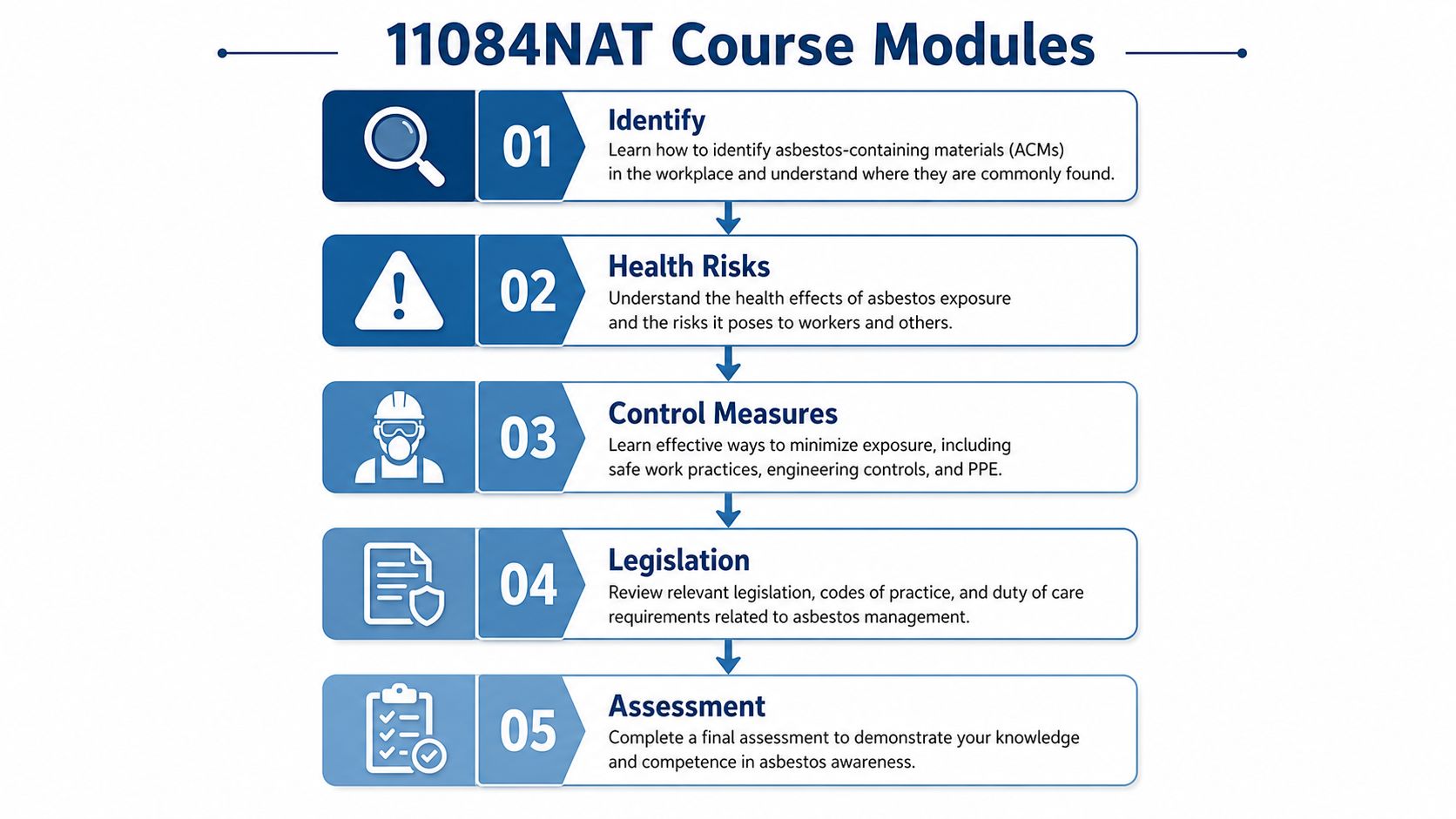
The content you can expect
The course usually works through common asbestos-containing materials, where they are often found, the health effects of exposure, legislative duties, risk identification, safe work practices, control measures, emergency response, and waste handling. Those pieces are connected. A worker first learns what asbestos may look like in the kinds of places found on Australian worksites, then learns how to react without disturbing it, and finally learns how to hand the job over through the correct control path.
A practical example helps. A bathroom renovation starts with a panel that looks ordinary, then a layer underneath raises concern. At that point, awareness training is doing its real job, because the worker recognises the problem early enough to stop, isolate the area, and escalate instead of pushing through the task.
The course content also fits with the broader training pathway. TP Training's combined crystalline silica and asbestos awareness course update sits in the same practical space, helping workers understand two common construction hazards without mixing up the controls that apply to each one. That matters on site, because a worker may need to recognise more than one hazard in the same room, but each hazard still has its own safe response.
Assessment and outcome
Assessment usually checks whether a learner can identify suspect ACM or PACM and explain the first safe response. That is the point of the course. Recognition prevents accidental disturbance, and the first response protects both the worker and everyone nearby.
Learners are generally asked theory questions rather than tasks that involve disturbing material. That keeps the focus where it belongs, on spotting warning signs, applying basic control measures, and knowing when the work must stop. Once completed, learners receive the relevant certificate or Statement of Attainment as evidence that they have finished the course.
The sequence is the part to remember. Identify. Stop. Escalate. Put the job into the correct management process. If a worker forgets the module titles, that sequence still gives them the right action on site. When the task needs more than awareness, the answer is not to keep working and hope for the best, it is to step out of the job and pass it to the right level of control.
What Asbestos Awareness Training Does Not Authorise You to Do
A common pitfall for many workers is misunderstanding the scope of awareness training. Completing this training does not qualify you to remove asbestos, drill through it, cut it, or dispose of it freely. Its purpose is to teach recognition and first response procedures. It does not transform you into a certified removalist.
The hard line on disturbance
Oregon State University's asbestos awareness guidance gives a very blunt set of don'ts. Never drill, hammer, cut, saw, break, damage, move, or disturb suspect asbestos-containing material. That's the right mental checklist for a worker standing in front of old tile, insulation, ceiling material, or sheeting that hasn't been verified.
The same guidance gives a concrete maintenance example. Housekeepers should never sand or dry buff asbestos-containing floor tiles, and only wet stripping methods may be used, with low-abrasion pads operated below 300 rpm (OSU asbestos awareness training guidance). The point isn't the exact machine brand or the exact room type, it's that the wrong method creates fibre release.
Awareness, non-licensed work, licensed removal
These are not the same thing. Awareness training tells you how to recognise suspect material and protect yourself and others. Non-licensed asbestos work still needs task-specific training and controls. Licensed removal work is another level again, and only licensed removalists can lawfully carry it out.
If you're asking, “Can I just do this quick cut?”, the answer is usually no if the material is suspect and unverified.
That's the simplest test to remember. If the task involves disturbance, the work has moved beyond awareness. If the task is removal, it has moved beyond a general worker decision altogether. Awareness is there to stop overconfidence, not to justify it.
Frequently Asked Questions and Your Next Step with TP Training
People usually want four straight answers. How long does it last, do I need refreshers, does it replace a White Card, and is it valid everywhere? The short version is that asbestos awareness is a separate competency, it's not a White Card equivalent, and refresher needs depend on the role and the work pattern. The safer approach is to treat it as current knowledge that should be kept fresh when work methods or site risks change.
Training options matter too. TP Training lists campuses in Penrith, Burwood, Auburn, Parramatta, and Sydney CBD for the 11084NAT asbestos awareness course, and it also offers a combined crystalline silica and asbestos awareness option for workers who need both competencies in one booking.
If you're also working through ID setup before enrolment, TP Training has a practical guide on the Unique Student Identifier process, which helps remove one more hurdle before you start.
The right next step is straightforward. Pick the delivery mode that suits your site experience, choose the campus that fits your location, and book the course before you're exposed to a job where the material is already in front of you. That's the difference between walking onto site prepared and learning the hard way.
TP Training provides asbestos awareness training that fits real site conditions, with practical delivery options and campus access across Sydney. If you're working around older buildings, renovation debris, or maintenance tasks, visit TP Training to review the course options and book the pathway that matches your role.

You may also like

Barista Course NSW: A Practical Guide to Getting Started