Affordable Traffic Control & Traffic Management: Top 2026
You're probably in one of two spots right now. You want a practical job that doesn't require a university degree, or you're already in construction and want a ticket that leads to steadier site work. Traffic control is often one of the first pathways people look at because it's visible, regulated, and tied closely to civil and infrastructure work.
The mistake many people make is treating "affordable" as the lowest course fee on the screen. In traffic control, that is rarely the smartest move. Affordable Traffic Control & Traffic Management means paying for training that gets you compliant, employable, and ready to work without having to redo units, fix paperwork problems, or explain weak training on site.
Australia currently has 10,300 road traffic controllers employed, up from 8,000 five years ago, which points to strong growth tied to infrastructure development and urban expansion, according to road traffic controller stats in Australia. That is why job seekers keep coming back to this field. The demand is real, but so are the compliance checks.
Table of Contents
Starting Your Career in Traffic Management Affordably
The practical question is not "What is the cheapest course?" It is "What gets me on site properly qualified, with the least risk of wasting money?" That is a different calculation.

A lot of new starters look at traffic control because it offers a clear entry point into construction support work. If you're comparing options, a useful starting point is this guide to low-cost traffic control courses in Sydney, but price should only be the first filter, not the final decision.
What affordable really means
Cheap training can become expensive fast if any of the following happen:
-
You can't use the qualification for the work you want because it doesn't line up with state requirements.
-
You need retraining later because the course didn't give you the practical grounding employers expect.
-
You lose work opportunities while waiting to sort cards, assessment records, or missing prerequisites.
Practical rule: If a course is inexpensive upfront but leaves you uncertain about what jobs you can legally do after completion, it is not affordable.
What job seekers should focus on first
At the beginning, keep your goal simple. You want training that is nationally recognised, relevant to NSW if that is where you'll work, and connected to the actual duties performed on a live roadwork or civil site.
That means looking beyond the ad headline. Ask what qualification you'll receive, what site tasks it prepares you for, whether practical learning is included, and what you still need before you can work. Those questions save more money than chasing the lowest sticker price.
Understanding Essential Traffic Control Qualifications
Traffic management training makes more sense if you think of it as a set of building blocks. One card gets you onto construction sites. Another lets you direct traffic. Another moves you into setup and plan implementation.
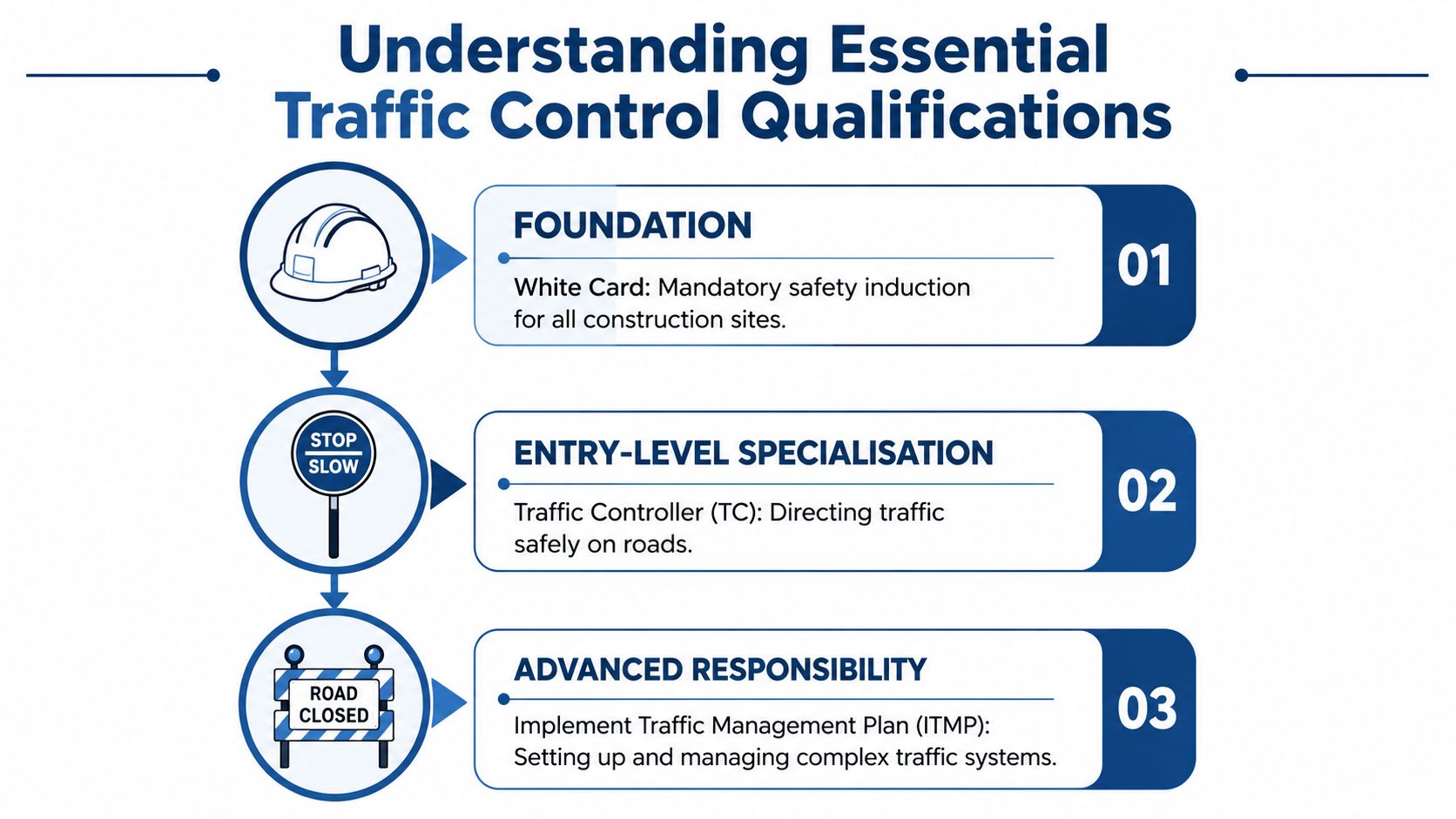
The base layer is the White Card. If you don't have that yet, this overview of the White Card course in Sydney CBD is worth checking before you book anything else.
The three core layers
| Qualification | What it does in practice | Why it matters |
|---|---|---|
| White Card | Covers general construction induction | You need it before working on construction sites |
| Traffic Controller Blue Card | Prepares you to stop and start traffic and work with portable control devices | It's the entry point into live traffic control work |
| Traffic Management Implementer Yellow Card | Prepares you to set up and implement traffic management plans | It opens the door to broader responsibility on site |
The formal requirement is important. The Traffic Controller Course (Blue Card) and Traffic Management Implementer Course (Yellow Card) are nationally recognised qualifications that must be completed to legally work as a certified traffic controller in Australia, and NSW also requires the SafeWork NSW Traffic Control Work Training Card for employment, as explained in this summary of traffic control courses in Australia.
How these cards work on a real site
If you’re holding a stop/slow bat and controlling vehicle flow through a work zone, you’re in Traffic Controller territory. If you’re setting up signage, positioning devices, and working from a traffic management plan, that shifts into implementation work.
That is why many workers start with traffic controller training and then add implementation once they understand site flow, crew coordination, and setup standards.
The right sequence saves money. Starting with the qualification that matches your immediate job goal is usually smarter than collecting cards you can’t use yet.
A practical example is the Traffic Management Implementer Course Yellow Card. It helps show how implementation training is structured, what practical skills are covered, and where it fits within a broader traffic management pathway in NSW.
Common beginner mistake
People often assume all “traffic courses” do the same thing. They do not. One gets you ready to control movement directly. Another prepares you to implement traffic management arrangements. If you book the wrong one first, you can lose time and spend more than necessary fixing the order later.
Calculating the True Cost of a Traffic Control Career
The advertised fee is only one part of the cost. In practice, your real spend includes prerequisites, time away from other work, travel to training, PPE if required for practical components, and the cost of getting poor training that doesn’t hold up on site.

That is why it makes more sense to calculate the total cost of becoming employable, not just the advertised course fee.
The hidden costs that catch beginners
Some costs are obvious, some are not. The ones that usually trip people up are:
-
Missing prerequisites such as the White Card or your USI details not being sorted.
-
Repeat training when a low-cost provider hasn’t delivered the depth needed for worksite confidence.
-
Interrupted job applications because you’ve got partial training but not the right combination of qualifications for the roles you want.
-
Weak practical understanding that shows up the moment a supervisor asks you to work around pedestrians, plant movement, blind spots, or changing site conditions.
One reason this matters so much is safety compliance. Emerging data shows that 62% of workers trained only in low-cost programs fail incident audits due to insufficient knowledge of isolating risks from pedestrians or managing blind spots, according to Safe Work Australia guidance on traffic management duties. That is a strong argument against buying on price alone.
Cheap upfront versus affordable overall
Here’s the practical comparison:
| Option | What looks good | What often goes wrong |
|---|---|---|
| Lowest upfront fee | Small initial outlay | Gaps in practical skill, confusion about compliance, retraining risk |
| Recognised, job-focused training | Higher initial commitment | Better chance of being work-ready and avoiding repeat costs |
If a course leaves you qualified on paper but hesitant around live traffic, you have not saved money. You have delayed the real cost.
A lot of people look at training cost separately from earning potential, but they are linked. If you want a realistic picture of the work side, this guide on traffic controller salary and pay rates in Sydney helps frame the decision properly.
What to ask before you book
Before paying, ask these questions:
-
Is the training nationally recognised?
-
Does it fit NSW work requirements if I want to work in NSW?
-
What practical component is included?
-
What qualification do I finish with?
-
What still needs to be done after the course before I can apply for work?
That is how you judge value, not by the cheapest ad.
Your Step-by-Step Pathway to Getting Certified
Starting is easier when you treat the process as a checklist. A common stumbling block is trying to sort everything at once. Do not do that. Get the basics in order, then build from there.
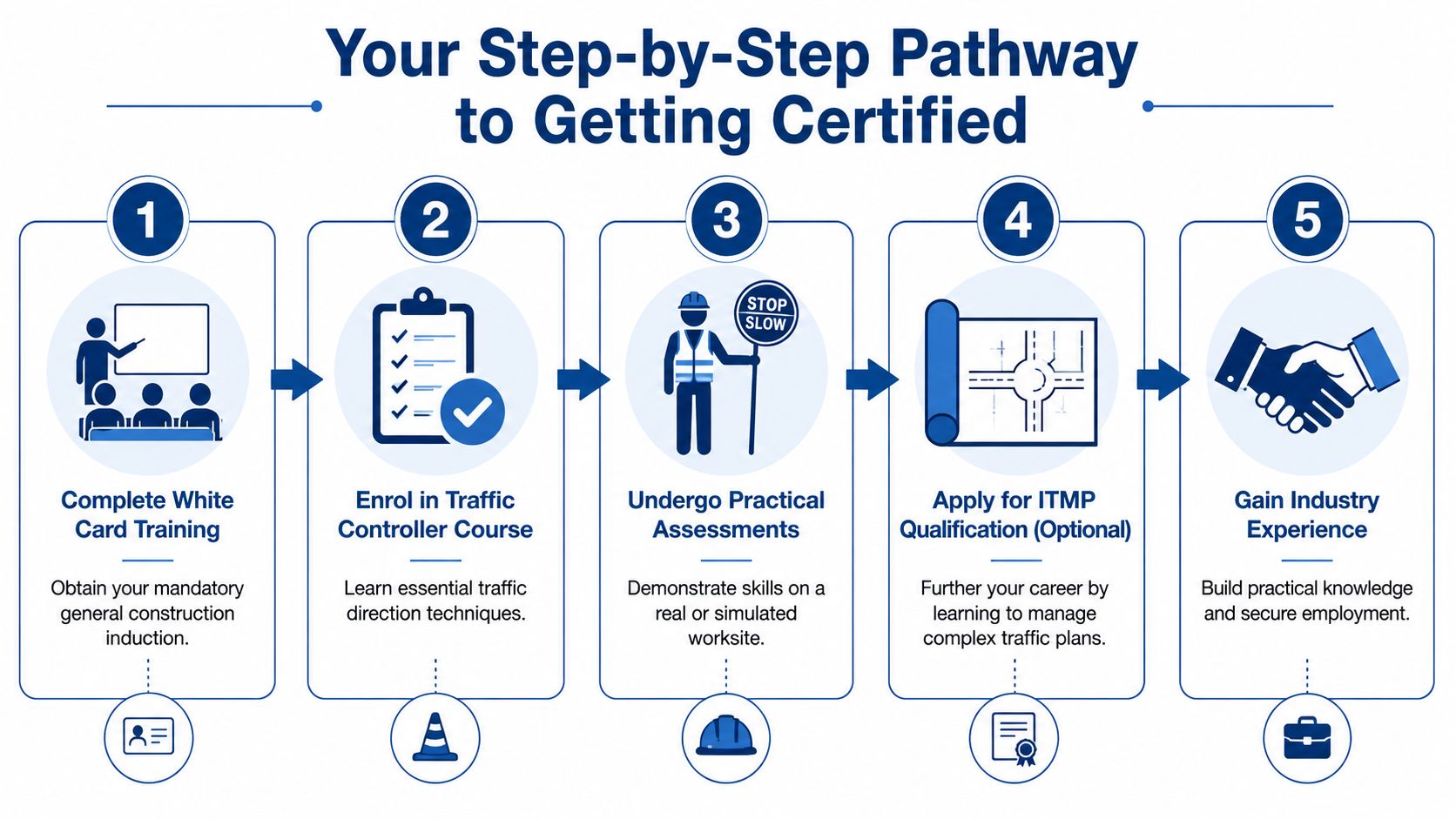
Step 1 to Step 3
-
Check your eligibility
You’ll generally need to meet the minimum age set by the provider, hold a valid White Card, and have a USI for accredited training, as outlined in this step-by-step guide to becoming a traffic controller in Australia. -
Choose the right first qualification
If your goal is entry-level traffic control work, start with the qualification that matches that role. Do not overcomplicate it by booking advanced training first if you have not worked around temporary traffic setups before. -
Book training with practical relevance
Practical learning matters because traffic control is not theory-only work. You need to understand positioning, communication, timing, and how to stay alert when conditions change.
Step 4 and Step 5
-
Complete the assessment properly
Do not rush this part. A pass matters, but real understanding matters more. People who take the practical side seriously usually settle into site work faster. -
Sort your work-ready paperwork
In NSW, that includes making sure your training lines up with the required work card process and local expectations for traffic control roles.
A simple pathway beats a rushed one. Workers who complete both certification and practical on-site training have a pathway success rate that exceeds 90%, and the Australian government has projected a 14.5% employment increase for traffic controllers by 2027, according to this traffic controller career guide.
What makes the pathway affordable
The most affordable path is usually the one with the fewest corrections. That means:
-
Getting prerequisites done first so your enrolment isn’t delayed
-
Training in the right order so each qualification builds on the last
-
Taking practical sessions seriously because site confidence affects employability
-
Applying quickly after training while the material is fresh
If you want another plain-English breakdown of the process, this guide to becoming a traffic controller in 2025 lays out the sequence clearly.
Where people waste money
They book too soon without the White Card. They choose a course that does not match the role they want. Or they focus on speed only, then realise they still need extra steps before they are employable.
The fastest route and the cheapest route are not always the same. The cleanest route is usually the better value.
Maximising Your Earnings and Career Growth
A traffic control career often starts with basic site duties, but it does not need to stay there. The workers who earn more usually do two things well. They become reliable on site, and they add qualifications that increase responsibility.
At the working level, pay reflects both competency and role type. Certified traffic controllers commonly earn between $50 and $80 AUD per hour, while team leaders on union sites can earn up to $60 per hour, based on this breakdown of traffic management company pricing and pay rates.
How progression usually happens
A typical progression looks like this:
-
Entry role
You control vehicle movement, follow direction, and learn site rhythm, radio use, and safe positioning. -
Broader traffic management duties
You move into setup responsibility, plan implementation, and stronger coordination with site supervisors and crews. -
Leadership or planning pathway
You become the person others rely on for setup quality, compliance discipline, and work zone organisation.
That progression does not happen just because time passes. Workers move up when supervisors trust them to think ahead, not just follow instructions.
The workers who grow fastest are not always the loudest on site. They are the ones who stay switched on, communicate clearly, and understand why the traffic setup is there.
What actually lifts your value
Upskilling matters, but only when it matches site needs. A worker who can handle more than basic stop/slow duties becomes more useful to contractors running larger or more complex jobs.
Useful habits include:
-
Turning up prepared with correct PPE and paperwork
-
Reading the site properly before stepping into position
-
Communicating early when visibility, pedestrians, or plant movement create risk
-
Adding higher-level training later when you’re ready for broader responsibility
That is how a basic ticket becomes a career path rather than a casual short-term role.
Why Choose Nationally Recognised Training in NSW
In NSW, compliance is not an extra. It is the job. Training needs to prepare you for the actual tasks you’ll perform, especially the core skill of controlling vehicle movement safely in temporary traffic management conditions.
SafeWork NSW is clear on that point. Traffic controller training courses in NSW address the skills required to stop and start traffic using a stop/slow bat in temporary traffic management scenarios, as outlined by SafeWork NSW traffic control training course requirements.
That is why nationally recognised training matters. It gives you a stronger base for legal compliance, site confidence, and job applications. It also reduces the risk that “affordable” turns into rebooking, redoing, or explaining weak training to an employer.
For NSW job seekers, that means choosing a provider that understands local requirements, delivers practical instruction, and offers access to the qualifications that match actual work pathways. TP Training operates across NSW training centres including Penrith, Burwood, Auburn, Parramatta, and Sydney CBD, with nationally recognised courses in traffic control and traffic management.
If you want a practical starting point, TP Training offers nationally recognised safety and vocational training across NSW for job seekers, career changers, and workers who need compliant, hands-on qualifications for real site work.

You may also like

Trade Courses Sydney: 3 Career Pathways Worth Exploring

Mock Interview Online Preparation Guide