CPR, First Aid, White Card, and Workplace Safety Certifications: 2026 Guide
You've found a job ad, your supervisor has asked you to update your tickets, or you're trying to move into construction, traffic control, hospitality, or care work. Then the confusion starts. One person says you need CPR. Another says full First Aid. Someone else tells you a White Card is enough. Before long, you're staring at course codes and expiry dates, trying to work out what applies to your role.
That confusion is common because CPR, First Aid, White Card, and workplace safety certifications do different jobs. One qualifies you to respond to a medical emergency. One prepares you for broader injury and incident response. One is about safe entry into construction work. Others sit around them depending on the tasks you perform and the site you work on.
The practical way to approach it is simple. Start with your industry, then your job duties, then the site rules, then the renewal cycle. If you skip that order, you can waste time on the wrong course or renew a certificate you didn't need yet. If you want a broader view of why emergency response training matters at work, this overview of the role of first aid and emergency response training is a useful starting point.
Table of Contents
- Your Guide to Essential Workplace Safety Certifications
- Understanding the Core Safety Tickets
- Who Needs These Certifications and Why
- Basic First Aid vs Advanced Training
- What to Expect in Your Training Course
- How to Choose the Right Training Provider
- Frequently Asked Questions
Your Guide to Essential Workplace Safety Certifications
The fastest way to sort your training is to separate the tickets by purpose.
A White Card is about construction induction and legal readiness for construction work. CPR training is about responding to cardiac arrest. A First Aid certificate covers a wider emergency response skill set for workplace incidents. Then there are role-specific courses layered on top, especially in industries where workers deal with higher risk environments, vulnerable people, or specialised site controls.
Most problems happen when people use these terms as if they're interchangeable. They're not. A worker can hold a White Card and still not meet a workplace's first aid expectations. Another worker can hold First Aid and still be refused entry to a construction site because they don't have the required construction induction.
A practical checklist helps:
- If your role involves construction work, check White Card requirements first.
- If your employer has named you as a first aider, check the required first aid unit and its renewal dates.
- If you work around children or high-care settings, compare standard first aid with childcare-focused training.
- If you only need one course right now, choose the one tied directly to your job duty, not the one that merely “looks useful”.
Practical rule: Match the certificate to the task you perform, not the broad industry label on your payslip.
That matters because many jobs cross categories. An office-based supervisor may visit a site. A hospitality worker may also be a designated first aider. A traffic worker may need construction-related induction plus additional role-specific safety training. Once you look at the actual duties, the right pathway becomes clearer and far less expensive in time and rework.
Understanding the Core Safety Tickets
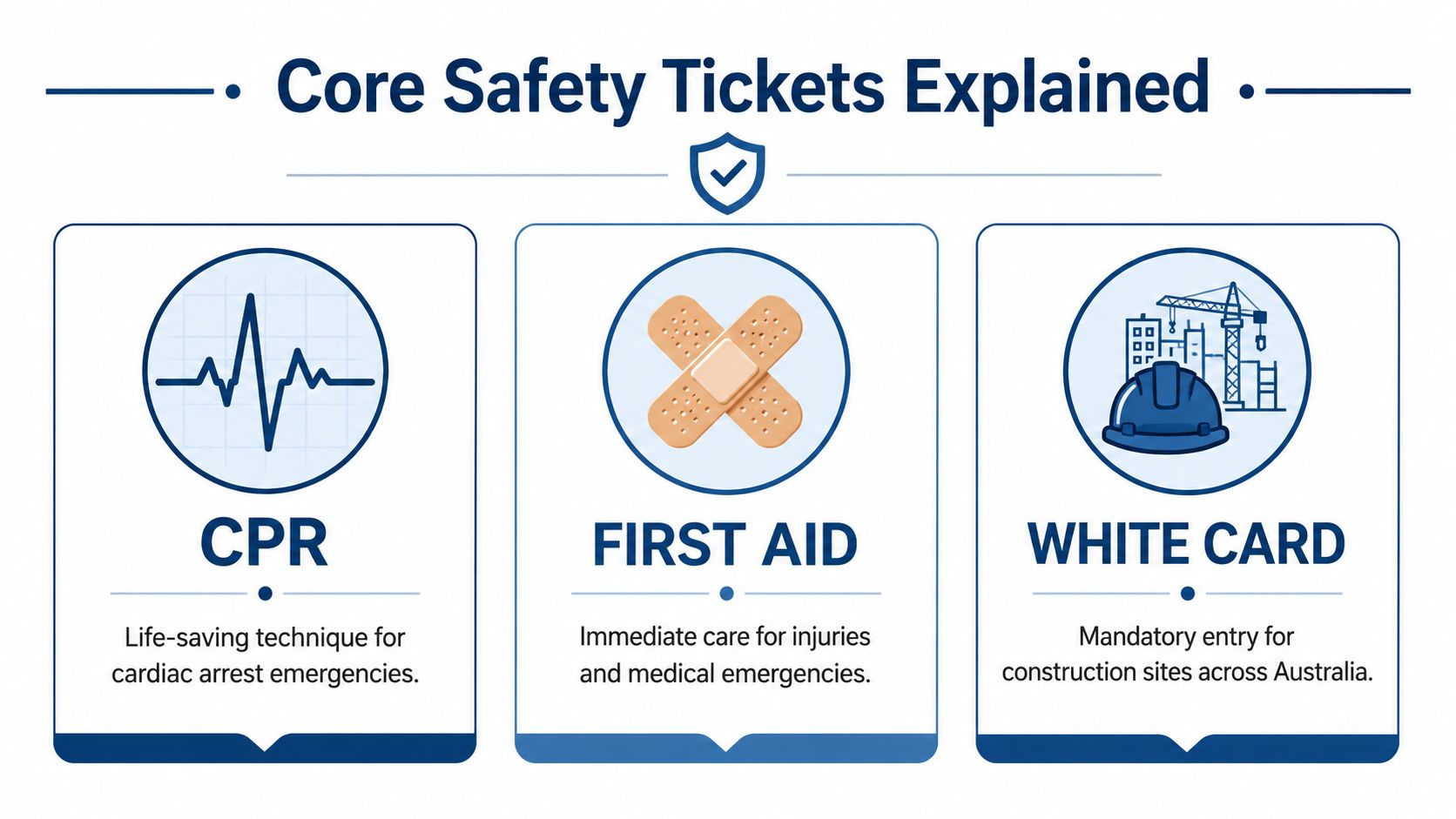
A common mistake is treating CPR, First Aid, and the White Card as versions of the same qualification. They solve different workplace problems. One covers site entry and construction induction. One covers emergency response. One sits in the middle by giving broader first aid capability that includes CPR.
What a White Card Covers
A White Card is the common name for the general construction induction credential linked to CPCWHS1001. It shows that a person has completed recognised training before starting construction work and understands baseline site risks such as hazards, safe work practices, and legal duties.
The practical issue is scope. A White Card is tied to construction work and site risk, not to every person connected with a project in any way. That distinction matters for office staff, designers, delivery personnel, client representatives, and supervisors whose duties vary from one site to another. The safest approach is to check the task being performed and the site rules, then match the ticket to that exposure. The linked article on whether a White Card is required for all types of construction work explains that point in more detail.
Validity causes confusion too. A White Card does not run on the same routine refresher cycle as CPR or First Aid. In practice, the main question is whether a worker has been out of construction long enough to need retraining under the applicable rules. That is one reason workers should confirm requirements with the site, employer, or training provider before booking and paying for a course they may not need.
If you need construction induction, a White Card Training Course is the relevant pathway. TP Training offers nationally recognised White Card training with practical delivery across NSW.
What CPR Training Is For
CPR training is focused on one high-risk event. Cardiac arrest.
In the Australian training framework, the workplace CPR unit is commonly HLTAID009 Provide cardiopulmonary resuscitation. It teaches the immediate response steps used to keep blood and oxygen moving until paramedics arrive or another responder takes over.
This course is narrower than First Aid, but the skill standard is stricter in practice because CPR performance drops if it is not refreshed. A certificate on paper is not enough. Students need floor-based practice, clear coaching, and an assessment that reflects the physical reality of an emergency.
Good CPR training feels hands-on and time-pressured, because that is what a real cardiac arrest feels like.
What a First Aid Certificate Means
A First Aid certificate usually refers to HLTAID011 Provide First Aid. This unit covers a wider range of workplace incidents, including bleeding, burns, fractures, shock, medical episodes, and the early management of a casualty until further help arrives.
For students comparing options, the key relationship is simple. CPR sits inside First Aid, but First Aid does more than CPR alone. That is why a worker may meet an annual CPR refresher expectation and still need the broader first aid unit for their job role.
Australian training and assessment requirements also create different renewal rhythms. The full first aid qualification is commonly renewed every three years, while CPR is typically refreshed every 12 months. That schedule catches people out, especially workers who assume one certificate date covers everything. The explanation in this guide to first aid certificate timing and CPR refreshers sets out how those timelines usually work.
Used together, these three tickets form a clearer roadmap. White Card answers, “Can I perform construction work on site?” CPR answers, “Can I respond to cardiac arrest right now?” First Aid answers, “Can I manage a wider range of workplace injuries and medical emergencies?” Once those roles are clear, choosing the right course becomes much simpler.
Who Needs These Certifications and Why
The need for a ticket usually comes from one of three places. The law. The site. The employer's emergency plan.

Construction and Site Access Roles
If you perform construction work, the White Card sits at the front of the list. Labourers, apprentices, tradespeople, site supervisors involved in construction activity, and many civil and traffic roles need that induction because the work environment includes hazards that require baseline safety knowledge before the person starts.
That doesn't mean the White Card is the only thing that matters. It means it solves a different compliance problem from medical response training. A worker may be legally ready for site entry but still need separate emergency response capability if their employer assigns that responsibility.
Designated First Aiders and General Workplaces
For offices, warehouses, hospitality venues, factories, workshops, and similar workplaces, the question is often less about site access and more about emergency coverage. Safe Work Australia's Code of Practice says employers must ensure an adequate number of trained first aiders are available, with a recommended minimum ratio of one first aider for every 50 workers in low-risk workplaces, and more in higher-risk environments like construction sites, as set out in the First Aid in the Workplace Code of Practice.
A related workplace standard often missed by smaller businesses is operational coverage. Guidance summarised by an industry body states there should be a minimum of three first aiders per shift across all operations, first aid kits must be accessible to all workers including night shifts and overtime personnel, and fully online first aid courses aren't legitimate for employer acceptance. That summary appears in this first aid workplace compliance FAQ.
If you roster one trained first aider and that person goes on leave, your paperwork may still look fine. Your actual coverage won't be.
Roles Where the Requirement Depends on Exposure
Some roles sit in a grey zone. Architects, BIM managers, office-based supervisors, and similar staff may attend construction environments without performing construction work themselves. In those cases, the requirement turns on what they do, where they go, and whether they enter hazardous zones.
The same practical logic applies to childcare, hospitality, community services, and traffic work. Some employers require first aid because the role involves public contact, supervision, or foreseeable incidents. Others require it because a worker has been nominated as the first aider on shift. The certificate is tied to responsibility, not just industry branding.
If you're not sure what applies, ask these questions in order:
- What tasks will I perform: Construction work, emergency response, public-facing service, or child supervision all point to different training pathways.
- Will I be the nominated first aider: If yes, broad first aid training is usually the more relevant starting point.
- Will I enter active construction areas: If yes, check whether your access is administrative only or tied to actual construction activity.
- What does the employer accept: The answer needs to align with recognised training and practical assessment requirements.
Basic First Aid vs Advanced Training
A lot of students get this choice wrong for a simple reason. Course names sound similar, but they solve different workplace problems.
If your employer says “first aid required,” the real question is what kind of incidents you are expected to handle, who you are responsible for, and whether CPR alone will satisfy the role. That is the practical link between CPR, First Aid, and the broader safety tickets covered in this guide. They are not interchangeable, and choosing the wrong one can mean paying twice.
Where Standard First Aid Fits
HLTAID011 Provide First Aid is the usual starting point for workers who may be the nominated first aider or who need to respond to common workplace injuries and medical events. It suits many general settings such as offices, warehouses, retail, hospitality, site offices, and mixed operational environments.
Its value is range. You are not just covering cardiac arrest. You are learning how to respond to a wider set of incidents until ambulance crews or other medical help take over.
The renewal point trips people up. First aid and CPR do not always run on the same cycle. In practice, workers are often expected to refresh the CPR component every year, even when the broader first aid unit remains current for longer, as noted earlier. If your employer audits training records, that difference matters.
If your role only requires CPR, compare that requirement against a standalone Provide Cardio Pulmonary Resuscitation course rather than booking a longer course you may not need.
When Advanced or Childcare Training Makes More Sense
Some roles need a narrower fit, not a broader title.
HLTAID012 Provide First Aid in an education and care setting is aimed at workers responsible for children and the incident patterns that come with that setting. Schools, early learning, outside school hours care, and similar environments often expect training that matches those duties more closely than standard workplace first aid.
The trade-off is straightforward. HLTAID011 is often enough for a warehouse supervisor, hospitality worker, or office first aider. It may fall short for an educator or childcare worker whose employer needs training aligned with education and care obligations. The course choice should match the people you support and the emergency procedures used on that site.
A higher-level or more specialised course is not automatically better. The right course is the one your employer, regulator, or site requirement will accept.
Choose the lowest level that fully meets the job. Extra units add time and cost, but the wrong low-level course can leave you non-compliant.
Comparison of First Aid Course Levels
| Feature | Basic First Aid (HLTAID011) | Advanced/Childcare First Aid (HLTAID012) |
|---|---|---|
| Primary use | General workplace first aid response | Education and care settings, or roles with added duty-of-care expectations |
| Best for | Designated first aiders in many standard workplaces | Workers in childcare and similar care-focused environments |
| CPR included | Yes, as part of the course framework | Yes, within the broader emergency response context |
| Renewal point to watch | CPR usually needs more frequent refreshing than the full first aid unit | Check employer and sector-specific expectations carefully |
| Common mistake | Assuming CPR alone covers the role | Assuming general workplace first aid covers education and care duties |
What to Expect in Your Training Course
The biggest gap between marketing and reality in this field is delivery. A proper safety course isn't just information on a screen. It asks you to show the skill.
How the Training Usually Runs
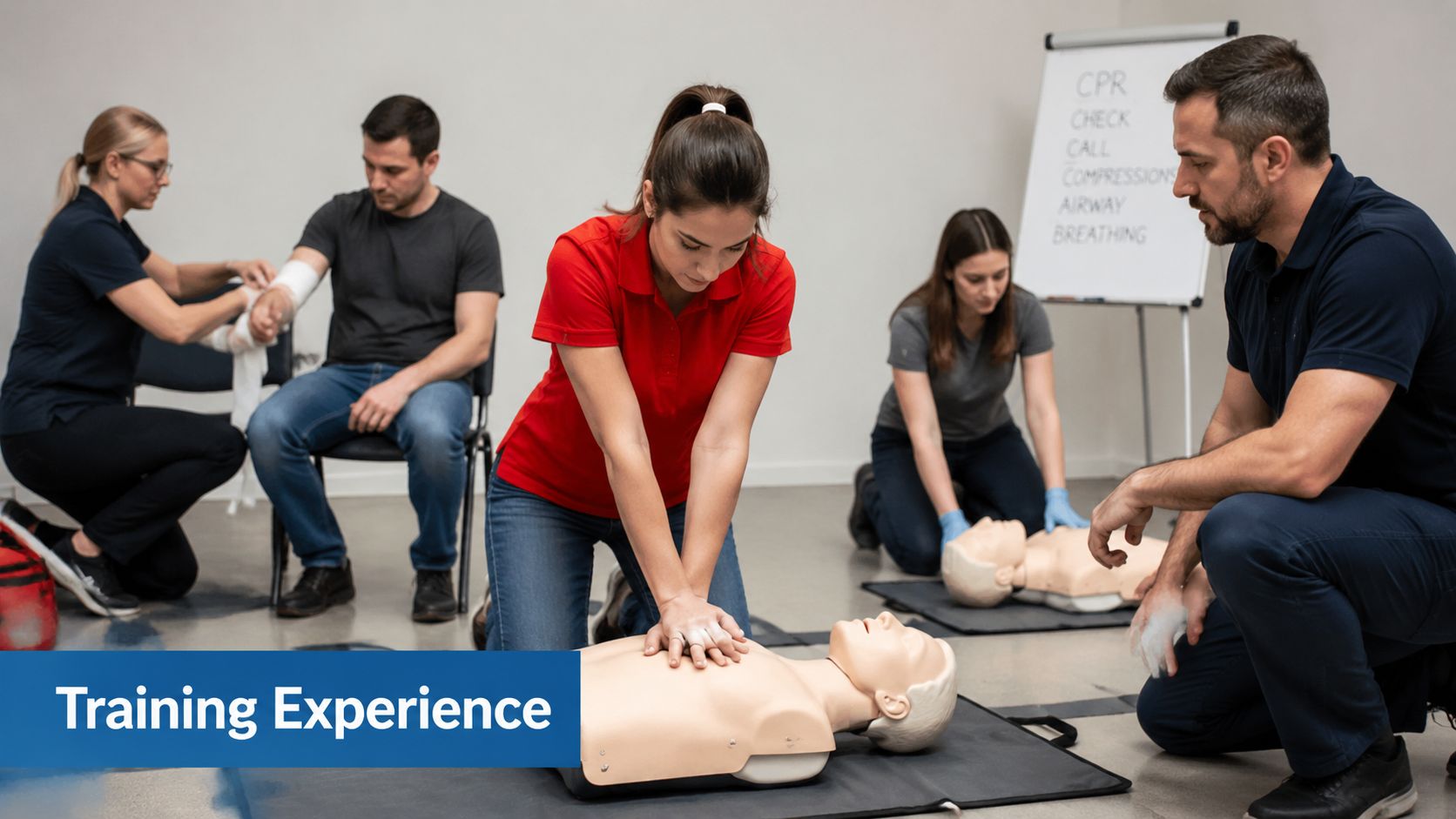
Many courses use a blended format. You may complete some theory before attending, then finish the practical parts in person. That structure works well when the provider uses the online portion for preparation and reserves class time for demonstrations, practice, questions, and assessment.
For first aid in particular, practical demonstration isn't optional. The workplace guidance discussed earlier makes clear that fully online first aid courses aren't accepted for employer use. In practical terms, students should expect physical participation, not passive viewing.
What Assessment Looks Like
Assessment should feel like a workplace simulation. In first aid and CPR, that usually means performing the actions instead of describing them. For nationally recognised HLTAID011, that includes CPR on an adult manikin on the floor, which is part of the required practical demonstration set out in the earlier-cited certification guidance.
You should also expect scenario-based judgement. It's one thing to memorise a sequence. It's another to recognise when to act, what to prioritise, and how to work within the limits of your training.
Time Cost and Proof of Completion
Course length and price are usually modest compared with the value of having the right ticket on hand. In Australia, first aid training typically costs AUD $50 for basic CPR training (HLTAID009) and AUD $100–$200 for Provide First Aid certification (HLTAID011), with durations of around 4 hours for CPR and 6–7 hours for full first aid, according to this guide to first aid course costs and duration in Australia.
After successful completion, the provider issues a Statement of Attainment for the recognised unit. That document matters because it's the formal proof employers look for when checking whether your training meets workplace requirements. If a provider can't explain clearly what document you'll receive, that's a warning sign.
If you need the broader qualification rather than CPR only, compare providers offering a recognised Provide First Aid course and check how much of the learning is practical hands-on.
How to Choose the Right Training Provider
Choosing a provider isn't just about location or price. It's about whether the certificate will stand up when an employer checks it and whether the training leaves you capable, not just enrolled.
What to Check Before You Book
Start with the basics:
- National recognition matters: The course should lead to a recognised unit and formal proof of completion.
- Practical assessment must be built in: If the provider talks only about convenience and never mentions demonstrations or in-person assessment, be careful.
- Trainer experience counts: Students learn faster when trainers can relate the content to actual workplaces instead of reading from slides.
- Scheduling should fit real work patterns: Shift workers, job seekers, and employers often need options that don't force unnecessary downtime.
Then check whether the provider can train the way your industry works. Construction and civil students often want direct, task-oriented instruction. First aid students usually benefit from scenario work and correction in real time.
A Practical Standard for Comparing Providers
A useful comparison method is to ask five questions before paying:
- Is the provider delivering nationally recognised training?
- Will I complete a practical assessment, not just online theory?
- Can the provider explain the renewal cycle clearly?
- Are the locations and times workable for my roster?
- Does the course suit my actual role, not just my industry label?
TP Training is one provider that aligns with those criteria. It delivers nationally recognised, practical training through NSW centres in Penrith, Burwood, Auburn, Parramatta, and Sydney CBD, with experienced trainers and hands-on learning across safety and vocational courses.
That's the standard to use with any provider. The right course from the wrong trainer can still waste your day. The right trainer with the wrong unit code can waste your money. You need both.
Frequently Asked Questions
A common mistake is enrolling in the wrong course because the ticket names sound interchangeable. They are not. CPR, First Aid, and White Card training each serve a different purpose, and the right choice depends on your job, your industry, and what your employer or site requires.
Can I do First Aid or White Card training fully online
Usually, no if you need a nationally recognised outcome that an employer will accept for workplace use.
For workplace first aid, practical assessment is part of the process. White Card delivery rules differ by state and by provider, so check the current requirements before you book. The safe approach is simple. Confirm that the course format matches the rule in your state and the requirement for your role.
Are Australian certifications valid overseas
Sometimes, but never assume automatic recognition.
Australian certifications are issued under Australian training and workplace rules. Overseas employers may treat them as useful evidence of prior learning, but formal acceptance depends on that country's licensing system, local regulations, and the employer's own hiring standard.
What if I lose my certificate or card
Start with the training provider if you have lost your Statement of Attainment or course certificate.
For a lost White Card, the replacement process depends on who issued it and the details attached to the original record. Keep a digital copy of every certificate, statement, and card as soon as you receive it. That habit saves time when a site supervisor or employer asks for proof at short notice.
Are there prerequisites before enrolling
For CPR and First Aid, entry is generally broad. In practice, providers commonly accept citizens, permanent residents, temporary visa holders, and international students, provided the student can meet the course requirements.
The primary requirement is the physical ability to complete practical tasks and participate safely in training and assessment.
Bring identification, wear clothing you can move in comfortably, and arrive ready to kneel, lift, and take part. That preparation makes the day easier.
Do I need both a White Card and First Aid
Sometimes.
A White Card covers general construction induction. First Aid covers emergency response skills. If you work on construction sites and your employer expects you to act as a workplace first aider, you may need both. If you only need site access, the White Card may be enough. If you work outside construction and need to respond to incidents at work, First Aid is usually the relevant qualification.
Is CPR enough on its own
Only if the job requirement specifically says CPR alone is acceptable.
CPR is narrower than full First Aid. It focuses on immediate resuscitation response, not the wider range of injuries and medical incidents covered in a First Aid course. Students often try to treat CPR as a faster substitute. It is a different unit, used for a different requirement.
If you are comparing options across these certifications and trying to match the right ticket to the right role, TP Training is one provider to review for recognised White Card, CPR, First Aid, traffic control, civil construction, hospitality, and workplace safety training in NSW.

You may also like
Asthma and Anaphylaxis Training in NSW
First Aid Training for Construction Workers NSW