
CPCCLSF2001 Basic Scaffolding Course NSW, Training & SB Licence Guide
Easy Fast Online Booking Basic Scaffolding Course in Sydney. Learn about CPCCLSF2001 Basic Scaffolding training, practical skills, SB High Risk Work Licence requirements, course pathways and training options with TP Training in Sydney, NSW.

Overview
Want fast booking online and low cost for a Basic Scaffolding Course in Sydney, you’re probably not just looking for a certificate. You want practical training, a clear pathway towards the Basic Scaffolding (SB) High Risk Work Licence, and a training provider that understands what construction workers actually need on site.
That’s where TP Training can help.
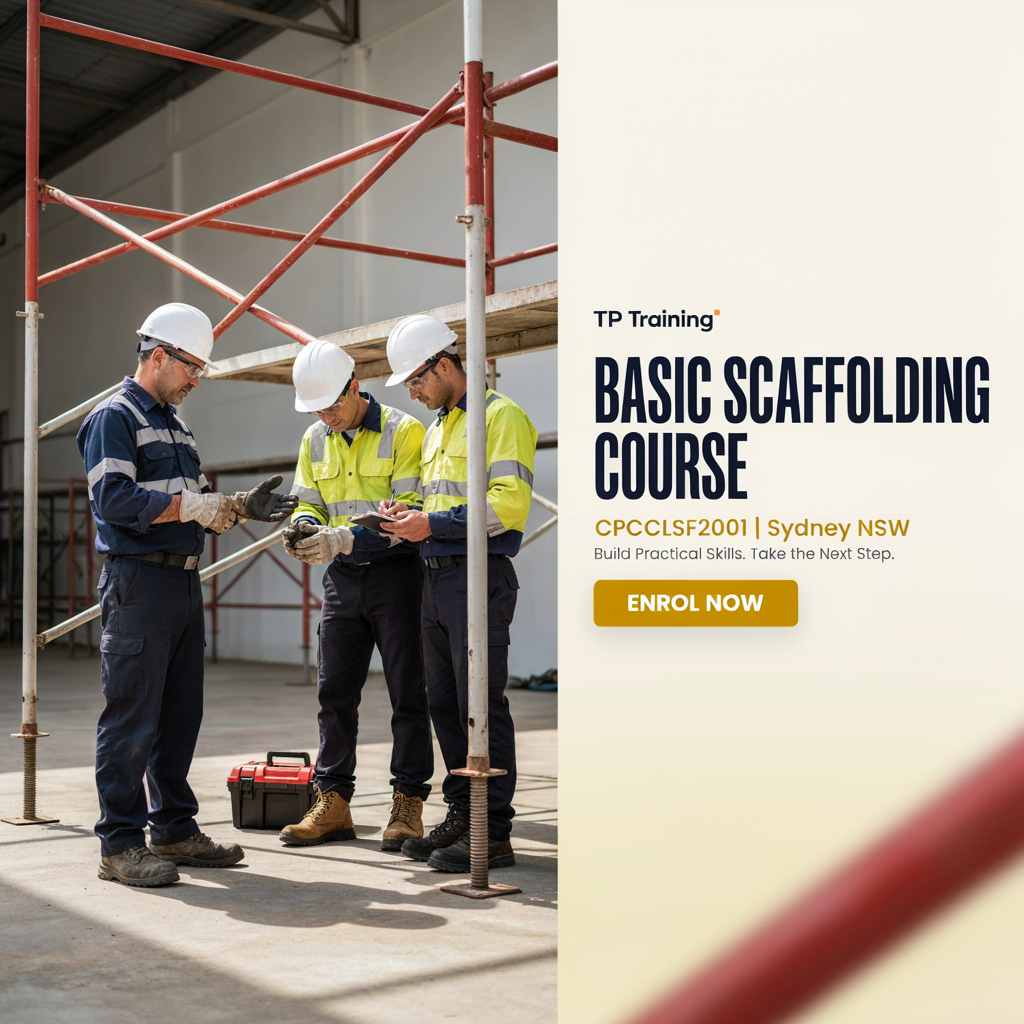
The CPCCLSF2001 Licence to erect, alter and dismantle scaffolding basic level unit covers the skills and knowledge required to safely perform basic scaffolding work, including modular and prefabricated scaffolds, bracket scaffolds, gin wheels, safety nets, static lines and cantilevered materials hoists up to 500 kg.
For workers in Sydney and across NSW, completing the appropriate training and assessment is an important step towards working in roles where a Basic Scaffolding (SB) High Risk Work Licence is required.
Explore TP Training Construction Courses
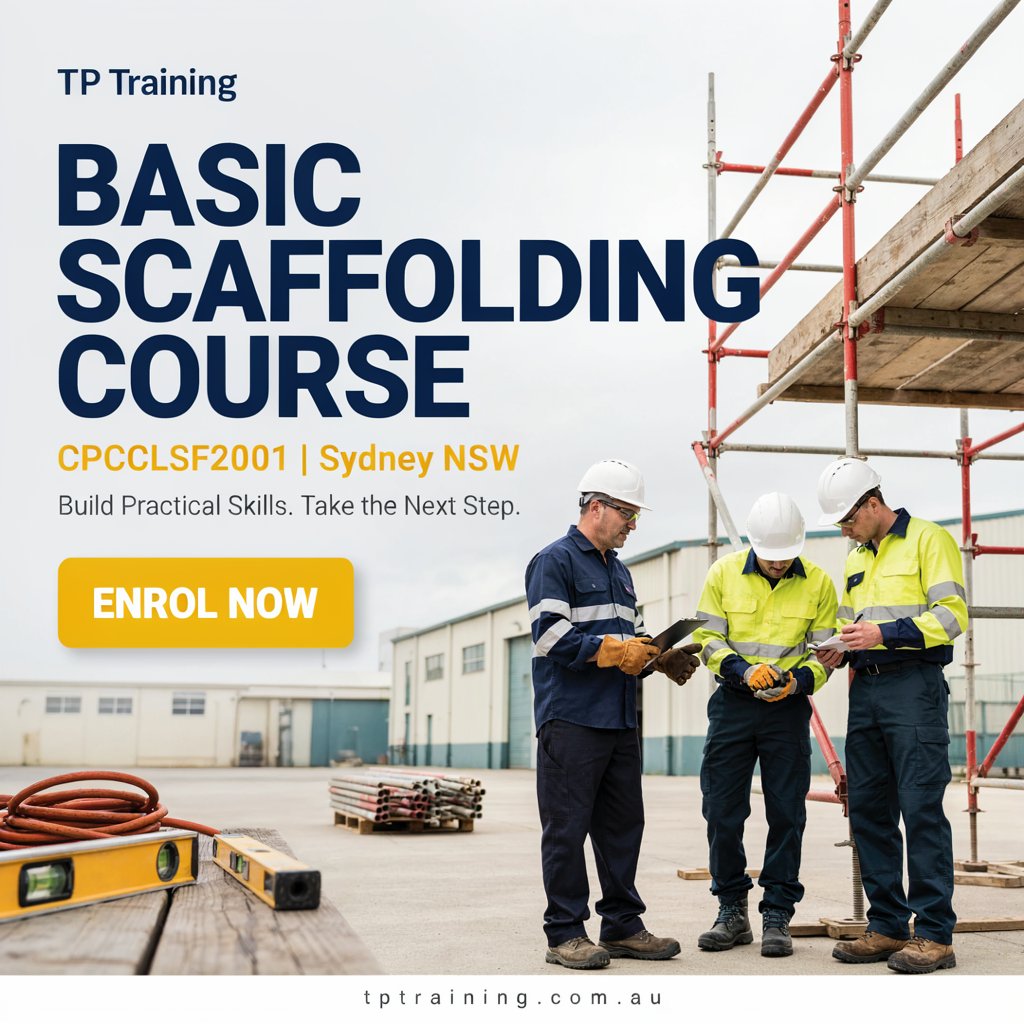
🏗️ Thinking about a career in scaffolding? The right training can help you build practical skills, understand workplace safety requirements and take the next step towards working in Australia’s construction industry.
Why Sydney Construction Workers Choose TP Training
When you’re comparing a Basic Scaffolding Course in Sydney, don’t make your decision based on a headline price alone.
Look for a provider that can give you:
🖥️ Easy Online Booking – Secure Your Seat in Just a Few Clicks
🚀 Fast Complete Your Course in Just 5 Day
🤝 Friendly Support Team Helping You Through the Entire Course
🏆 Trusted NSW Training Provider Experienced Trainers Providing Clear, Practical Safety Training, Helping Students Get Job-Ready Since 2011
📘 Nationally Recognised Certification for Construction Workers
📍 Convenient Sydney Training Locations with Easy Access
👥 Thousands of Students Successfully Trained Across NSW with us
✅ Other construction courses for future upskilling
✅ Clear information about what your training does — and does not — provide
TP Training’s construction portfolio includes high-risk work and construction courses such as Dogging, Basic Rigging, Crane training, White Card and other construction-related programs.
That makes it possible to think beyond your first ticket and build a longer-term training pathway.
Browse TP Training’s full Construction Course Category
How to Get a Basic Scaffolding Licence in NSW
One of the most common questions from people searching for basic scaffolding training in Sydney is:
“How do I get a basic scaffolding licence in NSW?”
The process involves more than simply completing an online form or receiving a certificate.
The national training register explains that CPCCLSF2001 covers the competency requirements for basic scaffolding work, but completing the unit itself does not automatically issue a High Risk Work Licence. Licensing is administered under the applicable state or territory WHS legislation.
In NSW, scaffolding is part of the High Risk Work Licence system. SafeWork NSW identifies:
- SB – Basic Scaffolding
- SI – Intermediate Scaffolding
- SA – Advanced Scaffolding
The licensing hierarchy means SB is the basic scaffolding class, while higher scaffolding classes cover additional levels of work.
A typical pathway looks like this:
1. Check that you are suitable for the training
Before booking, make sure you understand the course requirements and NSW licensing requirements.
- Must be 18 years or older
- Sastify Safework NSW Proof of identity (POI) – https://www.safework.nsw.gov.au/licences-and-registrations/licences/proof-of-identity
- Have a valid Unique Student Identifier (USI)
- Adequate English language, literacy, and numeracy (LLN) skills to read safety rules and write answers
- Basic computer skills for online enrolment or portal access
2. Complete the required training
You undertake training covering the knowledge and practical skills required for basic scaffolding.
3. Complete the competency assessment
Your practical and theoretical knowledge must be assessed against the requirements of the unit.
4. Receive the relevant training/assessment documentation
Successful completion provides evidence of competency as required for the licensing pathway.
5. Complete the NSW HRW licensing process
Where a High Risk Work Licence is required, the relevant NSW licensing process must also be completed.
This distinction is important.
🎓 Training is not the same thing as the licence
A reputable training provider should explain this clearly.
The national training register specifically states that achieving competency in CPCCLSF2001 does not in itself result in a licence. The licence is obtained through the applicable WHS regulatory process.
That is why TP Training focuses on helping students understand both the training requirements and the next steps rather than treating the course as simply a certificate purchase.
What Is CPCCLSF2001 Basic Scaffolding Training?
CPCCLSF2001 – Licence to erect, alter and dismantle scaffolding basic level is a current unit of competency in the national training system. It specifies the skills and knowledge required to safely perform basic scaffolding work.
The unit applies to scaffolding activities involving:
- Modular or prefabricated scaffolds
- Cantilevered materials hoists with a maximum working load of 500 kg
- Ropes and gin wheels
- Safety nets
- Static lines
- Bracket scaffolds
- Tank and formwork bracket scaffolds
This means the training is much more than learning how to put scaffold components together.
Students need to understand planning, inspection, risk controls, equipment selection, stability, fall protection, communication, erection, alteration, dismantling and completion procedures.
What Do You Learn in a Basic Scaffolding Course?
Basic scaffolding is safety-critical work.
The training requirements include planning the task, identifying hazards, selecting suitable equipment and risk controls, checking PPE and inspecting scaffolding equipment before use.
🦺 1. Plan the scaffolding task
You need to understand how to:
- Review workplace instructions
- Read relevant SWMS and workplace information
- Identify hazards
- Select appropriate risk controls
- Consider fall prevention and fall arrest equipment
- Identify the scaffold and associated equipment required
- Consider loads and scaffold stability
- Establish appropriate communication methods
These skills are important because scaffolding work often takes place around other trades, plant, pedestrians and construction activities.
🔧 2. Select and inspect equipment
Before scaffolding work begins, equipment needs to be checked.
Training covers areas such as:
- Selecting appropriate equipment
- Checking PPE
- Inspecting scaffold components
- Identifying defective equipment
- Reporting and isolating defective equipment
- Checking communication equipment
- Selecting fall protection equipment
The national unit specifically requires candidates to inspect scaffold and associated equipment and deal appropriately with defective items.
🏗️ 3. Set up the work area
A scaffold needs a suitable foundation and stable setup.
Training covers:
- Assessing the ground and foundation
- Preparing footings
- Preparing scaffold components
- Positioning equipment safely
- Establishing risk controls
- Setting up fall protection
- Maintaining communication with relevant people
🧱 4. Erect and dismantle basic scaffolding
This is where practical training becomes particularly important.
Candidates must demonstrate practical competency in erecting, altering and dismantling scaffolding and associated equipment.
The assessment requirements include a modular scaffold configuration, bracket scaffold, mobile scaffold, gin wheel, cantilevered materials hoist, safety net and static line.
🪢 5. Work with ropes, gin wheels and associated equipment
Basic scaffolding training also includes temporary rope connections and the safe erection, operation and dismantling of gin wheels.
The assessment requirements specify rope techniques including:
- Short splice
- Sheet bend
- Clove hitch
- Timber hitch
🛡️ 6. Complete the job correctly
Scaffolding work doesn’t finish when the structure is standing.
Candidates also need to understand:
- Final inspections
- Handover requirements
- Scaffold tagging
- Removing excess materials
- Checking equipment
- Reporting defects
- Safe storage
- Removing risk controls when appropriate
The national assessment requirements specifically include completion of handover documentation and scaffold tagging.
Who Is a Basic Scaffolding Course For?
A Basic Scaffolding Course in Sydney may be suitable for people who want to develop specialised construction skills and work toward the relevant licensing pathway.
It can be particularly relevant to:
👷 Construction workers
If you’re already working on construction sites, scaffolding skills can complement your existing experience and help you move into more specialised work.
🧰 Labourers
Construction labourers looking to build additional practical skills may consider scaffolding training as part of their career development.
🏗️ Tradespeople
Tradespeople who regularly work around scaffolds may benefit from understanding scaffolding systems, safety requirements and associated work practices.
🚧 New construction workers
If you’re considering entering the construction industry, basic scaffolding can form part of a broader skills pathway.
📈 Workers wanting to upskill
A scaffolding qualification can be considered alongside other construction tickets and licences to build a broader skills profile.
Basic Scaffolding Course Sydney: Why Practical Training Matters
Scaffolding isn’t a job where theory alone is enough.
A person working with scaffolding needs to understand how components behave in real conditions, how equipment is inspected, how stability is maintained and how hazards are controlled.
That’s why practical training matters.
The national assessment requirements require candidates to demonstrate practical performance across several scaffolding configurations and associated equipment.
A good training environment should therefore give students an opportunity to:
- Handle relevant equipment
- Practise safe setup
- Follow workplace procedures
- Understand scaffold stability
- Apply fall protection measures
- Identify hazards
- Communicate with others
- Practise erection and dismantling
- Complete relevant workplace documentation
💡 The goal isn’t simply to pass an assessment. The goal is to understand what you’re doing and why you’re doing it safely.
How Long Does a Basic Scaffolding Course Take?
Day Course: 4 days of training plus 1 day assessment
For students comparing Basic Scaffolding Course Sydney providers, it is important to look at the complete delivery structure rather than choosing a provider based only on the shortest advertised duration.
Ask:
- How much practical training is included?
- What equipment will I work with?
- How is competency assessed?
- What support is available?
- What documentation do I receive?
- What is the next step after successful assessment?
- Are there additional licensing requirements?
A shorter course is not automatically a better course if students don’t receive enough opportunity to develop the required practical skills.
For current dates, availability and course arrangements, contact TP Training directly.
📞 1800 577 301
📧 [email protected]
Basic Scaffolding Course Requirements in NSW
Requirements can change depending on the licensing and assessment arrangements, so students should always confirm their individual eligibility before booking.
For construction work generally, the national unit information notes that completion of the general construction induction training program is required for people carrying out construction work, with CPCWHS1001 Prepare to work safely in the construction industry meeting that requirement.
If you are new to construction, TP Training also provides White Card training.
Learn more about TP Training’s White Card Course
For HRW licensing, additional requirements may apply. Always confirm the current requirements with the relevant NSW regulator and your training provider before enrolment.
Basic Scaffolding Licence NSW: What Work Does It Cover?
The SB Basic Scaffolding licence is the entry level within NSW’s scaffolding HRW licence hierarchy.
SafeWork NSW’s scaffolding safety information states that a minimum Basic Scaffolding (SB) HRW Licence is required for erecting prefabricated modular scaffolding where a person or object could fall more than 4 metres.
The CPCCLSF2001 unit covers basic scaffolding work involving:
| Area | Examples |
|---|---|
| Modular scaffolding | Prefabricated/modular scaffold systems |
| Bracket scaffolding | Tank and formwork applications |
| Mobile scaffolds | Mobile scaffold structures |
| Gin wheels | Raising and lowering materials |
| Materials hoists | Cantilevered materials hoists up to 500 kg |
| Fall protection | Safety nets and static lines |
| Rope work | Temporary fibre rope connections |
The exact scope of work you can perform depends on the licence class, workplace requirements and applicable NSW WHS regulations.
SB vs SI vs SA Scaffolding Licences
If you’re researching scaffolding licences in NSW, you may have seen SB, SI and SA.
Here’s the simple explanation:
| Licence class | Level |
| SB | Basic Scaffolding |
| SI | Intermediate Scaffolding |
| SA | Advanced Scaffolding |
SafeWork NSW lists these as the three scaffolding classes within the HRW licensing hierarchy.
If you’re starting at the basic level, SB is the relevant class to investigate first.
As your experience and career progress, you may later consider whether further scaffolding training is appropriate for your role.
Why Choose TP Training for Basic Scaffolding Training in Sydney?
When comparing scaffolding course providers, price is only one part of the decision.
The better question is:
What am I actually getting for the money?
⭐ 1. Construction-focused training
TP Training provides a broad range of construction and industry training rather than operating around a single course.
Its construction category includes training such as White Card, Dogging, Basic Rigging, crane-related training and construction safety courses.
See TP Training’s Construction Course Range
That gives students the opportunity to consider their scaffolding training as part of a broader construction career pathway.
🔧 2. Practical skills matter
High-risk work training should be approached seriously.
CPCCLSF2001 itself contains practical performance requirements involving multiple scaffold configurations and associated equipment.
TP Training’s broader construction course offering follows a practical, industry-focused approach, including hands-on training across other high-risk work programs.
📍 3. Sydney training locations
TP Training provides training facilities in Sydney, including:
Main Office
Suite 9, 1–17 Elsie St, Burwood NSW 2134
Training Office
5 Melissa Street, Auburn NSW 2144
Training Office
5B 20 Highgate St, Auburn NSW 2144
Having training options around Sydney can be useful for students travelling from Western Sydney, Inner West and surrounding areas.
🤝 4. Support before you enrol
Choosing the right high-risk work course can be confusing, particularly if you’re unsure whether you need Basic Scaffolding, Rigging, Dogging or another licence.
TP Training’s team can help you understand the course pathway before you commit.
📞 1800 577 301
📧 [email protected]
💰 5. Compare total value — not just the advertised price
A cheap course isn’t necessarily the best-value course.
When comparing scaffolding course prices in Sydney, consider:
- Training hours
- Practical components
- Equipment available
- Assessment arrangements
- Trainer experience
- Student support
- Location
- Course documentation
- Licensing guidance
- What is included and what is additional
A transparent provider should make these details clear before you enrol.
Other Construction Courses You Can Consider With TP Training
Scaffolding is often only one part of a construction worker’s overall skill set.
Depending on your career goals, you may also want to explore other construction and high-risk work training.
🪝 Basic Rigging
TP Training offers CPCCLRG3001 – Licence to perform rigging basic level, with practical training for workers looking to move into rigging and related construction work.
View TP Training’s Basic Rigging Course
🏗️ Dogging
If you’re interested in crane operations, load handling and dogging work, TP Training also provides CPCCLDG3001 – Licence to perform dogging training.
View TP Training’s Dogging Course
🦺 White Card
For people entering the construction industry, CPCWHS1001 Prepare to Work Safely in the Construction Industry is an important starting point for general construction induction.
Explore TP Training’s Construction Courses
🚜 Civil construction training
If your career is moving toward civil construction, TP Training also offers equipment and civil construction training, including excavator, loader, backhoe, skid steer and articulated haul truck operations.
Explore TP Training’s Civil Construction Courses
Basic Scaffolding vs Rigging vs Dogging: Which Course Is Right?
These courses are related to construction and high-risk work, but they are not interchangeable.
| Training pathway | Main focus |
| Basic Scaffolding – CPCCLSF2001 | Erecting, altering and dismantling basic scaffolding |
| Dogging – CPCCLDG3001 | Slinging loads and directing crane/hoist operations |
| Basic Rigging – CPCCLRG3001 | Basic rigging activities and associated structures/equipment |
If your goal is specifically to work with basic scaffolding, CPCCLSF2001 is the course to investigate.
If your career goal involves cranes and lifting operations, Dogging or Rigging may be more appropriate.
If you’re not sure which pathway matches your intended job, contact TP Training before booking.
Is a Basic Scaffolding Course Worth It?
For the right person, it can be a valuable construction career investment.
Scaffolding is an important part of commercial construction, maintenance, infrastructure and other work environments where temporary access structures are required.
But the value goes beyond the piece of paper.
You are developing knowledge around:
- Working safely at height
- Scaffold stability
- Fall prevention
- Risk management
- Equipment inspection
- Workplace communication
- Scaffold erection and dismantling
- Safe work procedures
- Construction-site responsibilities
The national unit specifically requires candidates to demonstrate practical competence in these areas rather than relying solely on theoretical knowledge.
What Jobs Can You Pursue After Basic Scaffolding Training?
Completing relevant training and obtaining the appropriate licence can support applications for scaffolding-related work, subject to employer requirements, experience and the scope of your licence.
Potential roles and work environments can include:
- Scaffolding worker
- Basic scaffolding crew member
- Construction site worker
- Commercial construction projects
- Industrial construction
- Maintenance projects
- Infrastructure projects
- Shutdown and project work
Your actual employment opportunities will depend on your experience, other qualifications, location, employer requirements and the work you are licensed and competent to perform.
For people who want to build a broader construction career, combining scaffolding skills with other relevant tickets and competencies can also be worth considering.
Ready to Start Your Basic Scaffolding Training?
If you’re searching for a Basic Scaffolding Course Sydney, CPCCLSF2001 training, or information about the SB Basic Scaffolding Licence NSW, TP Training can help you understand the next step.
Before booking, make sure you understand:
📌 What the training covers
📌 What practical assessment is involved
📌 What licensing requirements apply in NSW
📌 What documentation you receive
📌 Whether additional requirements apply to your situation
📌 Course dates, location and current pricing
📞 Talk to TP Training
TP Training
Phone: 1800 577 301
Email: [email protected]
Main Office:
Suite 9, 1–17 Elsie St, Burwood NSW 2134
Training Office:
5 Melissa Street, Auburn NSW 2144
Training Office:
5B 20 Highgate St, Auburn NSW 2144
Explore TP Training Construction Courses
🏗️ Build practical skills. Train with purpose. Take the next step in your construction career with TP Training.
Final Thoughts
A Basic Scaffolding Course in Sydney is more than a box to tick if you’re serious about working safely and building a career in construction.
CPCCLSF2001 provides the competency framework for basic scaffolding work, while the NSW licensing process determines the High Risk Work Licence requirements that apply to your work.
The training covers real practical activities — from modular and bracket scaffolding through to gin wheels, materials hoists, safety nets and static lines.
For workers in Sydney, TP Training provides a practical pathway to construction training, with facilities in Burwood and Auburn and additional construction courses available when you’re ready to expand your skills.
If scaffolding is the direction you want to take, start by getting the right information, understanding the licensing pathway and choosing training that puts safety, practical competency and career development first.
Ready to find out more? Contact TP Training on 1800 577 301 or explore the construction course range online.
FAQs
Instructor

Target audiences
- 👷 People starting a career in scaffolding
- 🏗️ Construction and civil construction workers
- 🔧 Tradespeople wanting to expand their site skills
- 👷♂️ Labourers looking to move into more specialised work
- 🦺 Workers who need the Basic Scaffolding SB HRW licence
- 🏢 Employers needing workers trained for scaffolding compliance
- People searching specifically for Basic Scaffolding Course PCCLSF2001 training Sydney NSW
- People comparing scaffolding course prices in Sydney
You May Like
TLILIC0023 – C6 Crane Licence Course to Operate a Slewing Mobile Crane (up to 60 tonnes)
Ultimate Guide to Getting Your Slewing Mobile Crane Licence (Up to 60 Tonnes) in Sydney
CPCCLDG3001 Perform Dogging Licence Course and Training in Sydney
Looking for a Dogging Course in Sydney? TP Training offers nationally recognised DG High Risk Work training with practical instruction, expert trainers, and flexible Sydney...
CPCCLRG3001 Rigging Course (Level 1) – Licence to Perform Rigging Basic Level
Get your Basic Rigging Licence in Sydney with TP Training. CPCCLRG3001 course, hands-on training, multiple NSW locations. Enquire today.

RIIRTM301E Operate Truck or Trailer Mounted Attenuators Training Course (TMA)
Join TP Training’s RIIRTM301E Operate Truck or Trailer Mounted Attenuators (TMA) Course and become job-ready for high-demand traffic control roles. This nationally recognised training equips...
Crystalline Silica Exposure Prevention & Asbestos Awareness (10830NAT & 11084NAT) Courses Combo
Enrol online this essential combo 2 safety skill courses with the 10830NAT Course in Crystalline Silica Exposure Prevention & 11084NAT Course in Asbestos Awareness courses...
Course Features
- Lecture 0
- Quiz 0
- Duration 5 days
- Skill level All levels
- Language English
- Students 8
- Assessments Yes
“Great practical training and a professional learning environment. The course gives you the hands-on skills and confidence to understand basic scaffolding work and the requirements involved in working safely on construction sites.”
— Ben